
Dubai’s rental case is measurable, but yield alone doesn’t determine an investment’s strength. The average gross residential rental yield was 6.3% in August 2026, rising to 6.7% for apartments. For a UAE property market analysis for investors, those figures point to meaningful income potential, while Q3’s stabilisation in transaction activity, pricing and new supply makes asset selection increasingly important.
Investors should look beyond headline returns: tenant demand, property type, location and future supply all affect how rental yield translates into a long-term investment. Market activity may continue while its pace changes, making the quality of the specific asset just as important as the wider outlook.
This analysis examines Dubai rental yields alongside the economic conditions and buyer trends influencing demand, then considers what they may mean for property prices in 2026. It offers a measured view of the UAE market, helping you assess income prospects and price direction in the context of a market moving from rapid expansion toward a more balanced phase.
Key Takeaways
- Compare rental potential with sales momentum: Dubai’s residential transaction volume and value both declined in H1 2026 compared with H1 2025, a shift that can affect pricing and exit assumptions.
- Use population growth as a demand signal, then assess whether a property’s location and type align with the households it can serve.
- Model financing around buyer status and property value: expatriate first-home loan-to-value limits differ for properties below and above AED 5 million.
- Factor upcoming supply into area and asset selection, with substantial residential completions anticipated in Dubai in 2026 and further pipeline supply in 2027 and 2028.
- Read price forecasts as scenarios, not guarantees: ValuStrat forecast Dubai citywide residential capital values to rise by 10% in 2026.
Are rental yields good in Dubai in 2026?
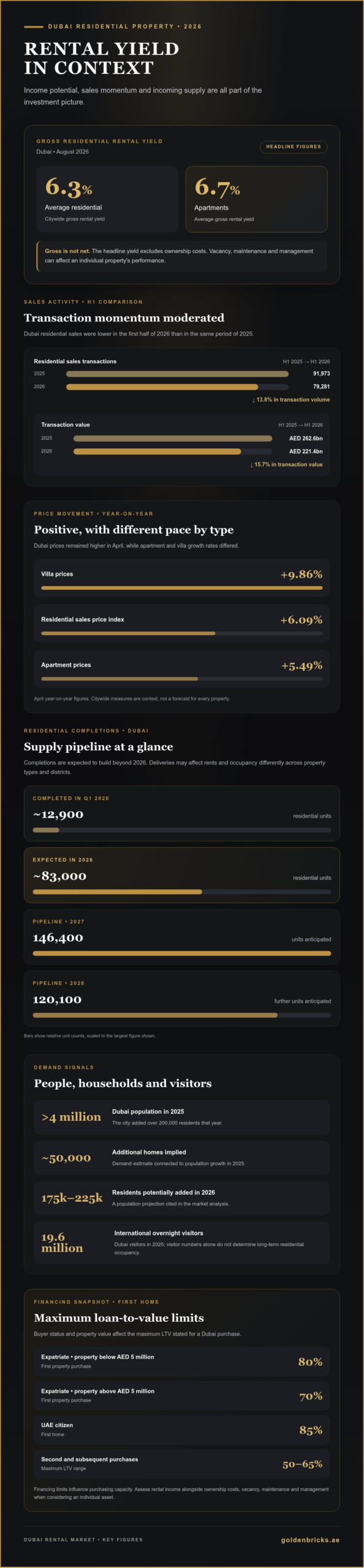
Dubai’s average gross residential rental yield was 6.3% in August 2026, with apartments averaging 6.7%. These figures indicate attractive income potential, but gross yield excludes ownership costs and does not establish an individual property’s net return. Compare expected annual rent with purchase cost, then account for vacancy, maintenance and management before assessing performance.
Which UAE areas offer the strongest rental yields and capital appreciation for investors? Dubai apartments led the available city-level rental-yield figures, averaging 6.7% in August 2026. For capital appreciation, Abu Dhabi recorded stronger year-on-year price growth in April, with its residential index up 27.76%; these citywide indicators don’t establish the best individual neighbourhood or asset.
Dubai’s sales activity moderated in the first half of 2026. The city recorded 79,281 residential sales transactions, compared with 91,973 in H1 2025, a 13.8% decline. Transaction value fell 15.7%, from AED 262.6 billion to AED 221.4 billion. This easing followed several years of strong growth and suggests investors should distinguish rental income from assumptions about rapid resale gains.
Price trends remained positive in April, though apartments and villas moved at different rates. Dubai apartment prices rose 5.49% year-on-year, while villa prices increased 9.86%. The residential sales price index was 6.09% higher year-on-year. These measures provide context, not a forecast for every property: location, condition, tenant demand and competing supply influence individual results.
Supply deserves close attention. Dubai completed approximately 12,900 residential units in Q1 2026, and around 83,000 units were expected to be completed during 2026. The pipeline then anticipated 146,400 units in 2027 and a further 120,100 in 2028. As these deliveries enter the real estate market, trends in occupancy and rents may vary across property types and districts. Tourism also supports housing demand: Dubai attracted 19.6 million international overnight visitors in 2025, although visitor numbers alone don’t determine long-term residential occupancy.
Abu Dhabi presents a distinct comparison. It recorded approximately 7,800 residential transactions in Q1 2026, while residential values remained supported in Q3 after transaction activity moderated. Its April price index rose 27.76% year-on-year; apartment prices increased 31.46%, versus 7.84% for villas. Supply is expanding: approximately 1,200 homes were delivered in Q1, with more than 7,000 scheduled by year-end. Twenty-two projects were announced in Q1, including nine branded residential developments.
Commercial sectors add another signal. Abu Dhabi occupancy exceeded 95% across prime business districts in Q1 2026, while Dubai’s office market remained stable in Q3, supported by leasing activity and corporate relocations. Investors can compare residential yield with these broader demand indicators, then evaluate the specific asset, quarter-by-quarter supply and tenant profile before deciding.
Economic growth, employment and mortgage conditions
The UAE’s economic outlook supports property demand, but investors should connect national growth to local employment and household formation. The IMF forecasts UAE economic growth of around 5% in 2026. Expansion across industrial, retail and service sectors can support hiring and housing needs, while employment stability influences tenants’ ability to sustain rent and buyers’ capacity to qualify for financing.
How have UAE property prices, rents, and transaction volumes changed in recent years? In Dubai, residential prices rose 20.1% in 2023, then eased by 0.17% in December 2025.
Population growth helps explain the expected demand. Dubai’s population surpassed 4 million in 2025, after the city added over 200,000 residents that year. This growth implied demand for roughly 50,000 additional homes. Dubai could add another 175,000 to 225,000 residents in 2026, making household formation and available housing important indicators for investors tracking the region.
Rental performance varies beyond Dubai. In Al Ain, apartment rental rates increased 7% year-on-year in Q1 2026, while villa rental rates rose 2%. This difference shows why investors should compare property type and local tenant demand, rather than applying one citywide rental assumption. Asking rents, achieved rents and occupancy each describe a different part of the income picture.
Mortgage limits shape the capital required from buyers. For an expatriate’s first Dubai property purchase under AED 5 million, the maximum loan-to-value ratio is 80%; above AED 5 million, it is 70%. UAE citizens can have a maximum ratio of 85% for a first home. For second and subsequent property purchases, the maximum is 50-65%. These distinctions affect purchasing capacity and potential demand across price bands.
For an investment assessment, compare expected financing needs with rental income, operating costs and your planned holding period. Employment supports tenant demand, while lending limits affect how many buyers can qualify. A property chosen for a quick resale carries different risks from one intended to generate rental income, so align the financing structure with your investment objective.
The UAE real estate market is forecast to grow at an annual rate of 3.07% between 2026 and 2031. This broad forecast provides context, not a property-level return. Investors can assess the economic drivers alongside supply and local rent trends through market intelligence, then compare the resulting outlook with their target asset and financing plan.
Buyer demand and transaction volumes
Dubai’s 2025 monthly sales figures show how transaction activity can shift within a single year. Sales reached 20,116 in July, then 18,655 in August and 20,309 in September. October recorded 19,760 sales, followed by a record December total of 18,575. These movements illustrate why a single month cannot establish a durable direction for buyer demand.
Off-plan homes represented a substantial share of Dubai transactions in autumn 2025. They accounted for 75.7% of the market in September and an adjusted 70.6% in October. That share points to strong buyer participation in projects before completion, but investors should distinguish launch activity from completed-home demand. Compare the property’s delivery timing, payment structure and intended resale or rental strategy before treating off-plan volume as evidence of current occupancy.
Transaction value offers another perspective. Deal numbers can fall while total value holds steady if buyers focus on higher-priced homes. Rising deal numbers, meanwhile, may reflect smaller units or lower transaction values. Assess value alongside volume, property type and location instead of relying on a single metric. Compare like-for-like segments across each period, and check whether the figures cover sales transactions or broader property activity.
Dubai’s July 2025 sales rose 21.3%, while June recorded 16,584 transactions, down 11.3% month over month. September’s 20,309 sales were 8.9% above August. These changes show how quickly monthly comparisons can reverse. A practical review should track several consecutive periods, then test whether the movement aligns with price changes, new project launches and tenant demand.
Demand also differs across emirates. Sharjah’s residential market moved to a more mature phase in Q2 2026: activity normalised after an exceptionally strong first quarter, while underlying demand remained resilient. Abu Dhabi’s residential activity moderated in Q3 2026 after a strong start, with property values still supported. These patterns indicate that transaction momentum is not uniform across the UAE, even when national economic conditions influence all emirates.
For a sustainable acquisition decision, use three checks: separate off-plan from ready-property transactions, compare sales value with deal volume, and review activity across multiple periods. Then assess the occupier profile supporting demand, including employment access, transport links and nearby logistics or business districts. Dubai’s office market remained stable in Q3 2026, supported by occupier demand, corporate relocations and steady leasing activity. That commercial context can help explain residential interest, but it does not replace asset-level analysis.
Final thoughts: will Dubai property prices rise or fall in 2026?
Dubai’s 2026 outlook is positive in the current forecast, but supply makes asset selection material. ValuStrat forecast citywide residential capital values to rise by 10% in 2026. Over the next 12 to 36 months, investors should weigh that projection against Dubai’s residential pipeline: 146,400 units were anticipated in 2027, with another 120,100 in 2028. More homes can increase choice and competition, especially where similar apartments arrive together.
Dubai’s tax environment is one part of an international investment comparison, not a complete return calculation. Dubai charges a 4% property transfer fee, which investors should include when comparing acquisition costs with other global property hubs. Compare like with like: transfer charges, recurring ownership costs, rental income and expected resale value. Those factors shape net performance more directly than a broad label such as “tax-friendly.”
Global high-net-worth interest offers another demand signal. Knight Frank’s Destination Dubai 2025 survey collected responses from 387 high-net-worth individuals across the UK, India, Saudi Arabia and East Asia. Survey interest can indicate investor sentiment, but it does not guarantee a purchase or establish future prices. Pair this signal with completed transactions, local buyer activity and the delivery schedule for the residential market.
How do off-plan and ready property investments compare in the UAE? Off-plan purchases let investors buy before a home is completed, while ready properties make it possible to inspect the existing asset and assess its rental potential. Compare delivery timing, payment commitments, current condition, tenant demand and competing supply before deciding.
What are the foreign ownership and freehold property rules across the UAE? Ownership rights depend on the emirate and the property’s designated ownership framework. Sharjah Law No. 2 of 2022 expanded foreign ownership rights in that emirate, illustrating why investors should assess each emirate’s rules separately.
What are the UAE property visa and residency requirements for investors? Property ownership and residency status are separate matters. Eligibility depends on the applicable visa criteria and qualifying property documentation. Treat residency as a separate due-diligence step, rather than assuming that every purchase grants a visa.
What are the steps to buy, register, and rent out a property in the UAE? Choose the asset, review its title and transaction documents, complete the sale, register ownership with the relevant authority, then prepare the property for leasing. For a ready apartment, assess its condition and rental suitability before finalising the purchase. For off-plan, review the completion terms and handover process.
Infrastructure can influence long-term appeal through access to employment, services and transport. For example, assess a Dubai apartment’s connection to business districts and public transport, including Dubai Metro access, alongside nearby competing supply. Together, connectivity, buyer sentiment and the delivery pipeline provide a disciplined basis for interpreting the 2026 forecast, rather than treating market-wide price growth as a property-level outcome.
UAE real estate market forecast
The UAE outlook combines a national growth forecast with distinct property cycles across its emirates. The real estate market is forecast to grow at an annual rate of 3.07% between 2026 and 2031. A UAE property market analysis for investors should treat that rate as broad context, not a projected return for a particular home. Asset performance depends on local demand, competing supply, rental income and the investor’s holding period.
Dubai’s delivery schedule is a central variable. Around 83,000 residential units were expected to be completed in 2026, followed by an anticipated 146,400 units in 2027 and a further 120,100 in 2028. The consequence is not uniform across the city: communities with similar new developments may face stronger competition for tenants, while established areas with distinct employment or transport links may have different demand drivers. Compare the delivery dates and property types relevant to each prospective purchase.
Supply expectations also need to be read alongside previous handovers. Dubai recorded approximately 29,000 residential handovers in 2024 and around 42,000 in 2025. These annual figures show an expanding delivery cycle, but they don’t establish how quickly each new home will be occupied. For an off-plan assessment, align the expected handover with nearby competing projects and the intended leasing or resale strategy. For a ready property, examine its existing tenant appeal and the alternatives available in its community.
Capital-value forecasts provide a separate perspective. ValuStrat forecast Dubai citywide residential capital values to rise by 10% in 2026, while average freehold villa values had risen by 206% since the pandemic. The historical change describes a past period, not a repeatable annual rate. Investors should separate that record from forward-looking forecasts and assess villas, apartments and individual communities on their own fundamentals.
Inflation adds context to nominal growth: UAE consumer price inflation averaged 1.3% in 2025. A UAE property market analysis for investors can use that figure to frame purchasing power, while still testing rental income, ownership expenses and expected resale value separately. The practical takeaway is selective growth, with delivery concentration and asset-level demand shaping outcomes more than a single national forecast. Assess UAE property opportunities against your objectives and preferred holding period.
Golden Bricks Real Estate: Exclusive Off-Plan Projects
Golden Bricks Real Estate helps investors compare off-plan opportunities with their objectives and planned holding period. Its Exclusive Off-Plan Projects and Project Curation support an assessment of options alongside market conditions, delivery timing and intended use. Investors considering an existing asset can explore Exclusive Ready Properties, while Property Management supports owners with ongoing property oversight.
Once you have defined your preferred emirate, asset type and investment strategy, the next step is to connect those priorities with suitable property opportunities. Golden Bricks Real Estate can discuss options for an off-plan purchase or a ready home.
Contact Golden Bricks Real Estate to discuss your property objectives or visit goldenbricks.ae.
Turn market insight into a considered investment plan
A UAE property market analysis for investors is most useful when it informs a specific decision, not just a general view of the market. First, define your priorities: rental income, capital growth, or a balance of both. Then set your preferred holding period, property type and tolerance for delivery or occupancy risk. These criteria turn broad market signals into a focused shortlist.
Golden Bricks Real Estate offers Exclusive Off-Plan Projects and Exclusive Ready Properties for investors weighing different routes into the UAE market. Property Management can help owners handle the ongoing responsibilities of an investment property. The right approach depends on your objectives and the asset you are considering.
Before proceeding, clarify the role you want the property to play in your portfolio and the practical demands of ownership. A considered conversation can help frame the next stage around your priorities. Contact Golden Bricks Real Estate to discuss your investment direction and take the next step with confidence.
Frequently Asked Questions
Will Dubai face oversupply by 2026?
Dubai faces substantial delivery pressure in 2026, but whether it becomes oversupply depends on how quickly new homes are absorbed. Around 83,000 residential units were expected to be completed in Dubai during 2026, with further large pipelines in 2027 and 2028. Assess exposure at the community and property-type level: compare competing handovers with tenant demand, occupancy and rental performance rather than treating the city as one market.
What are the latest UAE property market trends and forecasts for 2026?
The 2026 outlook combines continued economic expansion with a more measured property-market pace. The IMF forecasts UAE economic growth of around 5% in 2026, while the UAE real estate market is forecast to grow at an annual rate of 3.07% between 2026 and 2031. For an investor, distinguish national forecasts from an asset’s prospects by considering its emirate, property type, tenant profile and competing supply.
How do property prices and rental yields compare across Dubai, Abu Dhabi, Sharjah, and other emirates?
Dubai’s average gross residential rental yield was 6.3% in August 2026, while the UAE average was 4.94% in May 2026. Abu Dhabi’s residential sales price index rose 27.76% year-on-year in April 2026. These figures use different periods and measures, so they aren’t direct comparisons. For Sharjah and other emirates, compare individual property and local market data rather than assuming Dubai’s yield or price trends apply.
What are the UAE property purchase costs, fees, and taxes for investors?
Transfer fees vary by emirate: Dubai charges a 4% property transfer fee, while Abu Dhabi charges 2%. Treat these as transfer charges, not an all-in estimate of acquisition or ownership costs. Before committing, separate transaction expenses from recurring property costs and assess any tax obligations relevant to your circumstances. A sound budget should reflect the specific property, transaction structure and financing arrangements.
What are the main risks of investing in UAE property, including oversupply, vacancies, and regulation?
Key risks include competing handovers, weaker-than-expected tenant demand, vacancies and changes in the rules governing ownership. Evaluate a property’s exposure by comparing planned supply with the likely tenant base and by testing whether projected rent can support your holding strategy. Ownership frameworks also differ across emirates: Sharjah Law No. 2 of 2022 expanded foreign ownership rights there, so assess the rules relevant to the specific emirate and asset.
What are the foreign ownership and freehold property rules across the UAE?
Sharjah Law No. 2 of 2022 expanded foreign ownership rights in the emirate.