

More property options do not necessarily lead to better investment decisions. If you’re feeling overwhelmed by property investment choices, narrow the field with a clear budget, a short list of non-negotiables, and consistent notes on each property. Take breaks from searching, and give non-urgent decisions time to settle before committing.
It’s understandable to feel pressure when every option brings new figures, risks, and trade-offs. A disciplined process makes choices easier to assess without treating uncertainty as a reason to rush. This article explains how to manage decision fatigue, use professional advice effectively, and treat investment anxiety as a prompt to clarify your priorities. You’ll also learn how a measured approach can keep your attention on the factors that matter to your investment objectives in the United Arab Emirates.
Key Takeaways
- Set clear investment priorities and use consistent notes to compare properties on evidence rather than memory.
- Use brokers, solicitors and building inspectors for distinct perspectives on the financial, legal and physical aspects of a decision.
- Reduce information overload by focusing on the questions most relevant to your investment goals and the property under consideration.
- Reframe anxiety as a cue to pause, clarify the risks and make a deliberate decision rather than rushing toward certainty.
1. Decision fatigue after extended property searches
Long searches can turn useful comparisons into information overload. Stress can narrow your focus, causing you to notice an attractive feature while overlooking rental demand or vacancy risk. Keep a note for each property, recording its location, condition, expected rental demand, vacancy considerations, and drawbacks. Set a maximum price and define non-negotiables before viewings; these limits help keep your criteria consistent.
Schedule an hour or two of research a few times a week instead of searching continuously. When possible, avoid viewings after an exhausting day, take breaks, and sleep on non-urgent decisions. A short decision framework can restore perspective: compare each property against the same priorities, then identify what evidence you still need.
To choose an investment type in the UAE, start with your objectives, time horizon, cash flow, and tolerance for property-specific risks. Compare these priorities with the property’s rental demand, vacancy considerations, and management needs before deciding.
Off-plan and ready properties differ mainly in timing and the information available for assessment. You can evaluate a ready property based on its existing condition and current rental context. For an off-plan property, pay close attention to the project and its purchase terms.
Compare UAE locations, developers, and potential returns using consistent criteria: local rental demand, renter demographics, vacancy rates, property condition, and expected income against costs. A solicitor, broker, or building inspector can assess relevant information from their professional perspective.
Foreign ownership rules depend on the applicable location and transaction details. Have a solicitor assess the ownership terms and title arrangements before committing, rather than assuming the same rules apply throughout the UAE.
There is no single minimum budget for every investment. Affordability depends on the property price, available equity or cash flow, financing terms, and associated purchase costs.
Buying costs and fees vary by transaction and property. Establish the full cost picture, including relevant purchase and financing expenses, before deciding whether the projected rental income fits your investment plan.
Mortgage rates affect borrowing costs, while loan-to-value terms determine the equity required. Assess both alongside repayments and expected rental income. Lending affordability may depend on cash flow or equity, not just the size of your bank balance.
Evaluate a potential purchase by setting objectives, defining a maximum price, comparing suitable properties, reviewing financial and legal details, and obtaining relevant professional assessments before committing. Account for vacancies and price fluctuations by testing whether the investment remains workable if rental income or property value changes.
2. Getting advice from brokers, solicitors and building inspectors
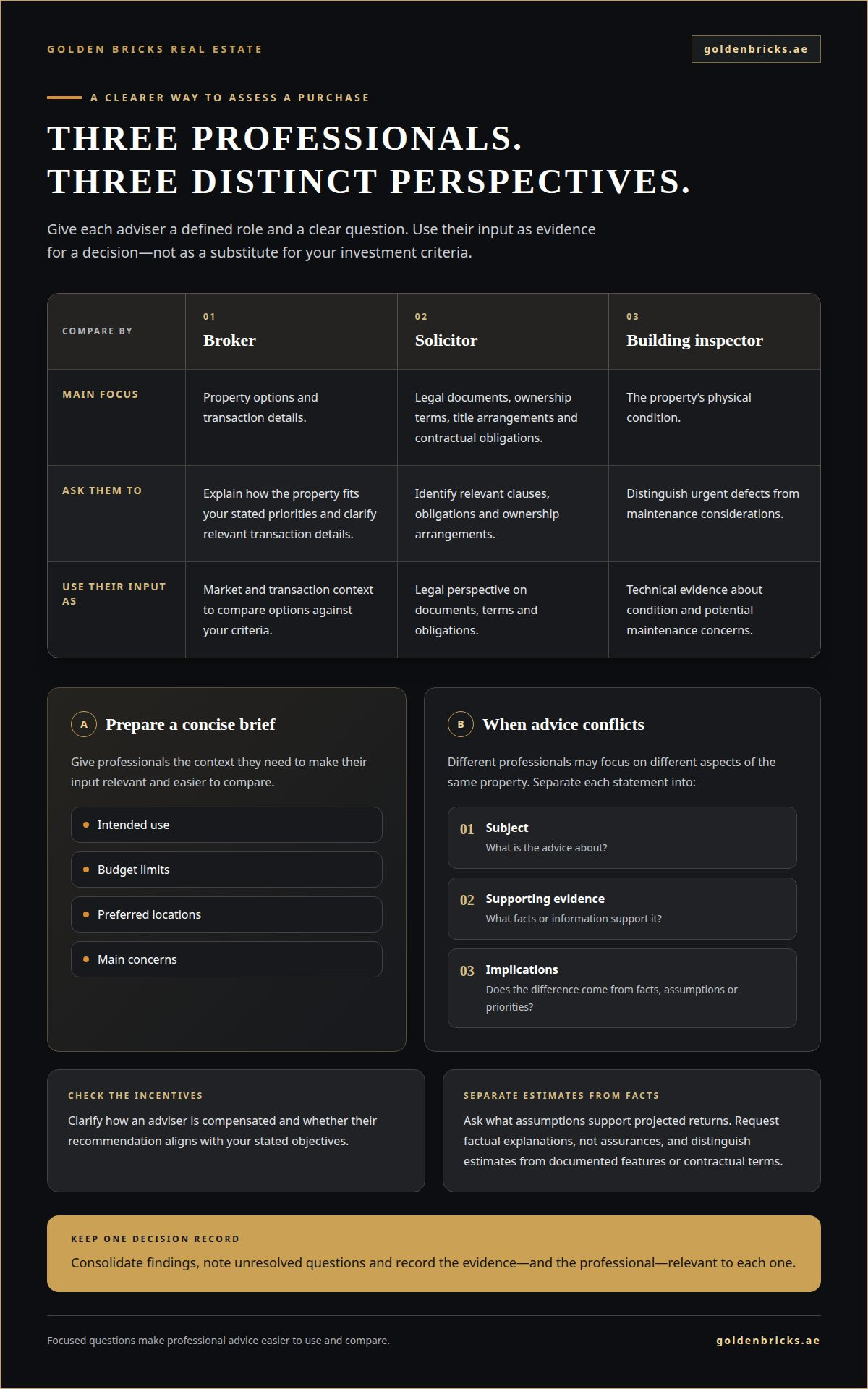
Professional advice can reduce information overload when each adviser has a defined role. In a UAE purchase, a broker can explain property options and transaction details, a solicitor can clarify legal documents and contractual obligations, and a building inspector can assess physical condition. Treat each perspective as evidence for a specific decision, not a substitute for your investment criteria. If you’re feeling overwhelmed by property investment choices, give each professional a clear question to make their input easier to use.
Before buying, prepare a concise brief covering your intended use, budget limits, preferred locations, and main concerns. Ask the broker to explain how a property fits your priorities, the solicitor to identify relevant clauses and obligations, and the inspector to distinguish urgent defects from maintenance considerations. Focused questions make professional advice easier to compare.
Conflicting advice does not automatically mean a professional is wrong. A broker may emphasise market appeal while an inspector focuses on a building defect; both can be accurate. Break each statement into its subject, supporting evidence, and implications. Then determine whether the disagreement is about facts, assumptions, or priorities. Feeling overwhelmed by property investment choices can make every opinion seem urgent, so return to the evidence behind each recommendation.
Assess incentives as carefully as conclusions. Clarify how an adviser is compensated and whether their recommendation aligns with your stated objectives. If a deal seems too good to be true, pause and ask what assumptions underpin its projected returns. Request factual explanations, not assurances, and distinguish estimates from documented property features or contractual terms.
Use independent, unbiased professionals for factual support, then consolidate their findings into one decision record. Note unresolved questions, the relevant evidence, and which professional can address each point. This keeps advice purposeful instead of creating another stream of conflicting information. As you refine your shortlist, review UAE property opportunities alongside your investment priorities.
3. Getting support from property professionals
Professional support is most useful when a decision calls for expertise beyond your own analysis. For example, buyers comparing two apartments may need separate input on purchase terms, building condition, and rental prospects. Identify the question first, then involve the professional whose expertise addresses it. This keeps advice focused and limits unnecessary research.
A buyer’s agent can help define search criteria, identify suitable options, arrange viewings, and assess how a property matches stated priorities. The precise role depends on the agreed scope of work. Whether working with local advisers or consulting international specialists such as kingestates.es for luxury property markets, an agent’s primary value is in structuring the comparison, not replacing legal or technical assessments.
Seek support before pressure narrows your options. Engage a broker when financing or transaction details need explanation, a solicitor when contractual terms need review, and a building inspector when physical condition could affect your decision. Give each professional a defined question. For example, ask an inspector how a reported defect could affect maintenance planning.
To manage input from several advisers, keep one decision record. For each property, note the question raised, the professional who addressed it, the evidence provided, and any remaining uncertainty. If opinions differ, separate measurable facts from assumptions. For example, differing rental-demand projections call for examining the assumptions behind each estimate.
Professional support can continue beyond acquisition. An investor considering ongoing ownership may need property management, particularly for tenant-related responsibilities, maintenance supervision, and lease administration. Seek relevant expertise whenever a decision affects legal commitments, physical condition, financing, or the practical demands of ownership. Clear roles and documented advice help you move forward with discipline, without expecting one adviser to answer every question.
To manage pressure, ask whether competing offers are in writing and when the offer deadline falls. This helps you assess how much time is available. Before an auction or negotiation, agree on a top price, who will speak, and when to stop. When possible, avoid viewings after a long day, take breaks from searching, and occasionally take a weekend off.
Financing can also feel demanding: in St George Bank’s Home Buying Survey, 42% of home buyers described applying for a home loan as overwhelming. A broker, solicitor and building inspector can provide factual support on questions within their expertise.
4. Changing perspectives to manage investment anxiety
Investment anxiety can point to an unresolved question, not a need to decide immediately. Concern about rental income, for example, may signal that local demand needs closer examination. Separate the concern from the conclusion: write down what feels uncertain, identify the evidence that could address it, and decide whether that evidence is available before proceeding.
Property investment involves challenges that no analysis can remove, including changing demand and future resale conditions. Distinguish controllable choices from uncertain outcomes. You can assess a property’s condition, compare its rental context, and review contractual terms. You cannot predict every future market movement, so make decisions against defined objectives.
Instead of searching for a perfect property, test whether it suits your needs. For a UAE investment, consider whether the location, property type, expected rental demand, and ownership responsibilities align with your plan. Then consider a less favourable scenario, such as a vacancy or lower-than-expected rental income. If that would undermine your wider finances, revisit the decision rather than relying on optimistic assumptions.
A written decision rule can stop anxiety from turning into endless reconsideration. Record the conditions that would make you proceed, pause, or walk away. For example, unresolved concerns about a building’s condition could mean waiting for an inspection assessment. Even a property that meets your priorities can be declined if its risks exceed your tolerance.
Finally, treat pausing as part of disciplined investment, not evidence of failure. Return to your objectives after reviewing new evidence, and note what has changed in your assessment. If the same concern remains, identify the specific information or professional perspective that could clarify it. For a more structured next step, review UAE property opportunities against your investment priorities.
Information overload can make every unanswered question feel like a reason to delay. You can manage it by accepting that you do not need to know everything and seeking independent, unbiased professionals. This does not remove uncertainty, but it can keep your research focused on the questions most relevant to the decision. Use outside perspectives to clarify your thinking while keeping the final choice aligned with your priorities and risk tolerance.
Golden Bricks Real Estate: Property Management
Golden Bricks Real Estate offers Property Management for investors considering the responsibilities that continue after acquisition. If ongoing ownership demands are shaping your investment decision, include property management needs in your assessment alongside location, rental demand, and your long-term objectives. This keeps the practical demands of ownership in view as you consider suitable properties.
For investors still deciding what to buy, Golden Bricks Real Estate also offers exclusive ready properties, exclusive off-plan projects, and project curation. These services can help you refine your options or consider how a project aligns with your investment priorities.
Contact Golden Bricks Real Estate to discuss property management and your investment requirements.
Make your next decision with purpose
If you’re feeling overwhelmed by property investment choices, treat that feeling as a prompt to define what a sound decision must achieve, not as proof that you’re unprepared. Choosing a property is one stage in a broader investment journey. Your priorities may change with your circumstances, so choose an approach that leaves room to reassess instead of demanding certainty about every future outcome.
For your next step, identify the decision that needs attention now: selecting an asset, assessing ongoing ownership needs, or refining your investment direction. A focused discussion with Golden Bricks Real Estate can help clarify that priority and connect it to a relevant path forward. The goal is not to remove every uncertainty, but to make your next move deliberate and aligned with your objectives.
Discuss your property investment direction with Golden Bricks Real Estate, and take the next step with clarity and confidence.


