

A property decision should be judged by its fundamentals, not by regret alone. Whether you can exit a UAE property deal depends on its signed terms and any applicable contingency; a contingency may give a buyer the right to withdraw if its conditions are violated. A disciplined approach to avoiding the regret of a bad property investment starts with testing the purchase price against realistic rental income and ongoing costs.
It’s understandable to question a decision when rents, occupancy or neighbourhood conditions differ from expectations. This guide explains how to spot warning signs, assess rental trends and estimate returns using conservative assumptions. It also covers due diligence before you commit and how to reassess cash flow and fundamentals if you already own a property.
Key Takeaways
- Compare an asking price with recent sales of similar properties in comparable areas to assess whether the purchase price is supported by the market.
- Assess neighbourhood occupancy, rent growth and appreciation together, using conservative assumptions to judge the strength of rental demand.
- Calculate potential return from rental income after accounting for financing, management, maintenance and vacancy costs.
- Before committing in the UAE, review the sale terms, consider an appraisal and establish a clear investment plan with professional advice.
1. How do I know if I made the wrong investment property decision?
Regret alone doesn’t prove an investment was wrong. Compare the purchase price, realistic rental income and ownership costs with your original plan. A disciplined process for avoiding the regret of a bad property investment starts by testing whether comparable sales support the price. Use properties with similar specifications in a comparable area that sold in recent months. Sales from nine months to a year earlier may reflect higher values, so older comparisons can mislead.
UAE property prices and rental yields vary by emirate, community, property type and tenant demand. Compare like-for-like properties, including achievable rent, occupancy and recent sales, rather than relying on broad regional averages. This measured comparison supports avoiding the regret of a bad property investment when market conditions differ between locations.
Foreign ownership conditions, mortgage eligibility and resale terms depend on the property and transaction. Before committing, review the applicable ownership conditions, financing terms and signed sale agreement, including any conditions for withdrawing.
Estimate the full purchase and holding costs in AED. Include applicable transaction fees, service charges, insurance, maintenance and potential vacancy, and separate one-off charges from recurring expenses. Costs vary by property and its arrangements.
Tax treatment, insurance, maintenance obligations and service charges all affect net returns. Include each relevant cost alongside rental income, distinguishing recurring charges from occasional repairs or upgrades.
Off-plan investments involve uncertainty around delivery and future value. Assess project information, developer details, payment terms and contractual protections, then consider whether the property fits your investment horizon.
Verify title and project records through the relevant official channels, and review the developer’s record and transaction documents. An appraisal can help support a lower-price negotiation or inform your decision on a pending sale.
Mortgage rates, loan-to-value limits and affordability depend on the lender, borrower and property. Model repayments against realistic rent, vacancy and ownership costs. A purchase that relies on optimistic assumptions can put pressure on cash flow.
2. Evaluating neighbourhood quality and rental-market trends
Assess a neighbourhood as a rental market, not just a collection of attractive buildings. Consider occupancy, rent growth and price appreciation together, since each reveals a different aspect of demand. High advertised rents mean little if similar homes remain vacant, while rising values may not offset weak rental income. Compare specific communities across the UAE rather than assuming one national pattern.
Look for practical features that support tenants’ daily needs, such as access to employment, transport, schools and essential services. Then consider whether the layout, condition and facilities suit the likely tenant profile. A family-oriented unit and a compact apartment may attract different renters, even in the same community.
Review rental evidence for comparable properties across more than one period, where available. Distinguish achieved rents from asking rents, and note whether leases are renewed or homes turn over. A single high asking rent doesn’t establish a reliable trend. Use a conservative rent estimate that allows for vacancy rather than assuming continuous occupancy.
For cash flow, subtract recurring ownership and operating expenses from expected rent. Include mortgage interest, maintenance, upgrade costs, property management and periods without a tenant. Consider how a repair or extended vacancy would affect the result. If positive cash flow depends on ideal conditions, ordinary setbacks could strain the investment.
Estimate rental return by comparing annual rental income with the property’s purchase cost, then assess the result alongside net cash flow. Gross yield alone excludes costs that affect what you keep. Recalculate with lower achievable rent and higher operating expenses to see whether the investment can withstand less favourable conditions. A market-intelligence review can help you evaluate community evidence and rental assumptions before committing.
3. Calculating real estate return on investment
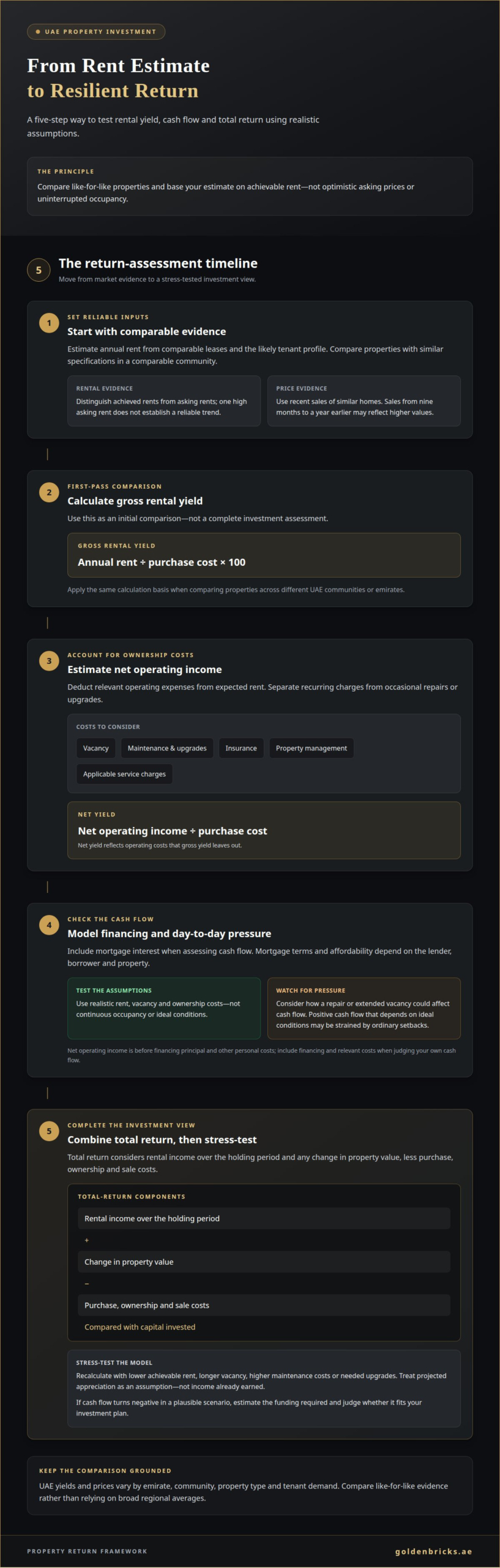
Assess a UAE property through rental yield, net cash flow and total return. Gross rental yield is annual rent divided by purchase cost, multiplied by 100. It offers a first comparison, not a complete investment assessment. Net yield subtracts operating costs before comparing income with the investment cost. Apply the same calculation basis when comparing properties across the UAE.
Start with estimated annual rent in AED, based on comparable leases and the likely tenant profile. Deduct vacancy, maintenance, insurance, property management fees and applicable service charges. Include mortgage interest when assessing cash flow, and account for council rates where they apply. The remainder is an estimate before financing principal and other personal costs. Divide net operating income by purchase cost to calculate net yield.
To estimate total return, combine rental income over the holding period with any change in property value, then deduct purchase, ownership and sale costs. Compare the result with the capital invested. Treat projected appreciation as an assumption, not income already earned. For a financed purchase, distinguish the property’s return from your return on personal capital. Borrowing changes both cash flow and investment exposure.
Use conservative inputs. Test lower rent, longer vacancy, higher maintenance costs or the need for upgrades. If cash flow turns negative in a plausible scenario, calculate the funding required and decide whether it fits your investment plan. Revisit the model when leasing results or operating costs change, and include management expenses rather than treating them as incidental.
To assess UAE rental yield, divide estimated annual rent by purchase cost, then compare net income after holding costs. Total return combines rental income and any change in property value, less costs across the investment period. Review both measures: a strong gross yield can still result in weak net returns if expenses or vacancy exceed expectations.
4. Due Diligence for UAE Property Investment
Before committing in the UAE, organise due diligence around the asset, transaction and investment plan. Define your intended holding period, target tenant profile and acceptable cash-flow range. Then compare these criteria with the property’s location, condition and expected rental demand. A clear plan helps distinguish a strategic purchase from one driven mainly by presentation or urgency.
Review the sale documents carefully, including the agreed price, payment schedule, completion terms and conditions for ending the transaction. Some contingencies may give a buyer the right to withdraw if a stated condition is violated. Their effect depends on the wording and circumstances, so identify each condition and understand its requirements before signing. Make sure the signed terms align with your funding plan.
Assess the property against the assumptions in your return calculation. Consider its condition, likely maintenance needs, service charges, insurance and potential vacancy. For an off-plan purchase, examine project details, payment milestones, delivery terms and suitability for your intended use. For a ready property, compare its current condition and expected operating costs with the rent assumptions in your model.
An appraisal can provide an independent assessment of value and may support a lower-price negotiation or inform a pending sale. Consider its findings alongside comparable transactions and projected rental income, rather than treating it as a substitute for cash-flow analysis. Review the figures in AED and decide whether the purchase still fits your investment criteria.
MoneySmart’s guidance emphasises having a clear plan and professional advice before a major purchase. Bring together the contract, property information, cost assumptions and appraisal findings so each decision rests on a consistent record. If ongoing ownership requires operational support, explore property management support as part of your investment planning.
Golden Bricks Real Estate: Property Management
Golden Bricks Real Estate offers Property Management for owners who need ongoing oversight of an investment property. This can be a natural next step when ownership requires attention beyond the initial purchase or when you want operational considerations to stay aligned with your investment objectives.
For investors assessing opportunities, Golden Bricks Real Estate also offers Exclusive Ready Properties, Exclusive Off-Plan Projects and Project Curation. These services support different stages of a property decision, from evaluating a completed asset to considering a development opportunity. The right direction depends on your investment priorities, intended holding period and assessment of the property’s potential.
Whether you own a property or are considering your next investment, contact Golden Bricks Real Estate to discuss your next step.
Make your next property decision with intention
A property investment is an ongoing commitment, not a single transaction. Set a clear point to review your objectives, ownership experience and changing plans. If a property no longer serves its intended purpose, reassess its role calmly instead of letting past expenditure or pride dictate your next move.
A disciplined approach to avoiding the regret of a bad property investment means treating each decision as part of a longer strategy. Use what ownership has taught you to refine your priorities, define the trade-offs you can accept and approach future opportunities with greater clarity. The aim isn’t to eliminate uncertainty, but to make choices that remain aligned with your financial objectives and time horizon. If you are also exploring property decisions in overseas markets, resources like tampahomeselling.com provide local guidance for buying and selling homes across Florida’s Gulf Coast.
For a considered discussion about your property plans, contact Golden Bricks Real Estate. A clear next step can help you move forward with purpose and confidence.
Frequently Asked Questions
Can You Get Out of a Real Estate Deal?
Sometimes, but whether a buyer can withdraw depends on the contract terms and circumstances. A contingency may provide a right to exit if its stated condition is violated. Review the signed agreement for deadlines, required notices and consequences before acting. If a sale is pending, an appraisal may support price negotiations or help you decide whether to proceed. Don’t assume that changing your mind alone cancels contractual obligations.
How do I know if I made the wrong investment property decision?
Reassess a decision if the property persistently fails to meet the objectives you set before purchase. Compare actual performance with your original plan, including the intended holding period, acceptable cash-flow range and tenant profile. A temporary setback differs from a structural mismatch, such as a property that cannot attract the renters your strategy depends on. Use that distinction to decide whether to adjust, hold or exit.
Why do so many Australians regret buying an investment property?
Regret can arise when ownership differs from expectations. Investors may underestimate the research required, overestimate rental returns or overlook vacancy and maintenance demands. Ongoing responsibilities may also conflict with an owner’s available time or financial priorities. Before purchasing, document expected income, expenses and management requirements. Reviewing those assumptions can help distinguish a poor fit from ordinary fluctuations in ownership. For investors looking into regional Australian markets such as Central Victoria, resources like olliejamesrealestate.com.au offer local market guidance to help evaluate realistic returns and property values.
How can investors check a property’s location, demand, vacancy risk, and future infrastructure plans?
Assess the immediate area for access to employment, transport, schools and essential services, then compare tenant interest with that for similar properties. Consider how long comparable homes remain available and whether advertised rents translate into occupied leases. For future infrastructure, consult official planning and project documents, noting the project’s status and relevance to likely tenants. Treat proposed improvements as potential influences, not guaranteed sources of demand or value growth.
How can investors avoid overpaying for property in the UAE and negotiate a fair price?
Build your negotiation position using recent sales of similar UAE properties, adjusting for differences in condition, layout and location. An appraisal can offer another view of value and may support a lower offer. Set a maximum price using your investment model, including ownership costs, rather than raising it simply to secure the property. Present comparable evidence and be prepared to pause if the terms exceed your limit.
How do property prices and rental yields compare across Dubai, Abu Dhabi, and Sharjah?
Prices and rental yields vary by emirate, community, property type and tenant demand. Compare similar properties using achievable rent, occupancy and recent sales instead of broad averages.