
Could a property meet a residency threshold and still be the wrong investment? For investors considering golden visa property investment dubai, that distinction matters. Residency eligibility may be one factor in a purchase, but it does not determine a property’s financial performance. The property-investor route is generally described as requiring qualifying property valued at AED 2 million or more for a 10-year residence visa. Ownership structure and property status may also affect an application, so confirm the current criteria before relying on them.
Before committing capital, clarify how the rules apply to the particular property and applicant. Assumptions about joint ownership, financing or off-plan property may not match current requirements. Verify eligibility using current guidance from the relevant authorities, including Dubai Land Department and ICP information. A property purchase does not by itself guarantee an application outcome.
This FAQ outlines the broad property-investor residency route, the ownership and documentation details to verify, and the difference between potential visa relevance and investment fundamentals. It also explains how to compare ready and off-plan opportunities on their own merits. Golden Bricks Real Estate draws on more than 25 years of global industry experience, using market intelligence and property curation to help investors compare opportunities without promising visa approval or investment returns.
Key Takeaways
- Distinguish the property-investor Golden Visa route from property ownership, citizenship, permanent residency and guaranteed approval.
- For golden visa property investment dubai, check how purchase value, registered ownership and supporting documents apply under current official rules.
- Keep property purchase and title documentation separate from the residency application, then verify current requirements with the relevant authorities.
- Assess liquidity, holding period, property type and personal objectives independently of any potential residency benefit.
- Compare ready and off-plan opportunities against your investment priorities before deciding whether a property also aligns with your residency plans.
What Does Golden Visa Property Investment in Dubai Actually Mean?
The phrase golden visa property investment dubai refers to a potential link between qualifying property investment and an application for long-term UAE residence. At Golden Bricks Real Estate, we clarify that it does not mean buying any property automatically grants a visa. Eligibility depends on the criteria for the relevant investor category at the time of application, and those criteria can change. Use current Land Department and Federal Authority for Identity, Citizenship, Customs and Port Security (ICP) guidance to verify qualification, application channels and required documents.
Keep the legal and financial decisions distinct. Property ownership gives the owner rights in an asset. A residence permit is immigration status issued under applicable rules. Neither is citizenship, and a Golden Visa should not be described as permanent residency. Owning a property, even one that appears to meet a qualifying threshold, does not guarantee approval. The application remains subject to official assessment and current requirements.
How is a property-investor Golden Visa different from other UAE residency?
The property-investor route is a long-term residence pathway linked to qualifying investment criteria. Other residency routes may be based on different grounds and have different eligibility conditions and terms. Property ownership alone does not establish eligibility, and the same residency terms should not be assumed for every owner or applicant.
Before making a decision, consult current Land Department and ICP guidance for the specific category. Check the applicable validity period, renewal conditions and application process when you intend to apply. Older summaries and broad descriptions may not reflect the criteria for a particular ownership arrangement or the rules currently in force.
What a Golden Visa does not guarantee
A property purchase does not, by itself, guarantee approval. Applicants must meet the applicable criteria and provide the documents requested through the official process. The property transaction and residency application are related, but they are separate steps. Completing one does not determine the outcome of the other.
Residency eligibility also does not establish a property’s financial performance. Rental income depends on the asset and market conditions, while resale value and capital growth are uncertain. A property that may be relevant to an application could still be unsuitable for an investor’s liquidity needs, time horizon or risk tolerance.
Residency eligibility is an immigration consideration, not evidence of property performance or protection from investment risk. Treat possible visa relevance as one factor in a broader assessment. Evaluate the asset, ownership structure and investment objectives on their own merits, then verify the residency position against current official guidance before relying on it in your purchase decision.
Which Dubai Property Investment Details Can Affect Golden Visa Eligibility?
Eligibility can depend on more than a property’s headline price. The registered ownership, the applicant’s share, the available documents and, in some cases, the financing or off-plan status may all affect how an application is assessed. Check these details against current DLD and ICP requirements before relying on a property as the basis for residency.
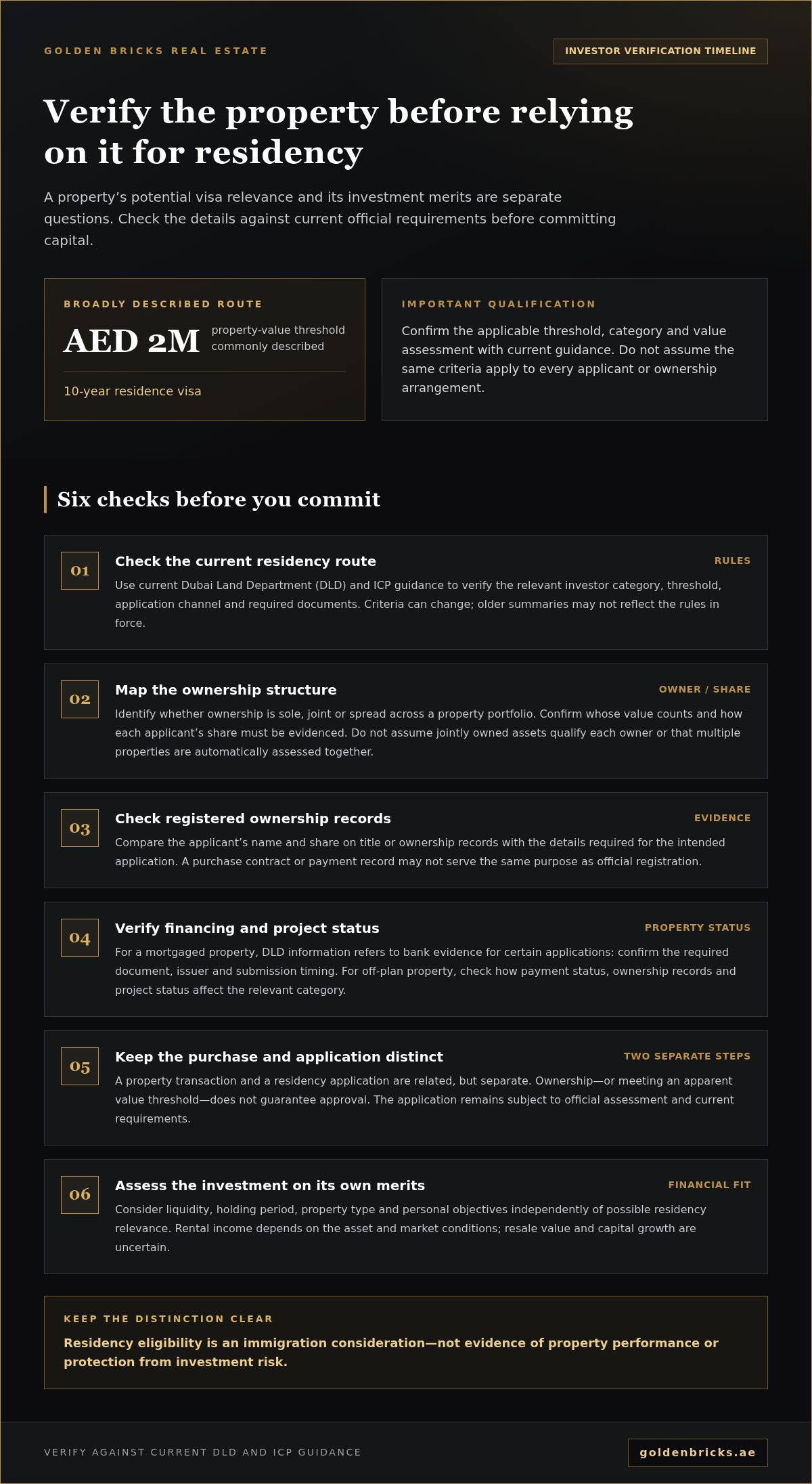
The property-investor route is commonly described as having an AED 2 million property-value threshold. Confirm the applicable threshold, how value is assessed and which application category the guidance covers through current official sources. Do not assume that the same figure or assessment applies to every applicant or ownership arrangement.
Does the purchase structure change how a property is assessed?
It may. Sole ownership, joint ownership and a portfolio of properties raise different questions about whose value counts and how an applicant’s share is evidenced. Do not assume that the combined value of jointly owned assets qualifies each owner, or that several properties are automatically assessed together. Check the current rules for the specific ownership structure against DLD guidance.
Registered ownership is central to the evidence trail. Compare the applicant’s name and share on the title or ownership records with the details required for the intended application. If the property has more than one owner, establish how each applicant’s interest must be documented. A purchase contract or payment record may not serve the same purpose as official registration, so identify which records the authority requires.
What should investors know about financed or off-plan property?
Verify financing and project status separately. DLD information refers to bank evidence for certain mortgaged-property applications, but confirm the current document, its issuer and when it must be submitted. Do not infer that every financed purchase is treated alike. For an off-plan property, check how payment status, ownership records and project status affect the relevant application category.
Before relying on a property for eligibility, verify its value basis, registered owner and share, property status, financing evidence and the documents required for the applicant category. Use this as a starting checklist, not as a substitute for checking current official criteria. Record the answers for the specific property and ownership arrangement under consideration.
Before making a commitment, seek clear answers to these questions:
- Which current DLD or ICP rule applies to this applicant and property category?
- How does the authority assess purchase value, ownership share or a multi-property portfolio?
- Which title, payment, bank or project-status records are required?
- Could the financing or off-plan status affect the evidence or assessment?
Eligibility research can inform a purchase, but it should not replace investment analysis. Investors comparing golden visa property investment dubai opportunities can weigh ready and off-plan options alongside ownership and documentation considerations. Review property opportunities by considering each asset’s merits as well as its possible residency relevance.
How Does the Property-Investor Golden Visa Application Process Work?
Think of the process as two connected but distinct tracks. First, complete and document the property transaction. Then prepare and submit a residency application under the relevant category. This distinction helps prevent a purchase document from being mistaken for proof that every immigration requirement has been met. For golden visa property investment dubai, confirm the current application channel, checklist and sequence against DLD and ICP guidance before preparing an application.
A practical sequence is:
- Confirm the applicable category. Review the current official criteria for the applicant, property and ownership structure before relying on a particular asset as the basis for an application.
- Complete the property transaction and registration. Retain official ownership evidence and transaction records relevant to the asset. A reservation or purchase agreement may not replace the documentation requested by the authority.
- Check the current application checklist. Match each required document to the applicant and property. Identify whether the case calls for additional ownership, financing or status records.
- Submit through the currently designated channel. Follow the authority’s instructions for forms, supporting documents and any subsequent identity, medical or other procedures that apply.
- Respond to official requests and await a decision. Keep records of submissions and follow the stated process if the authority requests clarification or further material.
What documents might an applicant need to prepare?
Current DLD and ICP checklists are the authoritative references. Examples that may appear in official guidance include a passport, title deed, photograph and documents showing the applicant’s status. These are examples, not a complete or universally applicable list. Confirm current document specifications, format and validity requirements before submission.
Requirements may vary with the case. Joint ownership, financing or an off-plan purchase can affect which property records or supporting evidence are relevant. Prepare documents that identify the applicant and establish the connection to the property, then compare them with the checklist for the specific category. If details differ across records, resolve the discrepancy before filing where possible.
Which authorities and steps should applicants expect?
DLD and ICP are relevant authorities for the property-investor residency route. Confirm their roles, channels and current procedures using official guidance. The process may involve submission, document review and further identity or medical procedures where applicable. Do not assume that every applicant follows identical steps or that a channel described in an older guide remains current.
Processing and approval depend on the relevant authorities and the requirements in force when a case is assessed. No property transaction or checklist can guarantee either outcome. Keep the property file and residency file organised separately. Use official instructions to track what has been submitted, what remains outstanding and what action is required next. Treat third-party timelines and procedural summaries as estimates, not commitments from an authority.
Is Property Investment for a Golden Visa a Sound Decision on Its Own?
A property’s possible relevance to residency is only one part of the purchase decision. Assess whether the asset fits your financial objectives, how long you can hold it and whether you can manage the risks of ownership. A visa-related threshold, where applicable, is an eligibility criterion. It is not evidence that a property is fairly priced, has strong rental demand or will appreciate.
For golden visa property investment dubai, compare the residency questions with the investment questions before committing capital. A ready property and an off-plan opportunity can involve different timing, documentation and ownership considerations. Neither is automatically a better investment or a stronger residency option. The right assessment depends on the specific asset, its purchase terms and your circumstances.
How should investors assess the property beyond visa eligibility?
Start with the asset itself. Review property condition, ownership documentation and market evidence with this UAE property investment guide for international buyers. Then consider your intended holding period and how readily you may need to access the capital. For a rental strategy, treat projected income and occupancy as assumptions to test, not guaranteed outcomes. Independent legal, tax and financial advice may be useful, particularly where ownership or funding arrangements are complex.
Compare the property with your objectives, not only with a qualifying figure. Ask whether its characteristics suit your intended use, whether the timing aligns with your liquidity needs and what risks could affect your plan. When assessing prospective acquisitions in Dubai, reviewing market inventory on agency sites like chainexrealestate.com can help clarify prevailing values and asset types. These questions matter even if the property appears to meet a residency criterion.
| Residency criteria | Investment due diligence |
|---|---|
| Which current official category and conditions apply to the applicant? | Does the asset suit the intended strategy and holding period? |
| How are ownership, property value and supporting records assessed? | What market evidence supports the purchase assumptions? |
| What documents and steps does the authority require? | How might liquidity, costs, condition and market changes affect the plan? |
What common assumptions should investors avoid?
Do not assume that a property linked to a residency route is automatically a sound investment. A possible residence permit does not protect against price movement, limited liquidity, ownership complications or changes in market conditions. Rental forecasts are estimates, and future resale value is uncertain. Keep the immigration assessment and financial case separate, then consider how each fits your objectives.
A disciplined comparison can clarify the trade-offs between ready and off-plan opportunities without treating either as a guaranteed route to residency or returns. Golden Bricks Real Estate offers market intelligence and property curation to support property selection. Review available property opportunities by assessing each asset on its own merits alongside any possible residency relevance.
For rental-focused investors, compare JVC rental yield and ROI, including gross yield, costs and unit-type differences as part of a separate assessment of potential property performance.
How Can Investors Take a Considered Next Step with Golden Bricks?
Start with clarity about the investment, not an assumption about the visa outcome. Define what you want the property to achieve, how long you expect to hold it and how ownership would be structured. Then verify eligibility independently using current official guidance. This keeps the residency question grounded in the applicable rules while allowing you to assess the property on its own merits.
What information should investors organise before comparing properties?
Set out your investment horizon, preferred property category, intended use and tolerance for risk. These parameters make comparisons more purposeful, whether you are considering a ready property or an off-plan opportunity. Establish your own decision framework before beginning a property search.
- Investment horizon: Clarify how long you expect to hold the asset and when you may need access to capital.
- Property preference: Decide whether you want to assess ready, off-plan or both categories.
- Intended use: Consider how you expect to use or manage the property.
- Risk tolerance: Identify the uncertainties you can accept, including changes in market conditions or timing.
Keep immigration eligibility questions separate from property selection. Ownership structure, category requirements and application documents should be checked against current DLD and ICP guidance. Property suitability, market context and comparisons between assets belong in an informed property discussion. This distinction prevents a residency assumption from narrowing your investment analysis too early.
How can property advisory support a disciplined decision?
Golden Bricks Real Estate provides brokerage across ready and off-plan property, alongside project curation and market intelligence. With more than 25 years of global industry experience, the firm helps investors compare opportunities against their stated objectives and consider relevant market factors. This supports analysis, but it is not a forecast, a guarantee of performance or a determination of visa eligibility.
For investors considering golden visa property investment dubai, a disciplined comparison gives each opportunity two separate assessments: whether it aligns with the investment plan, and whether its details may be relevant to a residency application under current rules. The first is a property decision. The second must be verified with the appropriate official authorities. Neither proves the other.
Once your priorities are clear, you can compare property opportunities with Golden Bricks Real Estate and assess ready and off-plan options against your investment objectives. Select an asset for its merits, and consider possible residency relevance as a separate factor.
Move Forward with a Clear Investment Framework
Turn your priorities into a clear property brief. Define what you want the asset to achieve, then compare opportunities against that purpose before treating possible residency eligibility as a deciding factor. For golden visa property investment dubai, this keeps the purchase anchored in your objectives while current eligibility details are verified through official guidance.
Golden Bricks brings more than 25 years of global industry experience to property decisions, with brokerage across ready and off-plan properties, supported by market intelligence and property management. This perspective can help you compare options carefully without treating residency relevance as a promise of approval or investment performance.
Explore property opportunities with Golden Bricks and take the next step with a clearer view of the assets that may suit your goals. A disciplined decision starts with the right questions and a clear understanding of what matters to you.
Frequently Asked Questions
Is Dubai property investment enough to guarantee a Golden Visa?
No. Buying property does not guarantee Golden Visa approval. The outcome depends on the rules in force, the applicant’s circumstances, the ownership and property evidence submitted, and the relevant authorities’ assessment. Before purchasing with residency in mind, compare the property records you expect to receive with current DLD and ICP requirements. Treat a possible visa outcome as one consideration, not as a certainty built into the transaction.
Can mortgaged property qualify for a Golden Visa in Dubai?
It may be considered, but a financed purchase is not automatically eligible. DLD information refers to bank evidence for certain mortgaged-property applications. Verify the exact evidence and applicable conditions for the individual case. Confirm which ownership, payment and lender documents the authority requires, and how any threshold is assessed. Check current official guidance before relying on a mortgaged property in your application plans.
Can jointly owned property qualify an investor for a UAE Golden Visa?
Joint ownership may be relevant, but do not assume the full property value counts for every co-owner. The assessment can depend on the rules currently applied and how each applicant’s share is recorded. Review the title deed and ownership structure together, then verify how those records are treated for the intended category. This is especially important if co-owners expect to make separate applications based on the same asset.
Can an off-plan property support a Dubai Golden Visa application?
Possibly, but a purchase price or marketing statement alone does not establish eligibility. The authority may assess registration, project status, payment progress and evidence of ownership under current rules. Verify how the specific property is treated before relying on it for an application. Separately, assess the project’s investment risks and purchase terms. Potential residency relevance does not establish financial suitability.
Can Golden Visa holders sponsor family members through property investment?
Family sponsorship may be available under applicable Golden Visa rules, but eligible relatives, required documents and conditions can vary by category and may change. Before factoring family residency into a property decision, check current official guidance for the relevant visa type and each family member’s circumstances. A general description of sponsorship benefits does not confirm that a particular relative qualifies or that all requirements have been met.
Does a Dubai property Golden Visa require the holder to remain in the UAE continuously?
Entry and absence conditions depend on the visa category and rules in force. Do not assume that a property-linked permit has no stay requirements, or that conditions are identical for every resident. If you expect to spend extended periods abroad, confirm the applicable rules and renewal conditions with the responsible authority before making plans. Consider travel patterns and family circumstances together, since they may affect how useful a residency option is for you.
How long does a property-investor Golden Visa application take in Dubai?
There is no reliable universal timeframe to assume. Processing can vary with the application channel, completeness of the property evidence, identity or medical procedures and the authority’s workload. Check the latest official service information for the relevant category. Treat estimates from older guides or service providers as indicative, not guaranteed. Allow flexibility before arranging travel or other commitments, particularly if further documents or clarification are requested during review.