

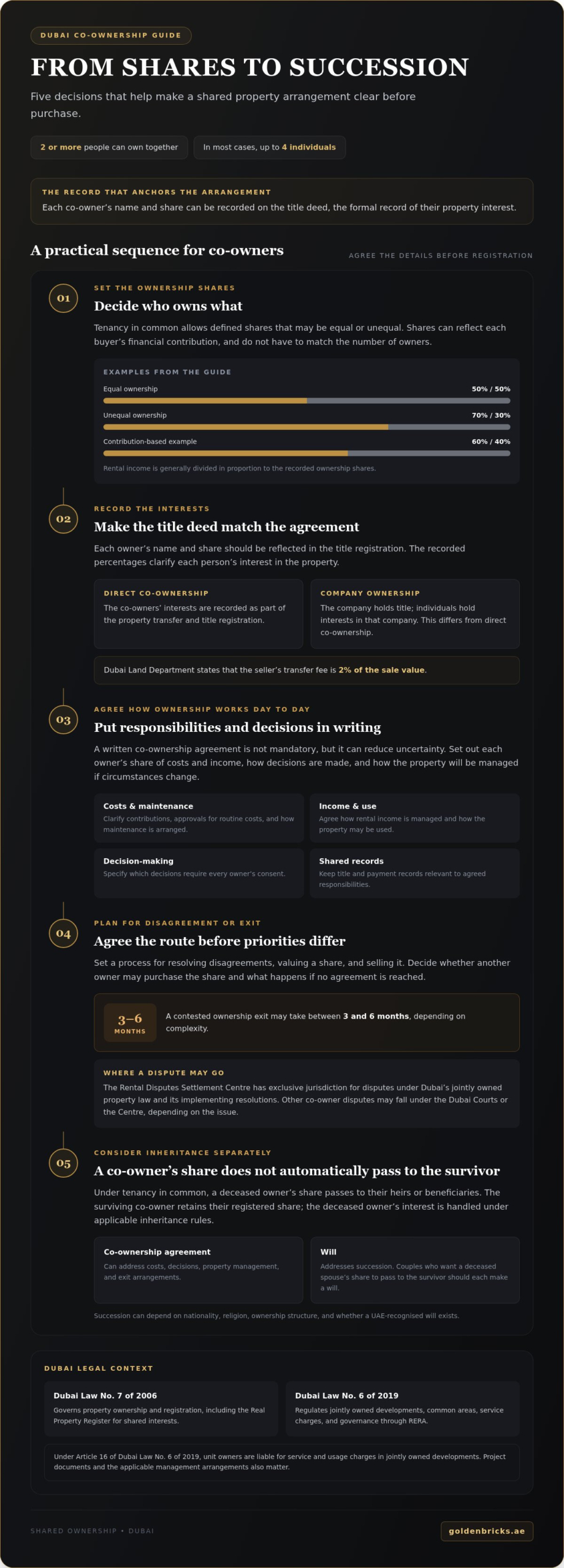
Yes, joint property ownership in Dubai is possible: two or more people can own a property together, and in most cases, up to four individuals can be registered as owners. Their names and shares can appear on the title deed, which is central to establishing each co-owner’s rights.
The title deed is important, but it is not the only decision to make. Co-owners should also agree on contributions, responsibilities, income, and what happens if someone wants to sell or a disagreement arises.
This guide explains how shared ownership works in Dubai, how equal or unequal shares are handled, and how title registration records each owner’s interest. It also covers key considerations when disputes arise, helping you understand the arrangements involved before making a shared purchase.
Key Takeaways
- Joint ownership is possible in Dubai, with up to four individuals able to co-own a property in most cases.
- Agree how contributions, ownership shares, income and costs will be allocated before completing a shared purchase.
- Set out decision-making, exit arrangements and dispute resolution in writing to reduce uncertainty if co-owners disagree.
- Ensure every owner’s name and share are reflected on the title deed, the formal record of their interests.
Can you have joint ownership of property in Dubai?
Yes. Two or more people can own a property in Dubai, with their shares recorded on its title deed. While Golden Bricks Real Estate operates across the entire UAE, Dubai features its own specific framework covering jointly owned developments, charges, and the rights attached to co-ownership.
Dubai’s Joint Ownership Framework
Dubai Law No. (6) of 2019 regulates jointly owned developments, common areas, service charges and governance through RERA. This matters because ownership includes obligations linked to shared parts, not only rights inside the individual unit. Dubai Law No. 7 of 2006 governs property ownership and registration in the emirate, establishing the Real Property Register for ownership rights, including shared interests.
Categories of Jointly Owned Projects
Dubai classifies jointly owned real property into three categories: Major Projects, Hotel Projects and other real property projects. The category matters because it shapes how common parts are managed. In Major Projects, the developer manages, operates, maintains and repairs common parts and utility services. Owners should understand the applicable project documents, including the Master Community Declaration, Statute and Building Management Regulation.
Buying Property Together
Buying together means recording each co-owner’s interest as part of the property transfer and title registration. In most cases, up to four individuals can jointly own one property. Dubai Land Department states that the seller’s transfer fee is 2% of the sale value. Company ownership is different: the company holds title, while individuals hold interests in that company. In another UAE emirate, the relevant local property framework applies, rather than Dubai’s specific rules.
Owners’ Rights and Responsibilities
Joint owners share rights in the property and must comply with its governing documents and applicable charges. Article 16 of Dubai Law No. 6 of 2019 makes unit owners liable for service and usage charges in jointly owned developments. If co-owners cannot agree on division, Article 1186 of the UAE Civil Transactions Law allows an owner to request it; if physical division is not feasible, a court can order a sale and divide the proceeds.
Tenancy in common and unequal ownership shares
Tenancy in common lets co-owners hold defined shares in one Dubai property, which may be equal or unequal. A couple might register a 70% and 30% split, or choose 50/50 ownership. The recorded percentages clarify each person’s interest; they need not match the number of people or their relationship.
Shares can reflect each buyer’s financial contribution, but couples should agree on the allocation before registration. For example, one partner contributing more toward the purchase could hold a larger recorded share, such as 60%, while the other holds 40%. Rental income is generally divided in proportion to those ownership shares.
A written co-ownership agreement is not mandatory, but it can clarify how the arrangement will work. Specify each owner’s share of costs and income, how decisions are made, and how an owner can exit. Include a valuation and sale process, along with terms for managing the property if circumstances change.
Inheritance requires separate consideration. Under tenancy in common, a deceased owner’s share passes to their heirs or beneficiaries, rather than automatically transferring to the surviving co-owner. The surviving spouse retains their registered share, while the deceased spouse’s interest is handled through applicable inheritance rules. Federal Law No. 28 of 2005 governs personal affairs, including inheritance and estate distribution.
Succession can depend on nationality, religion, ownership structure and whether a UAE-recognised will exists. Couples who want a deceased spouse’s share to pass to the survivor should each make a will. A carefully drafted agreement can address costs and exit arrangements, while a will addresses succession. Couples assessing suitable property opportunities may explore curated property opportunities.
How Are Disputes Between Joint Owners Resolved?
Disagreements may arise over property use, maintenance, rental income, or a sale. Without agreed decision-making and exit terms, co-owners can be left uncertain about their responsibilities and next steps.
Agreements and Dispute Resolution
A co-ownership agreement sets out how partners will make decisions and handle disagreements. Clear terms give everyone a shared reference when priorities differ. Specify how routine costs are approved, how maintenance is arranged, and how rental income is managed. Include a process for resolving disputes before they affect the property, and clarify which decisions require every owner’s consent.
Exits and Ownership Disputes
An exit arrangement explains how an owner can leave and how their share will be valued or sold. Agree in advance whether another partner may purchase that share, how a valuation will be selected, and what happens if no agreement is reached. A clear process helps prevent disputes from becoming prolonged disagreements about price or timing. A contested ownership exit may take between 3 and 6 months, depending on complexity.
For disputes under Dubai’s jointly owned property law and its implementing resolutions, the Rental Disputes Settlement Centre has exclusive jurisdiction. Other disputes between co-owners may fall under the jurisdiction of the Dubai Courts or the Centre, depending on the issue. The nature of the claim and the rights or obligations involved determine the appropriate route.
Legal assistance can help co-owners interpret their agreement, organise title and payment records, and present the issue to the appropriate authority. For example, a disagreement about maintenance contributions calls for records of the agreed responsibilities and payments. A dispute over selling the property requires attention to the ownership documents, consent, and any agreed exit process. Addressing these points early can help co-owners understand their options.
Dubai property title registration for co-owners
Dubai’s Real Property Register records property rights, including shared interests, under Law No. 7 of 2006. Registration makes the title deed the formal record of each co-owner’s interest.
Registering Co-Owners on a Title
Title registration lists each owner on the deed, making the ownership structure clear. Dubai property transactions, including joint purchases, must be registered with the Dubai Land Department. The deed can name two or more parties, so couples should ensure the purchase documents and registration include every intended owner. A guardian must act for a minor who co-owns property.
Registration also matters when ownership changes. Once a sale is finalised and payments are complete, the Dubai Land Department manages the transfer of the title deed to the new owner. After a divorce, any ownership changes must also be formally registered with the Department. A private agreement does not replace the official registration record.
Recording Ownership Shares
The title deed can identify each co-owner’s percentage, not merely their names. For example, a couple may register a 50/50 split or record 20/80 shares. Those percentages establish each party’s documented interest and provide a clear reference if a share is later transferred. Confirm the intended proportions are reflected in the registration documents.
If one owner sells a share, the Dubai Land Department transfer fee is 4% of the value of that share, rather than the whole property. A mortgage also affects the transaction: when financing is involved, the bank holds the title deed until the mortgage is fully repaid. Owners should account for this when planning a transfer or change in registered shares.
Once the deed reflects the agreed ownership, retain it with purchase and mortgage records. For ongoing asset oversight after registration, explore property management support.
Golden Bricks Real Estate: Exclusive Off-Plan Projects
Golden Bricks Real Estate offers Exclusive Off-Plan Projects for buyers considering a shared property purchase in Dubai. Its Exclusive Ready Properties provide another option for couples comparing ownership opportunities, while Project Curation helps bring relevant opportunities into focus. After a purchase, Property Management supports ongoing ownership needs.
Before choosing a property, co-buyers can align its type with their registered shares, intended use, and longer-term plans. A considered selection helps couples clarify their priorities alongside the ownership and registration decisions outlined above.
To discuss property opportunities, contact Golden Bricks Real Estate.
Shape Your Next Property Decision
The value of joint property ownership in Dubai depends not only on the asset, but also on how well the co-owners’ plans stay aligned over time. Before pursuing a purchase, discuss how the property fits your shared priorities, what role it should serve, and how you will approach future decisions. That conversation can help turn an ownership structure into a considered investment strategy.
Golden Bricks Real Estate can help you explore Exclusive Off-Plan Projects or Exclusive Ready Properties, with Property Management available for ongoing ownership needs. These offerings support different stages of the property lifecycle, from assessing opportunities to managing an acquired asset.
When you are ready to consider your next step, contact Golden Bricks Real Estate. A clear shared direction gives couples a stronger foundation for selecting a property that reflects their plans.
Frequently Asked Questions
Finally, what happens on the death of one of two or more joint owners?
A deceased owner’s share is handled according to the ownership structure and applicable inheritance rules. Under tenancy in common, the share passes to heirs or beneficiaries rather than automatically to the surviving owner. The outcome depends on the ownership structure and applicable inheritance arrangements. Nationality, religion, and a UAE-recognised will can also affect how an estate is distributed.
How to protect a surviving spouse’s share in Dubai real estate?
Each spouse should make a will that clearly addresses their property interest and intended beneficiary. A surviving spouse keeps their own registered share, but the deceased spouse’s share is treated through inheritance procedures. Federal Decree Law No. 29 of 2020 allows each emirate to establish a registry for wills made by non-UAE nationals. Keep ownership records and estate documents consistent.
What is a title deed?
A title deed is the formal record of registered ownership for a property. In a shared purchase, it identifies the co-owners and can show each person’s ownership percentage. For example, a deed recording two owners at 60% and 40% provides a reference for their respective interests. Preserve the deed with transfer and mortgage documents for future transactions or estate administration.
What forms of joint property ownership are available in Dubai?
Co-owners may hold property under different ownership arrangements. The distinction matters especially if an owner dies: under joint tenancy, the deceased owner’s share passes to the remaining owners, while under tenancy in common, it passes to heirs or beneficiaries. Tenancy-in-common shares can be equal or unequal, so couples should choose a structure that matches their succession intentions.
Can foreign nationals jointly own property in Dubai, and where?
Yes, foreign nationals can jointly own property in Dubai’s freehold areas. Non-GCC expatriates cannot purchase property in non-freehold or restricted areas. Before agreeing to a shared purchase, identify the property’s ownership classification and ensure the intended co-owners and shares are included in the registration. The property’s legal status determines whether foreign buyers can hold registered interests there.
What fees and costs apply to joint property ownership in Dubai?
According to the Dubai Land Department, the seller’s transfer fee is 2% of the sale value, and the buyer’s is 2%. Agent commission is approximately 2%.