
A UAE property portfolio doesn’t have to begin with buying an entire property. A considered approach to how to build a property portfolio in the UAE can include fractional ownership, where investors pool funds, or REITs, which offer real estate exposure without direct ownership of physical property. If you buy directly, compare potential rent with purchase and ongoing costs, then diversify across locations and property types.
It’s natural to focus first on how much capital a purchase requires, but the investment structure matters just as much. The right approach depends on your income goals, time horizon, and ability to manage cash flow across different assets.
This guide explains how to compare gross and net rental yield, consider ways to invest without owning an entire property, and assess locations across the UAE. It also covers purchase costs, financing, and ongoing expenses, helping you shape a portfolio around a clear plan rather than a headline yield.
Key Takeaways
- Compare gross rental yield with net returns after recurring ownership costs to assess an investment’s income potential.
- Explore fractional ownership and REITs as ways to gain real-estate exposure without purchasing an entire property.
- Spread investments across locations and asset types to reduce reliance on a single market segment.
- Plan for service charges, maintenance, financing, vacancy and management costs when modelling cash flow.
- Research tenant demand, resale potential and market conditions before selecting a property or location.
What is the gross rental yield?
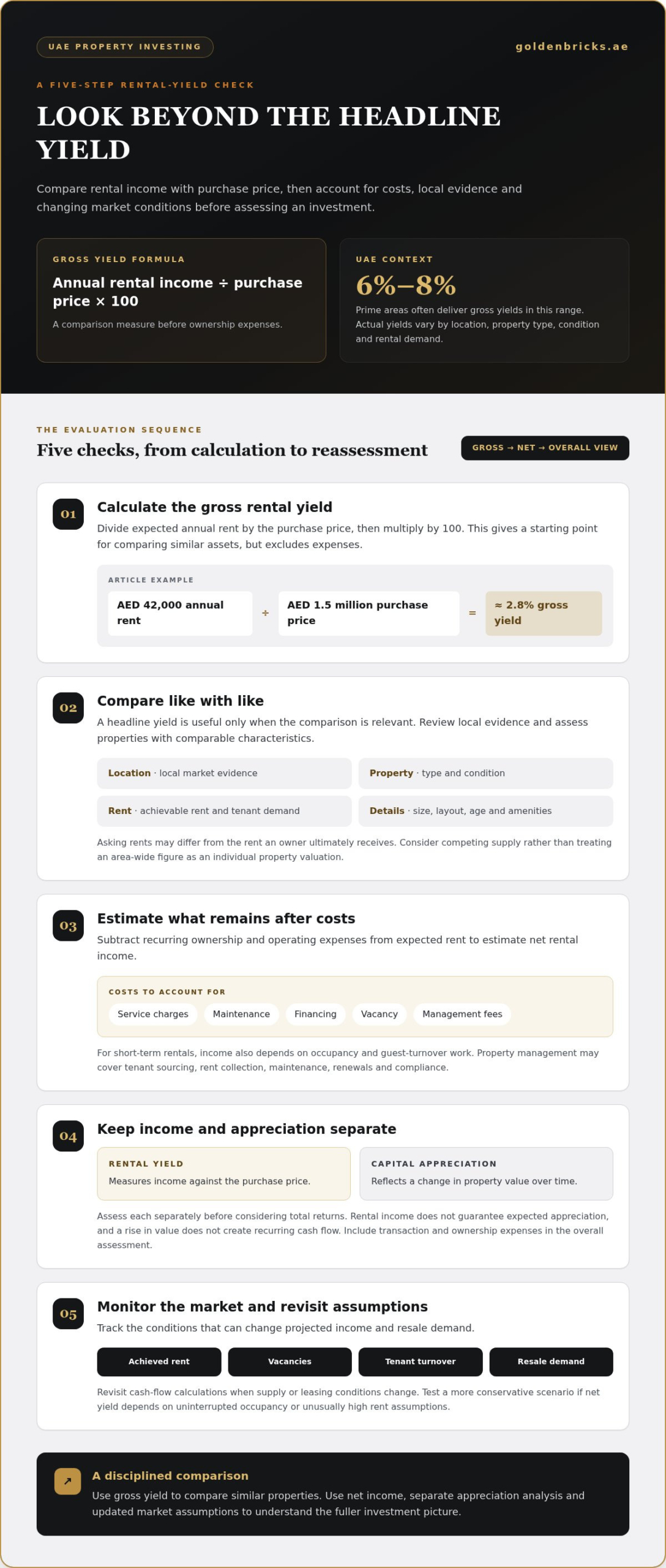
Gross rental yield compares annual rent with a property’s purchase price. Prime areas in the UAE often deliver gross yields of 6% to 8%. Actual prices and yields vary by location, property type, condition, and rental demand, so compare local evidence before setting an acquisition budget.
- Calculate gross rental yield. Divide expected annual rental income by the purchase price, then multiply by 100. For example, AED 42,000 in annual rent on a property priced at AED 1.5 million produces an approximately 2.8% gross yield. Use this calculation to compare similar assets, but remember it excludes expenses and doesn’t show the income remaining after ownership costs.
- Compare properties using relevant market evidence. A headline yield is useful only when you compare similar property types in similar locations. Review achievable rent, tenant demand, property condition, and competing supply. Asking rents may differ from the rent an owner ultimately receives. For price comparisons, account for size, layout, age, and amenities rather than treating an area-wide figure as a valuation of an individual property.
- Estimate net rental income. Subtract service charges, maintenance, financing costs, vacancy, and management fees from expected rent. Short-term rental income also depends on occupancy and the work involved in guest turnover. Consider these expenses alongside gross rent, then compare the resulting net income with the capital committed. Property management can cover tenant sourcing, rent collection, maintenance, renewals, and compliance.
- Assess appreciation separately from rental returns. Rental yield measures income against the purchase price; capital appreciation reflects a change in property value over time. Estimate each separately before considering total returns. A property may generate rental income without appreciating as expected, while a rise in value does not create recurring cash flow. Include transaction and ownership expenses when assessing overall performance.
- Monitor rental trends and revisit your assumptions. Track achieved rent, vacancies, tenant turnover, and resale demand in the property’s market. Revisit projected income when supply or leasing conditions change, and update your cash-flow calculations before expanding. If a property’s net yield relies on uninterrupted occupancy or unusually high rent assumptions, test a more conservative scenario. This makes comparisons between assets more disciplined.
Prime areas in the UAE often deliver gross rental yields of 6% to 8%, but yields vary by location, property type, condition, and rental demand. Property prices also vary, so compare similar local properties by size, layout, age, and amenities.
Can I invest in Dubai real estate without buying an entire property?
Yes. Fractional ownership allows multiple investors to pool funds to purchase real estate, reducing each person’s contribution. REITs provide property exposure without requiring investors to own physical properties. Real estate tokenisation is developing through regulated initiatives involving the Dubai Land Department and other authorities.
According to the UAE Government, investors who invest AED 2 million or more in property in the emirate are eligible for a 10-year Golden Visa. Portfolio risks include market corrections, oversupply, regulatory changes, vacancy, and concentrated exposure; manage them through diversification, cash-flow planning, and clear agreements between co-investors.
- Set your investment objective. Decide whether you want recurring income, long-term wealth accumulation, capital appreciation, or a balance. Define your investment horizon, liquidity needs, and tolerance for fluctuations before choosing a structure. These priorities help distinguish an investor seeking direct control over a specific property from someone who prefers broader real estate exposure with less operational involvement.
- Choose a structure that fits your profile. Direct ownership gives you a registered interest in a specific property. Fractional investment shares the purchase funding among investors, while a REIT offers exposure through an investment vehicle. Compare how each option handles decision-making, income distribution, resale, and access to capital. Consider as well the level of involvement each requires.
- Assess fractional investment arrangements carefully. Pooling funds can reduce each investor’s contribution compared with buying a property alone. Before investing, understand the ownership arrangement, investor rights, expense allocation, income distribution, and exit process. Partners should clearly agree on roles and responsibilities, and on how profits and losses will be managed. Set out the terms in a written agreement.
- Understand what the ownership record represents. Dubai Land Department registration provides legal proof of property ownership. Tokenisation initiatives are developing through regulated efforts involving the Dubai Land Department and other authorities, but tokenised exposure should not automatically be treated as direct registered ownership. Identify the legal interest an investment represents and how it relates to the underlying property.
- Give every investment a defined portfolio role. Decide whether each holding is intended to contribute income, growth, or diversification, then review how it fits your wider plan. Track liquidity, management requirements, and shared exposure to market conditions. Before adding another asset, assess whether it increases concentration or introduces a distinct potential source of returns.
Diversification across emirates and asset types
Build a portfolio around different demand drivers instead of buying properties exposed to the same market trends. Compare locations, tenant profiles, property types, and income objectives before allocating capital. The aim is to balance exposures, not simply collect properties without a shared investment rationale.
-
Spread Investments Across Emirates
Compare opportunities across emirates, then assess each market’s tenant demand, resale prospects, and cycle. Consider how local employment, infrastructure, and community growth may shape demand for different properties. Don’t assume performance in one emirate predicts returns elsewhere. Give each location a clear role in your portfolio based on income or growth objectives, not reputation alone.
-
Vary Communities and Dubai Neighbourhoods
Spread holdings across communities with distinct demand profiles. Compare places primarily serving residents with those attracting visitors, and assess the tenant pool and leasing model suited to each. Review resale demand, competing supply, and likely buyers’ needs. Concentrating every property in one community leaves the portfolio more exposed to local corrections, shifts in demand, or oversupply.
-
Mix Property Types
Balance apartments, villas, and other property types according to their tenant markets and roles in your income plan. For example, an apartment and a family villa may appeal to different households and respond differently to changes in demand. Compare likely rental demand, management requirements, and resale audiences before buying. A varied mix can reduce dependence on one segment, but it cannot remove broader market risk.
- Balance income and growth exposures. Assess ready properties alongside off-plan assets, and high-yield opportunities alongside investments selected for capital growth. These categories can respond differently to leasing conditions and development timelines. Choose an allocation that reflects your cash-flow needs and investment horizon. Don’t adopt a fixed model simply because it appears in another investor’s portfolio.
- Use REITs to broaden exposure. REITs provide real estate exposure without requiring direct ownership of physical properties. Consider them alongside individual holdings when direct ownership would concentrate capital in a narrow range of assets. Review the REIT’s investment focus and market exposure, then assess how it complements your existing holdings. Treat it as a distinct structure, not a substitute for evaluating property-level risks.
- Review concentration before each purchase. Map each holding by emirate, community, property type, and income purpose. Look for overlap, such as several units competing for the same tenant profile or relying on the same demand drivers. Market corrections, regulatory changes, or oversupply can affect returns when holdings share exposure. Where it suits your plan, direct the next purchase toward a different segment or source of demand.
Financing, cash flow and ongoing ownership costs
Before expanding your holdings, model each purchase against rental income, financing obligations, and recurring expenses. Dubai ownership rules and transaction costs also shape the capital required upfront.
-
Assess Financing and Cash Flow
Stress-test the purchase using expected rent, vacancy, service charges, maintenance, management fees, and financing costs. Foreign investors can finance Dubai property through local banks, but loan eligibility and interest rates affect affordability and net cash flow. Assess refinancing potential and keep a cash buffer for periods without rental income.
Include Dubai mortgage registration costs of 0.25% of the loan amount, plus an AED 290 administration fee. Compare these funding needs with the property’s rental demand before committing.
-
Evaluate Purchase Fees and Commissions
Calculate transaction expenses separately from the purchase price.
Include these costs in your initial capital requirement rather than relying on the deposit alone. For example, when comparing two properties, model the registration, legal, and commission expenses for each before assessing your available funds. A higher purchase price also affects percentage-based costs, so update the calculation for every acquisition.
-
Account for Taxes and Recurring Costs
Dubai property owners are described as paying no annual property tax. That does not eliminate recurring ownership expenses: include service charges, maintenance, vacancy, financing costs, and management fees when estimating net cash flow. These costs can materially reduce the income left after rent is received.
For a renovation, include planned work and transaction expenses in the property’s total capital commitment. Track actual expenses against the budget, then revise rental-income projections to account for vacancy and ongoing upkeep.
Foreigners can purchase freehold properties in designated Dubai zones, with full ownership and the flexibility to buy, sell, or rent them. Before adding another property, compare ownership structures, financing obligations, and recurring costs across your portfolio. Property management can handle rent collection, maintenance, renewals, and compliance as your ownership responsibilities grow.
Dubai market research and location analysis
Choose locations by assessing tenant demand, resale depth, and likely buyer profiles, not headlines alone. Use these steps to determine how individual properties fit your portfolio.
- Define the role of each location. Distinguish areas suited to rental income from those selected for capital appreciation. Dubai Marina, Downtown Dubai, and Palm Jumeirah are identified as tourism hotspots for short-term rentals. For each area, assess whether visitor demand suits your operating approach, and compare it with locations serving long-term residents. Each location should support a defined portfolio objective.
- Test the tenant and buyer pool. Identify the likely tenant, then consider who might buy the property when you exit. Jumeirah Village Circle, Dubai Marina, Business Bay, and Dubai Hills Estate are commonly used for anchor properties. Compare rental and resale demand in the specific community rather than assuming a popular district makes every unit easy to sell.
- Use transaction activity as context. A Dubai Land Department report cited 180,900 transactions valued at over AED 522 billion, a 36% increase over the previous year. Treat this market-wide activity as context, not proof that a particular asset will appreciate. Compare the property’s segment, community, tenant profile, and likely resale audience before interpreting broad transaction growth.
- Review appreciation against the holding period. Prime residential market data reports Dubai property value growth of 55% from December 2020 to December 2023. Historical appreciation describes a past period, not a forecast for a future purchase. Assess how market cycles, competing supply, and future buyer demand could affect your intended exit, alongside expected rental income.
- Screen anchor assets for resilience. Prioritise a proven community, ease of renting, strong resale liquidity, and manageable operational demands. Then examine the property itself: layout, condition, access to amenities, and suitability for its expected tenant. A strong location cannot make up for weak demand for the unit. Compare the likely future buyer and leasing audience before committing capital.
- Turn research into a purchase decision. Compare each shortlisted asset against the same measures: tenant demand, expected income, resale prospects, market-cycle exposure, and management requirements. Use Dubai market intelligence to identify how those factors differ by community, then focus your search on properties that serve a clear role in the portfolio. Explore Dubai market intelligence to inform your location analysis.
Golden Bricks Real Estate: Exclusive Off-Plan Projects
Golden Bricks Real Estate helps investors compare Exclusive Off-Plan Projects with Exclusive Ready Properties when shaping a UAE portfolio. Project Curation supports a considered review of opportunities against location, investment objectives, and intended holding period. For owners focused on managing existing assets, Property Management can handle tenant sourcing, rent collection, maintenance, renewals, and compliance. These services are useful when you have defined your portfolio strategy and want to assess property options or operational needs in that context.
To discuss your investment objectives and property requirements, contact Golden Bricks Real Estate.
Set Your Next Investment Decision in Motion
A coherent portfolio takes shape when each acquisition follows a defined investment mandate. Before proceeding, establish the role you want the next asset to play, the capital you can allocate, and how it should complement your existing holdings. This turns how to build a property portfolio in the UAE into a practical decision about fit, timing, and long-term direction.
Golden Bricks Real Estate offers Exclusive Off-Plan Projects and Exclusive Ready Properties for investors considering different acquisition stages. Its Property Management service can support owners with the operational demands of their holdings. Consider these options in light of your portfolio strategy, rather than treating a property purchase as an isolated decision.
Contact Golden Bricks Real Estate to discuss your investment objectives and explore a suitable next step. A considered plan gives each decision a clearer purpose and supports confident progress.
Frequently Asked Questions
Are off-plan properties riskier than ready properties?
Off-plan investments carry construction and timing risks that ready properties do not share in the same way. Construction delays or market changes can affect returns, while escrow accounts secure payments made by off-plan buyers. A ready property may generate rental income sooner, but its condition, existing tenancy, and maintenance needs still require review. Compare the risks with your investment horizon and cash-flow needs before choosing either route.
Are short-term rentals more profitable than long-term rentals in Dubai?
Not necessarily. Higher nightly rates alone do not mean stronger net returns. Short-term rental income depends on occupancy, operating costs, and the work involved in managing frequent guest turnover. Long-term rentals usually use yearly contracts, which can make income planning more straightforward, though tenants may move out after a year or two. Compare expected income after expenses, not nightly rates against annual rent alone.
Do I need to pay taxes on rental income in Dubai?
Individual investors in Dubai are described as paying no personal income tax on rental earnings or capital gains, and Dubai’s stated income and capital gains tax rate is 0% in 2025. Dubai property investors are also described as paying no annual property tax. These statements concern the specified taxes, not every possible cost of ownership. Include service charges, maintenance, vacancy, and management expenses in your income plan.
What Makes a Property Investment Strategy Successful?
A successful strategy links each purchase to a defined objective and a practical exit plan. For example, an income-focused investor should compare expected rent with the property’s full ownership costs, while a growth-focused buyer should consider future resale demand. Review the portfolio when rental conditions, financing, or personal cash-flow needs change. Clear criteria help ensure a compelling sales narrative does not take the place of investment analysis.
Who Should Consider Multiple Property Ownership in the UAE?
Owning multiple properties may suit investors with capital beyond their immediate needs, the capacity to absorb vacancies, and a plan for managing several assets. It can also suit investors seeking different income or growth exposures, provided additional properties do not create excessive concentration. Before buying again, assess the portfolio’s total financing obligations, liquidity, operating workload, and exposure to shared market conditions.
What are the steps to build a property portfolio in the UAE?
Start by setting an investment objective and defining your available capital and time horizon. Compare direct ownership with fractional investment or REIT exposure, then assess properties by tenant demand, total costs, and resale prospects. Choose a location and asset that fill a clear portfolio role. After purchasing, monitor income, expenses, and market conditions before deciding whether another asset supports your strategy.
Can foreigners buy property in the UAE, and where are freehold areas?
Foreigners can purchase freehold properties in designated zones in Dubai, with full ownership and the flexibility to buy, sell, or rent them. The right location depends on intended use, rental demand, and the resale market. Dubai Marina, Downtown Dubai, and Palm Jumeirah are identified as popular freehold zones for foreign buyers. Confirm that the specific property is within a designated freehold area before proceeding.
What is the minimum investment needed to buy UAE property?
There isn’t one minimum investment figure that applies to every property purchase; the required capital depends on the property and its costs. Fractional ownership pools funds among investors, while REITs offer real-estate exposure without direct ownership of a physical property. Separately, according to the UAE Government, investors who invest AED 2 million or more in Dubai property are eligible for a 10-year Golden Visa. That threshold is not a universal purchase minimum.