
The greatest of the risks of real estate investment in the UAE may be exposure to changing market conditions: global economic shifts, interest rates and new supply can influence property values and rental demand. Regulatory bodies charge a registration fee of 4% of the purchase price, but the full investment risk extends beyond the transaction itself.
Property ownership can be a long-term investment with Golden Bricks Real Estate, but returns depend on more than the purchase price. Ownership terms, construction progress, vacancies and ongoing costs can all affect performance.
This article explains how these risks arise and what they can mean for your investment, from ownership terms to off-plan delays and uncertain rental income. It also covers how economic conditions can affect the UAE property market, helping you assess an opportunity with a clearer view of its potential costs and risks.
Key Takeaways
- Calculate the full ownership cost, not just the purchase price, and account for transaction fees, service charges, maintenance and possible renovation.
- Understand whether a property is freehold or leasehold, since each offers different ownership rights and time horizons.
- Assess an off-plan project’s developer history, timeline and purchase agreement to understand how delays or cancellations could affect your plans.
- Test rental assumptions against potential vacancy, tenant turnover and competing supply in the area before estimating income.
- Consider how interest rates, global economic shifts and new market supply could affect property values and demand.
1. Legal and regulatory requirements for property buyers
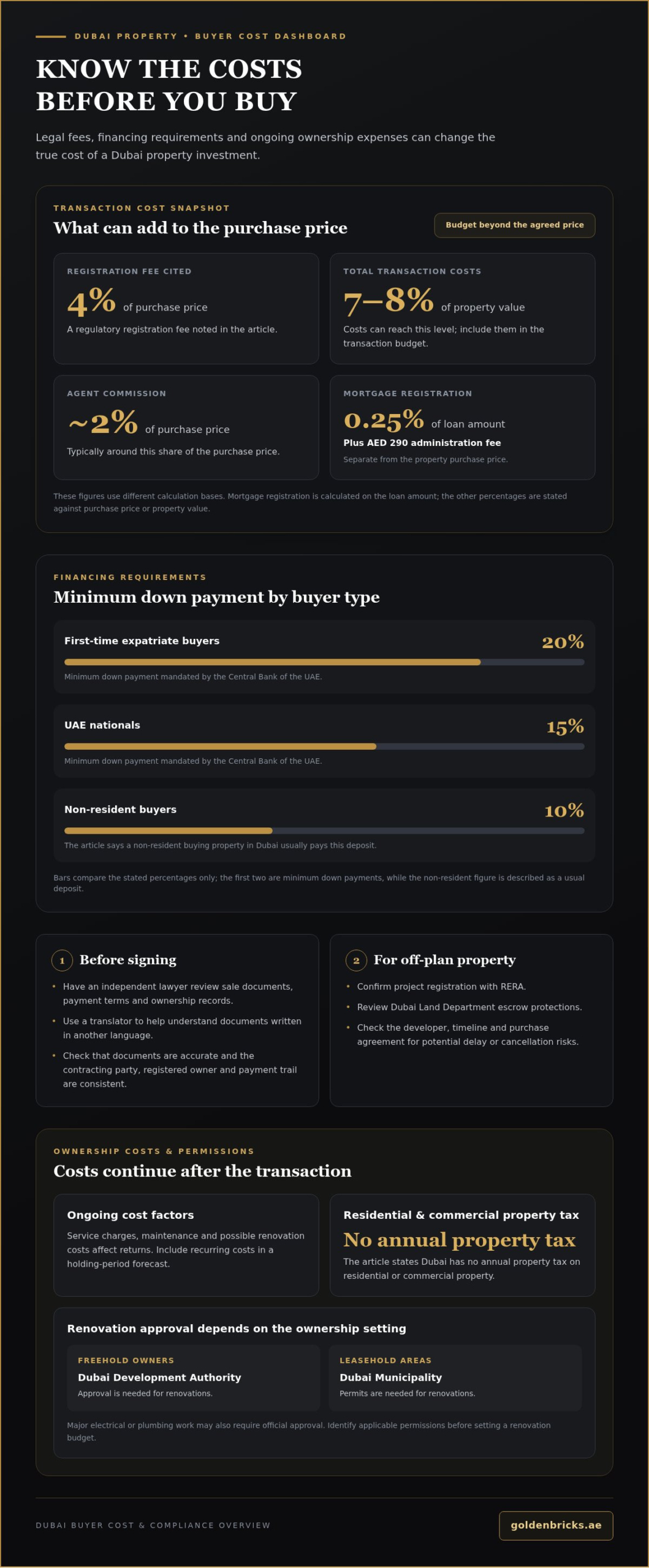
Legal costs can materially change the purchase budget for property in Dubai. Dubai mortgage registration costs 0.25% of the loan amount, plus an AED 290 administration fee. These charges are separate from the purchase price and should be included in the transaction budget.
Financing rules also affect buyers’ cash requirements. The Central Bank of the UAE mandates minimum down payments of 20% for first-time expatriate buyers and 15% for UAE nationals. A non-resident buying property in Dubai usually pays a 10% deposit. Agent commissions are typically around 2% of the purchase price, and total transaction costs can reach 7-8% of property value.
Before signing, have an independent lawyer review the sale documents, payment terms and ownership records. A translator can help you understand documents written in another language. For off-plan property, confirm project registration with RERA and review Dubai Land Department escrow protections. Non-compliance with Dubai real estate regulations can have legal consequences, so check that documents are accurate. Dubai has no annual property tax on residential or commercial property, but service charges, maintenance and renovation costs still affect returns.
Renovation permissions depend on the ownership setting. In Dubai, freehold owners need Dubai Development Authority approval for renovations, while owners in leasehold areas need permits from Dubai Municipality. Major electrical or plumbing work may also require official approval. Identify the applicable permissions before setting a budget to reduce the risk of unexpected delays and costs.
Legal exposure is only one of the risks of real estate investment in the UAE. Dubai property prices rose sharply from 2012 to 2014, then declined gradually until 2020; transactions and prices began rising sharply in 2020. Prices reached record highs during 2024 and 2025, while growth moderated in 2026 as supply increased and buyers became more value-conscious. Similar properties entering one area can pressure rents and resale values. Compare supply pipelines, tenant demand, infrastructure and planned development before choosing an asset. Diversifying across locations or property types can reduce concentration risk, while professional property management can help oversee maintenance, tenant turnover and vacancy.
How liquid is the UAE property market, and how long might a sale take? The UAE Central Bank describes real estate as a fairly liquid market, with assets that generally maintain or appreciate in value over time. The time needed to sell depends on the property’s location, condition and asking price, as well as buyer demand and market conditions.
2. Freehold and leasehold ownership
In Dubai, freehold ownership covers both the property unit and its land. Leasehold ownership grants the right to use a unit for a defined period, rather than owning the land. A 99-year leasehold provides property rights for 99 years; afterward, ownership reverts to the freeholder. These legal differences shape control, resale prospects and long-term property investment plans.
Before buying, compare the title and sale documents with your intended holding period. If you want long-term control, understand what the freehold title conveys. For a leasehold property, identify the lease duration, terms and implications of expiry. The distinction can affect future demand, since buyers also consider the remaining lease term, property condition and supply of comparable homes.
Foreign buyers should establish which ownership arrangement applies to the specific property and area. In Dubai, the distinction between freehold and leasehold is central: the title, not a lifestyle description or marketing label, defines the rights acquired. Treat residency separately from ownership. Some Dubai property-linked visa categories last two years, but property ownership alone should not be assumed to secure residency. Review the applicable criteria and legal documents before making a visa part of your investment plan.
Buying through a shell company can make it harder to identify the beneficial owner of a property. This lack of transparency may complicate due diligence and make it harder to assess whether a transfer has a legitimate purpose. Check that the contracting party, registered owner and payment trail are consistent, and keep records explaining the purchase and source of funds. Clear documentation supports a transparent transaction and ownership structure.
Budget for costs beyond the agreed price. Dubai transaction costs can reach 7-8% of property value, while registration fees, service charges, maintenance and potential renovation expenses add to the ownership burden. The amount and timing depend on the transaction and property. Include recurring costs in a holding-period forecast, since they reduce net income even when the unit is occupied. For a mortgaged purchase, account for the effect of interest rates on repayments and cash flow.
How do UAE mortgage rates, down payments, and lending rules affect investment risk? The Central Bank of the UAE mandates minimum down payments of 20% for first-time expatriate buyers and 15% for UAE nationals. Mortgage rates affect financing costs and available cash flow; model repayments against expected income before committing, because rate movements can change the investment’s carrying cost.
For a practical next step, compare the ownership documents and planned holding period before entering a property purchase or lease transaction. This helps align legal rights, financing exposure and intended use from the outset.
3. Off-plan completion delays and project cancellations
Off-plan property may look attractive because of its price and staged payment plan, but buying before completion carries delivery risk. Construction challenges, financing issues and changes to development schedules can delay Dubai projects. A later handover may postpone rental income, extend financing costs and push back the time when you can occupy or resell the property. Consider not only whether prices may rise, but also whether the project can meet its stated timeline.
Before committing, examine the developer’s delivery record, financial stability and current project schedule. Compare the advertised completion date with the sales and purchase agreement, and read the clauses on payment milestones, design changes and delays. These terms matter if handover takes longer than expected. If your plan depends on rental income during a particular season, allow for the possibility that the unit will not be ready in time.
Dubai Land Department regulations, including escrow accounts, are intended to mitigate financial risks from off-plan delays or cancellations. Escrow protections do not eliminate the practical impact of a delayed handover. Confirm that the project is registered with RERA and track its status through the Dubai Land Department. Comparing payment records with construction progress can also help you assess whether the project remains on schedule.
Project changes can create legal disputes as well as financial pressure. A revised development plan may affect unit specifications, amenities or completion timing, while cancellation can disrupt your intended use. RERA can cancel a real estate project in certain cases, including when land is affected by re-planning projects. Before paying, read the agreement’s provisions on changes, termination and dispute handling, and keep signed documents, payment confirmations and formal project communications.
Market volatility adds another layer of risk. If a delayed project is completed after demand, competing supply or buyer interest has shifted, your original resale assumptions may no longer reflect the market. Compare the project with existing properties and the supply pipeline, rather than relying only on launch-stage pricing. Reviewing the developer, escrow arrangements, agreement and schedule helps clarify your exposure. The trade-off is straightforward: an attractive entry price may come with less certainty about when the asset will generate income or be ready to use.
4. Rental income, vacancy and tenant turnover risks
Rental income depends on achievable rent, occupancy, operating costs and the supply of competing homes. Prime UAE areas often deliver gross rental yields of 6% to 8%, but that range isn’t a net return. Service charges, maintenance, property management fees and vacant periods reduce cash flow. A careful forecast should subtract these expenses before treating rent as income available for other investments or debt payments.
Compare projected rent with the property value using a like-for-like example. A Dubai property bought for AED 1.5 million and earning AED 42,000 annually produces an approximate gross yield of 2.8%. By contrast, a two-bedroom serviced apartment in a prime area, priced at AED 2.2 million with annual rent of AED 176,000, has an approximate gross yield of 8%. Different assets and locations can therefore produce materially different rental outcomes.
Gross yield assumes the property earns rent throughout the year. Tenant turnover can create vacancies, while maintenance between tenancies may delay the next rental. An influx of similar homes in one Dubai area may put pressure on rents and resale values. Before buying, compare nearby supply, tenant demand, accessibility and amenities. Properties near metro stations, business hubs and lifestyle destinations typically attract consistent tenant interest, but the individual unit’s condition and price still affect its competitiveness.
Assess rental income and capital gains as separate sources of return. Rent provides recurring cash flow, while resale proceeds depend on the future sale price and costs incurred while holding the asset. The example shows why sale price alone does not measure investment performance.
Use Dubai Land Department transaction information as one reference when comparing a property’s purchase price with market activity. Then test your rental plan against lower achievable rent, a vacancy period and unexpected repairs. Population growth, economic trends and high property supply can all influence Dubai’s rental market. Allow for these changes in your capital plan instead of assuming uninterrupted income.
Professional property management can coordinate tenancy administration, maintenance and tenant turnover, helping owners oversee a rental property’s day-to-day demands. It does not eliminate vacancy or market risk. Review income and costs regularly, particularly when a lease ends or competing supply changes. This keeps decisions grounded in actual performance rather than the original yield estimate.
5. Global economic conditions affecting Dubai real estate
Dubai’s property market is connected to economic forces beyond the emirate. Global growth, interest rates, oil prices and regional instability can affect investor confidence, financing costs and demand. For buyers using a mortgage, higher borrowing costs can reduce affordable purchase budgets and leave less income after repayments. Foreign investment can support demand, but international capital may also respond quickly to changing economic conditions.
Dubai’s history shows why timing matters. Property values fell sharply during the 2008 global financial crisis and again during the COVID-19 pandemic. These episodes demonstrate that a property’s location and rental potential cannot eliminate wider market volatility. An investor planning to sell during an economic downturn may face lower offers or a longer sale process. Holding capacity therefore matters alongside expected price appreciation.
Market activity can remain substantial even as conditions change. The Dubai Land Department reported transaction values above AED 522 billion, while Dubai recorded 180,900 real estate transactions, a 36% increase over the previous year. In 2026, transaction activity moderated and buyers became more selective. Population growth, international investment and Dubai’s economic fundamentals continued to support demand, while additional supply encouraged buyers to scrutinise value more closely.
Supply can affect performance across the UAE and within individual neighbourhoods. A broad increase in available homes gives buyers more choice, while a concentration of similar units can intensify competition for tenants and resale buyers. Compare expected demand with planned supply, infrastructure and the economic activity supporting nearby employment. Factor in service charges, which remain payable even if global conditions weaken rental income or delay a planned sale.
Review the investment under several scenarios before buying. Consider whether it remains manageable if mortgage costs rise, sale values fall or tenant demand weakens. Compare expected rental income with service charges, maintenance and financing costs. Track economic indicators, market trends and regulatory changes throughout the holding period. This focuses attention on cash flow and exit options rather than relying on a single property-price forecast.
For a more disciplined assessment of Dubai supply, demand and market conditions, use market intelligence for property investment before making a purchase decision.
Golden Bricks Real Estate: Exclusive Off-Plan Projects
Golden Bricks Real Estate offers Exclusive Off-Plan Projects for buyers assessing properties before completion. Its Project Curation and Market Intelligence services can support a considered comparison of projects and investment objectives. If you prefer a completed asset, Exclusive Ready Properties offer an alternative to construction and handover exposure. Property Management can support investors who plan to earn rental income and need ongoing oversight.
Turn to Golden Bricks Real Estate when weighing off-plan exposure against a ready property or planning for the management needs of a rental asset. The right approach depends on your investment horizon, income priorities and tolerance for delivery risk. Contact Golden Bricks Real Estate to discuss your property objectives.
Make Your Next Property Decision Deliberate
The risks of real estate investment in the UAE are best managed by aligning decisions with your capital, time horizon and intended use of the asset. Before proceeding, define your priority: a completed property, an off-plan opportunity or support managing a rental investment. This clarity can turn market analysis into a practical acquisition strategy.
Golden Bricks Real Estate offers Exclusive Off-Plan Projects, Exclusive Ready Properties and Property Management. These options serve different investment priorities, from considering a project before completion to selecting a completed asset or arranging ongoing oversight. No approach removes every risk, so match the property and ownership plan to your capacity for risk.
When you’re ready to consider your next step, contact Golden Bricks Real Estate to discuss your property objectives. A considered decision today can provide a stronger foundation for your investment plans.
Frequently Asked Questions
What is the biggest risk of buying property in Dubai?
The biggest risk is exposure to market cycles: global economic conditions, interest rates and additional supply can weaken property values or buyer demand during your holding period. This is especially important if you plan to sell by a fixed date or mortgage payments leave little room for lower rental income. Before buying, stress-test your holding costs and consider whether you can retain the property if a sale takes longer than expected.
What are the main risks of investing in UAE real estate?
The risks of real estate investment in the UAE include unclear ownership terms, project delays, vacancies, tenant turnover and changing market conditions. These risks can compound: a delayed handover, for example, may postpone rental income while financing costs continue. Map each risk to a practical response, such as reviewing title documents, assessing project progress, allowing for operating costs and testing your exit plan against weaker demand.
How do property prices and rental yields vary across Dubai, Abu Dhabi, and other UAE emirates?
Prices and yields vary by emirate, neighbourhood, property type, condition and competing supply. To compare Dubai, Abu Dhabi and another emirate, use similar properties and the same calculation method. Estimate annual rent against the full acquisition cost, then account for vacancy, service charges and maintenance. Compare tenant demand, transport links, employment centres and planned development rather than relying on emirate-wide averages.
What are the typical costs and fees when buying UAE property?
Mortgage registration is 0.25% of the loan amount, plus AED 290. Agent commissions are typically around 2% of the purchase price. Include service charges and possible renovation costs in your overall budget.
How do service charges, maintenance, and vacancy affect UAE property returns?
These expenses reduce the income left after rent is collected. Service charges and maintenance remain ownership costs, while vacancies temporarily stop rental income and tenant turnover may bring additional upkeep. For a practical assessment, calculate expected rent, subtract recurring charges and maintenance, then allow for periods without a tenant. Compare the resulting net income with financing and other holding costs, not just the advertised gross yield.
What are the rules for foreign property ownership and freehold areas in the UAE?
Ownership rights depend on the property’s title and location. In Dubai, freehold ownership covers the unit and its land, while leasehold grants use rights for a set term; a 99-year leasehold ends with ownership reverting to the freeholder. Foreign buyers should review the title and sale documents to establish the precise rights acquired. Some Dubai property-linked visa categories last two years, but residency and ownership are distinct matters.
How are rental income and capital gains taxed for UAE property investors?
The UAE has a 0% personal income and capital gains tax rate, and Dubai has no annual property tax for residential or commercial properties. Those tax points do not remove operating expenses: service charges, maintenance, vacancy and transaction costs still affect the net result. Separate rental cash flow from any gain on resale when assessing performance, since they arise at different stages and respond to different market conditions.
What risks apply to off-plan property purchases in the UAE, and what buyer protections exist?
Off-plan purchases can face construction delays, changes to development plans or cancellation, affecting handover timing and expected income. In Dubai, projects should be registered with RERA, and buyers can track project status through the Dubai Land Department. Escrow accounts are intended to mitigate financial risks from delays or cancellations. Before committing, review the developer’s record, project timeline, payment terms and sales agreement.