
Real estate can support financial independence, but rental yield alone does not show whether a property can deliver dependable income. Achieving financial independence through real estate in the UAE calls for assessing net returns after costs and vacancy; long-term UAE rentals are commonly modelled with 5%–10% vacancy, compared with 15%–25% for short-term rentals. The difference can materially affect projected cash flow.
It’s reasonable to ask whether property investing is practical with limited capital. The answer depends on your purchase route, available funds, and whether rental income can cover vacancies and ongoing expenses. A disciplined assessment helps distinguish an appealing headline yield from a realistic return.
This article explains how to calculate gross yield and cash-on-cash return, test vacancy assumptions, and assess property’s role in a longer-term financial plan. It also considers ways to invest with less capital, helping you weigh the trade-offs before deciding whether UAE property fits your goals.
Key Takeaways
- Assess a property’s net income after operating costs, then compare it with the cash invested to understand its practical return.
- Weigh paid-off, leveraged, and hybrid portfolios against your capital, borrowing obligations, and income priorities.
- Build realistic vacancy assumptions into rental projections, distinguishing long-term leases from short-term stays.
- Set a long-term income target and consider how property ownership, ongoing management, and reinvestment could contribute to it.
1. Investment metrics including cap rate and cash-on-cash return
Start by separating gross yield from operating performance. Divide annual rent by purchase price for gross rental yield; a property priced at AED 1.5 million and rented for AED 42,000 annually produces an approximate gross yield of 2.8%. Cap rate uses net operating income after property expenses, divided by purchase price. Cash-on-cash return compares annual pre-tax cash flow with the cash invested, including the down payment and purchase costs. These measures show asset efficiency and return on deployed capital.
An owner-occupier primarily values use and stability, while an owner-investor may balance personal use with rental income. A landlord assesses properties for sustained rent, vacancy exposure, operating costs, and management needs. Test these figures before treating an 8% gross yield as passive income. Expenses and vacant periods can reduce the cash reaching the owner, so model them before purchase.
Entry routes vary by investment method. Direct purchases require more capital; budget-area studios and compact one-bedroom apartments can start at AED 200,000–300,000. These routes differ in ownership control, liquidity, and responsibility for property operations.
A property investment worth AED 2 million or more in the UAE can qualify an investor for a 10-year Golden Visa, according to Federal Authority for Identity, Citizenship, Customs & Port Security. Property investments around AED 750,000 may qualify for a standard two-year residency, subject to conditions.
What are the UAE rules for foreign property ownership, freehold areas, and residency visas? Foreign buyers should distinguish eligibility to own property from eligibility for residency. Ownership conditions depend on the relevant emirate and property title, while residency thresholds are separate criteria.
2. Is It Really Worth Investing in Dubai with Little Money?
Limited capital changes the portfolio structure, not the need for disciplined calculations. A property bought outright avoids loan repayments, leaving rental income after operating expenses. Borrowing can help acquire assets but adds repayment risk. A hybrid approach combines owned equity with selective borrowing. For a leveraged purchase, compare projected net operating income with debt payments and assess whether rent can cover repayments during vacancies.
Calculate net cash flow by subtracting vacancy, service charges, maintenance, management, and financing costs from collected rent. UAE service charges depend on the building and community, while management costs reduce income available to the owner. Prime UAE areas often deliver gross rental yields of 6% to 8%, but gross yield excludes these expenses. Estimate net income before comparing properties or projecting capital gains.
Which UAE property types and locations offer the best rental income and long-term growth? No single property type or location suits every investor. Compare residential properties by tenant demand, access to public facilities, purchase price, and ongoing costs, all of which affect rental appeal and resale potential. A property’s position within its community can also influence demand and long-term appeal.
How does UAE real estate compare with stocks, REITs, and other investments for passive income? Direct property offers ownership and rental income, but concentrates capital and requires asset oversight. Stocks and REITs have different liquidity and diversification characteristics; long-term stock-market growth has been cited at 7 to 10 per cent yearly. Compare those trade-offs against your income needs and investment horizon.
What taxes, registration fees, agency fees, and other costs apply to UAE property investors? Purchase charges, agency commission, legal expenses, and ongoing service charges all affect net returns. Applicable costs vary by emirate and transaction. Agency commission is typically payable by the buyer, though negotiable, so include all purchase and holding costs in your calculations.
What steps should an investor take to build a diversified UAE property portfolio for financial independence? Set an income objective, estimate net cash flow, and compare properties across different types and communities. Keep liquid funds for expenses, and avoid relying on the rent or appreciation of a single asset. This measured approach helps align ownership decisions with long-term financial goals.
3. Dubai long-term and short-term rental vacancy assumptions
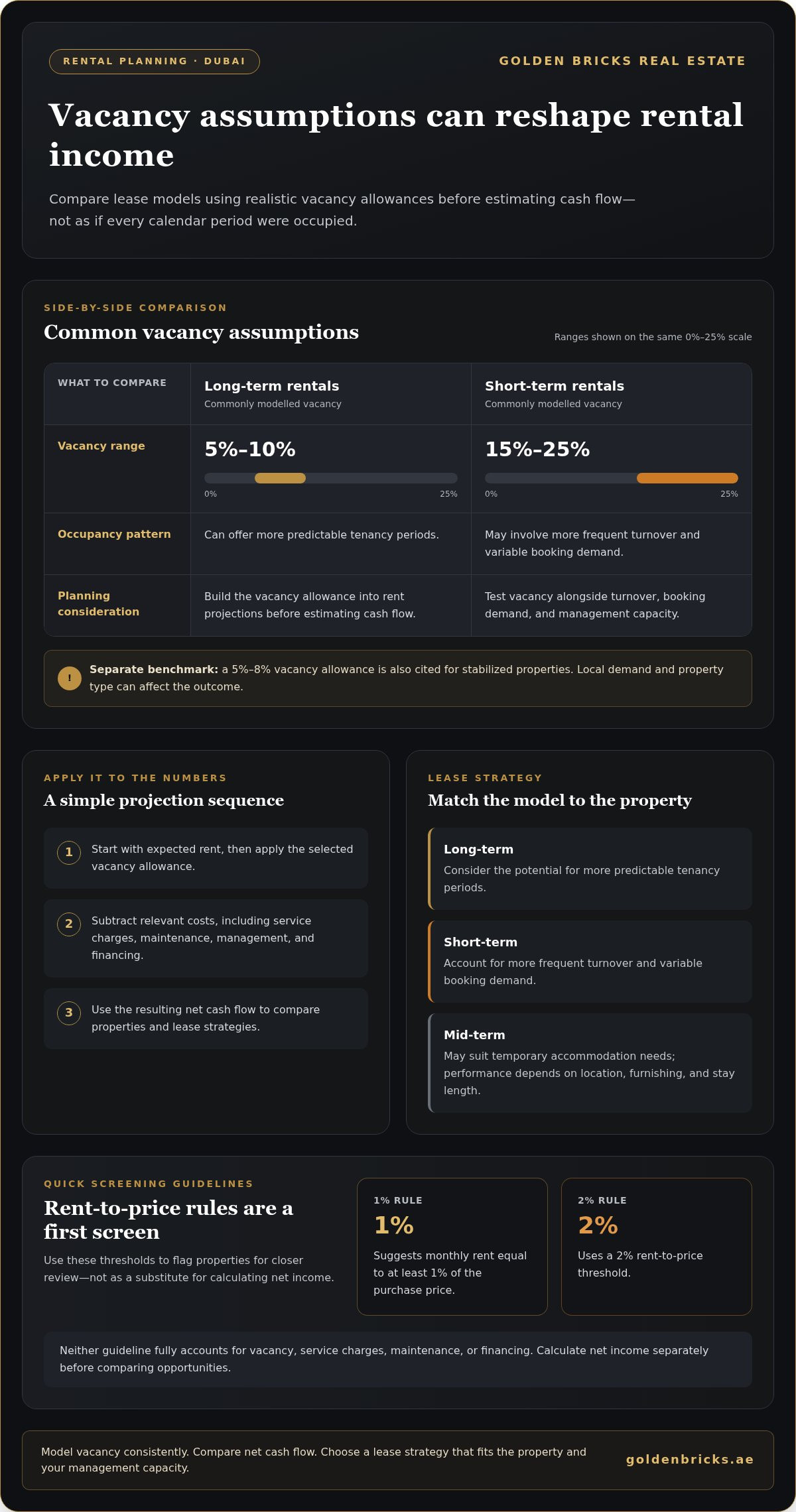
Vacancy assumptions shape projected rental income, even before maintenance or management costs. Dubai long-term rentals are commonly modelled with 5%–10% vacancy, while short-term rentals use 15%–25%. A separate 5%–8% benchmark is cited for stabilized properties, with local demand and property type affecting the outcome. Apply the selected vacancy allowance to expected rent before estimating cash flow, rather than treating every calendar period as occupied.
Lease strategy affects occupancy patterns and operating demands. Long-term rentals can offer more predictable tenancy periods, while short-term stays may involve more frequent turnover and variable booking demand. Mid-term leasing can suit tenants needing temporary accommodation, but performance depends on location, furnishing, and stay length. Compare the approaches using consistent vacancy and expense assumptions, then choose the model suited to the property and your management capacity.
Yield rules offer an initial screen, not a final investment decision. The 1% rule suggests monthly rent equal to at least 1% of the purchase price; the 2% rule uses a 2% rent-to-price threshold. These guidelines can quickly flag properties for closer review, but they do not account fully for service charges, maintenance, financing, or vacancy. Calculate net income separately before comparing opportunities across Dubai communities.
Reinvesting rental income can expand a portfolio over time. Direct surplus cash to reserves first, then consider using the remainder to reduce debt or invest in another property. This links rental performance with future buying power, while diversification can reduce reliance on one building or tenant profile. Keep appreciation separate from recurring income in your projections: capital growth may contribute to long-term returns, but rental cash flow must cover ongoing expenses independently. Regularly compare actual occupancy and collected rent with your assumptions, and adjust your plan when performance or tenant demand changes.
4. Real estate as a route to financial independence
Financial independence requires assets that support living costs, not simply rising property values. In Dubai, a rental apartment can provide recurring income, while appreciation contributes to wealth through eventual sale or refinancing. Treat these as separate return sources. A decade-long investment horizon gives time to manage vacancies, maintain the property, and reinvest rental proceeds toward a broader portfolio.
Consider an illustrative plan investing AED 2,000 monthly. Contributions total AED 120,000 after five years; an example projection estimates AED 340,000 to AED 360,000 after ten years, assuming an 8% annual overall return. A separate 15-year projection estimates a portfolio value of AED 640,000 to AED 660,000. These are planning examples, not a substitute for testing assumptions against costs and market performance.
At a 6% net rental return, a portfolio valued at AED 640,000 to AED 660,000 could produce about AED 3,200 monthly in the illustrative 15-year plan. Compare that income with essential spending, then account for reserves and reinvestment before treating it as available income. A 10%–20% buffer for unexpected expenses helps keep the plan resilient; rental income and property appreciation remain distinct contributors.
AED 150,000 in end-of-service benefits offers another example of capital allocation: the cited approach distributes it across 10 to 15 properties rather than concentrating it in one asset. Dubai currently has no local income tax or capital gains tax on individual property investment earnings, according to the stated market information. These features can support a wealth strategy, but ownership concentration and liquidity still matter. For a considered next step, explore UAE property opportunities aligned with a long-term income plan.
Golden Bricks Real Estate: Exclusive Off-Plan Projects
Golden Bricks Real Estate helps investors translate return criteria into property choices through Exclusive Off-Plan Projects and Exclusive Ready Properties. Its Project Curation can help investors compare assets with their income objectives, preferred ownership approach, and appetite for development-stage exposure. For owners focused on rental performance, Property Management supports the ongoing responsibilities of holding an investment property.
Turn to Golden Bricks Real Estate once you have clarified the asset type and investment approach you want to pursue. The next step is to discuss the property criteria that matter to your plan, from rental potential to long-term portfolio fit.
Visit Golden Bricks Real Estate to discuss your UAE property investment objectives.
Set Your Next Property Decision in Motion
Achieving financial independence through real estate in the UAE is a long-term strategy shaped by how consistently each investment serves your wider financial plan. Start by defining what a property needs to contribute: income, portfolio diversification, future occupancy, or a combination of priorities. Clear criteria help you assess opportunities with discipline as your circumstances evolve.
Golden Bricks Real Estate offers Exclusive Off-Plan Projects, Exclusive Ready Properties, and Property Management. These services can support different stages of an investment journey, from selecting an asset to managing it as part of a longer-term portfolio. Consider which ownership approach aligns with your objectives, then discuss your property requirements with the team.
Contact Golden Bricks Real Estate to explore a considered next step for your UAE property investment. A well-defined plan gives each decision a purpose and helps you move forward with greater clarity.
Frequently Asked Questions
Is It Really Worth Investing in Dubai with Little Money?
Yes, limited capital can provide property exposure without buying an entire home. Compare how each route handles ownership, liquidity, income distribution, and fees before committing savings. Direct ownership comes with different levels of control and responsibility than pooled investments.
What is the gross rental yield?
Gross rental yield is annual rent divided by the property’s purchase price, expressed as a percentage. It offers a quick comparison of rent relative to price, but excludes service charges, maintenance, management, and vacancy. For a more useful income estimate, calculate net operating income after these deductions, then compare it with the property value or cash invested.
How much capital is needed to achieve financial independence through real estate in the UAE?
There is no single capital target: it depends on your desired income, net returns, and investment route. Begin by estimating annual living costs, then assess how much net income your intended assets could contribute. A plan for achieving financial independence through real estate in the UAE should also account for reserves and purchase costs. REITs and fractional deals offer lower entry points than direct property ownership.
What rental yields can investors expect across UAE emirates?
Prime UAE locations often deliver gross rental yields of 6% to 8%, while reported Dubai apartment returns average around 7.15%. Actual yields vary with emirate, property type, rent levels, purchase price, occupancy, and operating expenses. Compare like with like: a compact apartment and a larger residence may attract different tenant demand and cost structures, even within the same market.
How do UAE property prices, rents, and service charges affect net rental yield?
Purchase price sets the yield denominator, while collected rent provides its income numerator. Estimate net income after charges, vacancy, maintenance, and management before deciding whether the rent supports your investment objective.
How can investors finance UAE property purchases, and what mortgage rates and down payments are typical?
Financing terms depend on the borrower, property, lender, and loan structure, so mortgage rates vary. A first-time expatriate buyer must make a minimum down payment of 20% of the property value; a UAE national buyer’s minimum is 15%. Non-resident mortgages typically have loan-to-value ratios capped at 50%–75%. Dubai mortgage registration costs 0.25% of the loan, plus AED 290.