

The emirate with the higher property prices doesn’t necessarily deliver the stronger rental yield. In the Abu Dhabi vs Dubai real estate investment comparison, Dubai’s average overall property price was د.إ 1,939 per square foot in February 2026, compared with د.إ 1,783 in Abu Dhabi. Yet average gross asking yields in Q2 2026 were 5.53% in Dubai and 5.76% in Abu Dhabi.
That contrast shows why the right choice depends on more than headline prices or a single yield figure. Each market offers a distinct investment profile, shaped by location, property type, rental demand and your investment horizon.
This comparison covers prices, rental yields, demand and long-term return potential in both emirates. It explains where Dubai’s scale and liquidity may suit one strategy, and where Abu Dhabi’s value and rental performance may support another.
Key Takeaways
- Compare foreign ownership rules by designated area, not just by emirate, as eligibility depends on where the property is located.
- Include transfer fees in your acquisition budget: the stated rates are 4% in Dubai and 2% in Abu Dhabi.
- Assess rental demand by property type and neighbourhood; emirate-wide averages can obscure stronger-performing local markets.
- Weigh Dubai’s liquidity and off-plan flexibility against the need to manage market-cycle and supply risks, particularly over a five-year horizon.
- Compare gross rental yield with potential capital growth and ownership costs to judge the return profile that fits your investment horizon.
Is Dubai better than Abu Dhabi for long-term real estate investment?
Neither emirate is automatically better for long-term investment. Dubai Law No. 7 of 2006 provides designated freehold areas for non-UAE nationals, while Abu Dhabi Law No. 19 of 2005, amended in 2019, provides ownership in designated investment areas.
For foreign buyers, location determines eligibility. Abu Dhabi Law No. 13 of 2019 opened specified investment zones to full foreign ownership, and the emirate has 12+ designated freehold zones. In Dubai, non-UAE nationals can purchase freehold property within designated areas. A property outside an eligible zone may carry different ownership rights, so confirm the title type and location before comparing investment returns.
Residency can also influence the purchase decision. Dubai had a wide range of properties priced around AED 2 million that could qualify for residency pathways. The Dubai Land Department issues the property-route Golden Visa permit for 10 years. These pathways are distinct from ownership rights: eligibility for a visa does not itself establish that a buyer can purchase any property in any area.
Overseas buyers can compare cash purchases with mortgage financing. Rates and down-payment requirements depend on the lender’s assessment of residency status, income, property and loan term. There is no single rate or deposit that applies across both emirates.
Use this comparison to identify which market better fits your ownership and holding strategy:
| Option | Foreign ownership | Residency pathway | Long-term consideration |
|---|---|---|---|
| Dubai | Freehold in designated areas under Law No. 7 of 2006 | Property-route Golden Visa permit for 10 years through the Dubai Land Department | Assess eligible location, title and intended rental strategy |
| Abu Dhabi | Designated investment areas under Law No. 19 of 2005, amended in 2019 | Specified investment zones opened to full foreign ownership under Law No. 13 of 2019 | Assess zone eligibility and the specific property’s ownership rights |
For a long-term rental strategy, the emirate alone does not determine whether a property is suitable. Compare eligible ownership, likely tenants, location and management needs. For example, buyers considering Yas Island should assess the specific property and its rental demand, rather than assume all freehold locations perform alike.
A practical decision sequence helps keep the legal and financial questions distinct:
- Identify the designated freehold or investment zone and verify the property’s ownership structure.
- Assess whether a property-linked residency pathway is relevant to your plans.
- Compare cash funding with lender mortgage terms, including the deposit and rate offered for your circumstances.
- Match the location and property type to your long-term rental or resale strategy.
Choose between Dubai and Abu Dhabi based on eligible ownership, financing terms and your holding strategy, not cultural appeal alone.
Dubai vs Abu Dhabi : Which Emirate Offers Better Rental Yields?
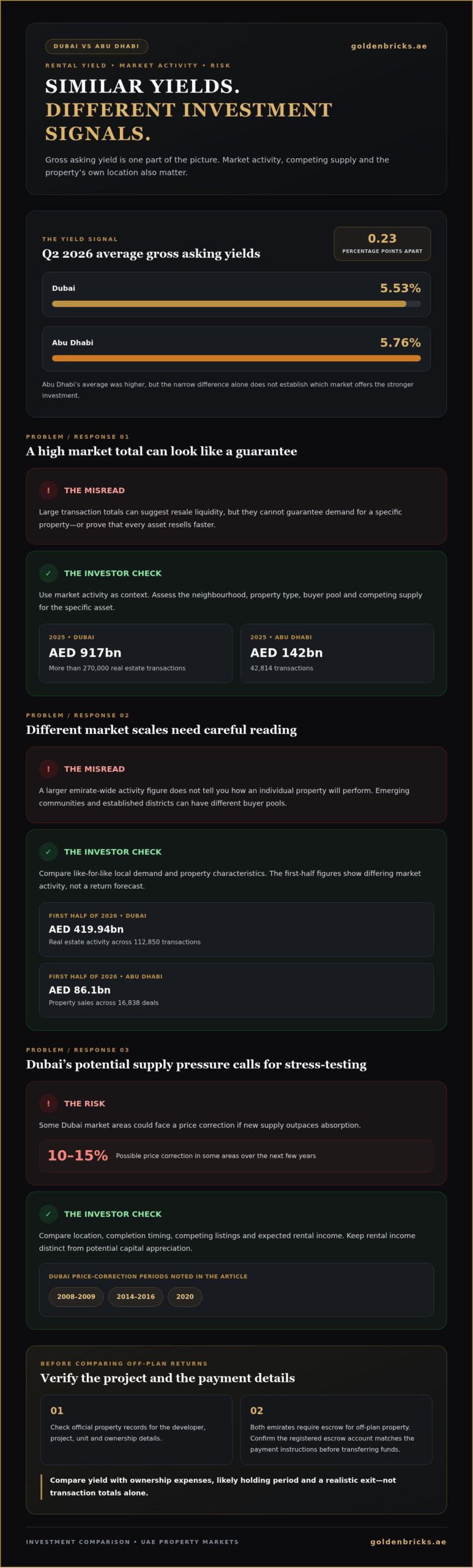
Q2 2026 average gross asking yields were 5.53% in Dubai and 5.76% in Abu Dhabi. That narrow difference does not settle which market offers the stronger investment. Dubai recorded more than 270,000 real estate transactions worth AED 917 billion in 2025. Abu Dhabi recorded AED 142 billion across 42,814 transactions that year. Transaction volume can support resale liquidity, but a high market total cannot guarantee demand for a specific property.
For a five-year horizon, Dubai’s liquidity and off-plan structure may offer more flexibility, alongside a need for careful risk management. Its market has experienced price corrections during 2008-2009, 2014-2016 and 2020. These cycles show why investors should distinguish rental income from potential capital appreciation. A planned exit depends on buyer demand, property condition, pricing and competing supply, not transaction totals alone.
Abu Dhabi’s activity also merits attention. In the first half of 2026, property sales reached AED 86.1 billion across 16,838 deals. Dubai recorded AED 419.94 billion in real estate activity across 112,850 transactions over the same period. These figures indicate different market scales; they don’t establish that every Dubai asset resells faster than every Abu Dhabi property. Downtown and established residential districts can have different buyer pools from emerging communities.
Supply is a key risk in Dubai: some market areas could face a 10-15% price correction over the next few years if new supply outpaces absorption. Compare the property’s location, completion timing and competing listings with expected rental income. Abu Dhabi’s lower transaction count does not by itself mean weaker returns; neighbourhood demand and asset type remain material. For both markets, compare gross yield with ownership expenses and the likely holding period.
To verify a developer, title deed or off-plan project, consult the relevant emirate’s official property records and match the developer, project, unit and ownership details. Both emirates require escrow for off-plan property. Before transferring funds, confirm that the registered escrow account matches the payment instructions.
- Compare yield with resale activity, rather than treating either measure as a complete return forecast.
- Stress-test Dubai investments against past corrections and possible supply pressure.
- Assess Abu Dhabi by neighbourhood and property type, not transaction volume alone.
- For off-plan purchases, verify project records and escrow details before payment.
Investors weighing new developments can use market intelligence for property investment to compare opportunities against their income and exit objectives.
Property prices per square foot
February 2026 averages show different price profiles across the two emirates for anyone evaluating an Abu Dhabi vs Dubai real estate investment.
These averages are comparison points, not valuations for every island, district or development. Location, property type and building specifications affect the price per square foot. Make like-for-like comparisons: apartments against apartments, and villas against villas. Then consider how location, expected rent and ownership costs affect potential returns.
| Measure | Dubai | Abu Dhabi |
|---|---|---|
| Average overall price, February 2026 | AED 1,450 | AED 1,200 |
| Average apartment price, February 2026 | AED 1,520 | AED 1,280 |
| Average villa price, February 2026 | AED 1,310 | AED 1,050 |
| Average real estate ROI | 6-8% | 5-7% |
Average real estate ROI is stated at 6-8% in Dubai and 5-7% in Abu Dhabi. Those broad figures don’t establish the return on an individual property. A lower purchase price per square foot may support a different yield profile, while rental demand, occupancy, expenses and resale conditions shape the outcome. Assess the income case and potential capital appreciation separately.
Neighbourhood performance adds detail to the emirate-level comparison. In Q2 2026, gross asking yields for one-bedroom properties were 6.86% in Dubai’s Jumeirah Village Circle, 6.12% in Dubai Marina and 5.72% in Downtown Dubai. Abu Dhabi examples were 6.24% on Yas Island and 6.30% at Al Raha Beach. Prime zones, including Al Maryah Island and parts of Al Reem, were stated at 7-8.5% gross yield.
For a property-linked Golden Visa application, the stated purchase threshold in either emirate is AED 2,000,000. Treat this as a residency criterion, not an investment return: property ownership and visa eligibility are separate considerations. Compare the property’s eligible value, location and intended holding strategy before making a decision with experts like Golden Bricks Real Estate.
To compare potential returns, assess neighbourhoods by property type and gross yield, then weigh those figures against price per square foot and your investment horizon. Activity across each emirate’s real estate sector provides useful market context, but transaction volume alone does not determine a property’s performance.
Short-term and long-term rental demand
Rental demand varies by length of stay, tenant profile and location. Comparing these factors helps investors assess income potential and the stability their investment requires.
Short-Term Rental and Tourism Demand
Short-term rentals respond to visitor flows, making tourism exposure particularly relevant in Dubai. The emirate attracted 7.15 million overnight visitors in the first quarter of the previous year, a 7% year-over-year increase. High-demand Dubai tourist locations can generate gross yields above 10%, but this strategy depends on continued visitor demand and effective property operations.
That profile differs from a conventional long-term lease, where residents rather than visitors drive occupancy. Dubai Marina and Downtown Dubai illustrate locations with distinct visitor and residential appeal. When comparing the emirates, assess the intended guest or tenant, seasonal booking patterns and operating requirements before relying on short-stay income.
Long-Term Rental Demand and Lifestyle Amenities
Long-term rentals depend on residents choosing communities for everyday convenience, not just visitor access. In Abu Dhabi, Yas Island and Al Raha Beach offer useful neighbourhood comparisons; in Dubai, Jumeirah Village Circle is another residential example. Access to retail, transport, schools and leisure amenities can influence tenant demand and a property’s ability to retain occupants.
For a steadier income strategy, compare similar units in the same community and property type. Review lease terms, vacancy periods, competing supply and recurring ownership costs. A family-oriented unit on Yas Island may attract a different tenant profile from a centrally located Dubai apartment, even when both offer strong amenities.
Rental Yields and Annual ROI
Average apartment gross rental yields are stated at 5-7% in Dubai and 5-6.5% in Abu Dhabi. These ranges provide a starting point, not a complete annual ROI calculation. Gross yield compares rent with purchase value; annual returns also reflect costs, vacancy and any change in the property’s value.
Compare the emirates using the same method: estimate annual rent, divide it by the purchase price, then account for operating costs and vacancy. A high gross yield can be offset by expenses or inconsistent occupancy. Long-term leasing may produce a steadier rental pattern, while tourism-led income can vary with visitor demand and operating performance.
Before choosing a strategy, match the property and community to the expected tenant, then model income under more than one occupancy scenario. Dubai’s tourism figures support examining short-stay demand, while Abu Dhabi locations such as Al Raha Beach and Yas Island merit assessment for residential leasing. The better fit depends on your preferred balance of yield, stability and management effort.
Real estate investment returns
Compare total return, not rental yield alone. A disciplined Abu Dhabi vs Dubai real estate investment comparison separates rental income, changes in property value, vacancy and ownership expenses. Dubai’s overall annual ROI, including modest capital growth, is often stated at 6-8%. Abu Dhabi recorded price growth of 5-10% in key neighbourhoods, while rental performance varies by asset type and location.
Yield figures require context. Dubai’s mid-market areas, including Business Bay and Jumeirah Village Circle, are stated at 6-8% gross rental yield. Prime Dubai areas are listed at 4-6%, while Abu Dhabi prime zones are stated at 7-8.5%. These contrasts show why district, property type and purchase price matter more than an emirate-wide average alone.
Neighbourhood examples add detail. Yas Island had rental yields around 6.2%, while Dubai’s most profitable district was reported at 6.99% ROI. Abu Dhabi’s most popular neighbourhood was reported at 6.90% ROI. These figures use different measures, so don’t compare them as though they were calculated identically. Assess gross yield against gross yield, and annual ROI against annual ROI.
An Abu Dhabi vs Dubai real estate investment strategy should distinguish potential rental income from potential capital growth. A property with strong rent may have less room for price appreciation if its purchase price already reflects demand. A growing community may attract future buyers while offering a different rental profile today. Assess tenant appeal and ongoing ownership costs alongside the wider market profile.
Use the same method in both markets: record the purchase price, expected annual rent, recurring expenses and likely vacancy. Then estimate potential resale value over your intended holding period. Seven years, ten years or longer may suit either emirate; the asset’s price, rental profile and resale demand shape the comparison.
- Separate gross yield from net income after expenses and vacancy.
- Assess capital appreciation independently at neighbourhood level.
- Match your holding period to income and resale objectives.
- Use the same return measures and assumptions in both markets.
To refine your assessment, review property market intelligence alongside your income and capital-growth objectives.
Golden Bricks Real Estate: Exclusive Off-Plan Projects
Golden Bricks Real Estate helps investors turn market comparisons into a property shortlist through its Exclusive Off-Plan Projects and Exclusive Ready Properties. Project Curation supports a focused review of opportunities against priorities such as location, property type, rental strategy and intended holding period.
Investors considering a completed asset can explore Exclusive Ready Properties, while those assessing future delivery can review Exclusive Off-Plan Projects. Property Management can support owners after purchase. These offerings provide distinct ways to compare and manage property assets, rather than a single approach for every investment objective.
Contact Golden Bricks Real Estate to discuss property opportunities that align with your investment priorities.
Set Your Investment Mandate Before You Move Forward
Turn market comparisons into a clear investment plan. Decide whether your priority is rental income, potential capital appreciation or a balance of both. Then define the property type, preferred ownership structure, holding period and exit conditions that fit your wider portfolio. This gives your Abu Dhabi vs Dubai real estate investment decision a practical framework, rather than relying on a single market statistic.
Golden Bricks Real Estate supports this process with Exclusive Off-Plan Projects, Exclusive Ready Properties and Property Management. Consider which option aligns with your objectives: a future-delivery opportunity, a completed asset or ongoing management after purchase. A disciplined shortlist makes it easier to assess every property against the same investment criteria.
When you’re ready to consider opportunities against your investment priorities, contact Golden Bricks Real Estate. A considered next step can bring greater clarity to your investment strategy.
Frequently Asked Questions
How Do Rental Yields Compare for a Similar Asset?
For one-bedroom properties in Q2 2026, Jumeirah Village Circle in Dubai recorded a 6.86% gross asking yield, compared with 6.24% on Yas Island in Abu Dhabi. Al Raha Beach recorded 6.30%, while Dubai Marina reached 6.12%. These examples suggest location can matter as much as emirate. Compare the same property type and yield basis, then account for vacancy and running expenses.
Is Foreign Ownership More Secure in Dubai or Abu Dhabi?
Neither emirate is inherently more secure; ownership rights depend on the property’s designated area and title. Dubai Law No. 7 of 2006 provides designated freehold areas for non-UAE nationals. Abu Dhabi Law No. 19 of 2005, amended in 2019, provides non-national ownership in designated investment areas. Before purchase, match the property location and title details to the applicable ownership framework.
Is property cheaper in Abu Dhabi or Dubai?
Compare similar locations and specifications, since emirate-wide averages do not price individual properties.
Which Emirate Offers Better Long-Term Capital Appreciation?
Neither emirate has a guaranteed advantage in capital appreciation. Abu Dhabi recorded price growth of 5-10% in key neighbourhoods, while Dubai’s market has experienced corrections, including in 2020. For a long-term comparison, assess the purchase price, new supply, local demand and resale appeal for the specific property. Treat rental income and expected value growth as separate components of the investment case.
Who Should Invest Where?
Dubai may suit investors who prioritise a larger transaction market and more resale activity; Abu Dhabi may appeal to buyers comparing lower average prices and neighbourhood-level yield opportunities. For example, an apartment buyer should compare tenant demand and ownership costs in each shortlisted community. The right emirate depends on risk tolerance, preferred property type, income objectives and how long your capital can remain invested.
How do Abu Dhabi and Dubai property prices and rental yields compare in 2026?
Q2 2026 average gross asking yields were 5.53% in Dubai and 5.76% in Abu Dhabi. These measures cover different periods and market indicators. Use them as broad context, then compare properties of similar type, location and condition.
How have property prices and rents changed in Abu Dhabi versus Dubai over the past five years?
Both markets have moved through changing cycles, and performance varies by neighbourhood and property type. Dubai experienced a price correction in 2020; Abu Dhabi recorded price growth of 5-10% in key neighbourhoods. For a five-year decision, compare like-for-like sale prices and rents across the same period, then account for changes in supply, tenant demand, vacancy and property condition.
What are the purchase costs, transfer fees, and ongoing service charges in Abu Dhabi and Dubai?
The stated property transfer fee is 2% in Abu Dhabi and 4% in Dubai. Ongoing service charges vary by property and building, so include the applicable charge in your net-yield calculation. Also budget for transaction-related expenses separately from the transfer fee, and compare the full ownership cost before committing.