
Handover doesn’t always mean the final payment is due. With a post handover payment plan dubai property, buyers pay part of the purchase price after receiving the keys rather than settling the full balance at handover. Plans may use a 50/50 or 60/40 structure, while some developers offer monthly instalments of 1% under extended terms.
That flexibility can ease payment timing, but the schedule is only one part of the decision. The developer’s track record, expected handover date and balance due after completion all affect how the plan works in practice.
This guide explains how post-handover payments are structured, how 1% plans and other flexible terms operate, and what to consider when assessing an off-plan property. You’ll also see why the developer’s delivery record and the timing of handover matter when aligning the payment schedule with your investment objectives.
Key Takeaways
- Compare the amount due after handover and the instalment schedule with your expected cash flow, not just the initial payment.
- A 1% plan refers to monthly instalments calculated against the property’s total value; understand how its timing fits alongside booking and construction payments.
- Assess off-plan payment flexibility alongside the developer’s reputation and anticipated handover timing, since both affect the payment schedule’s practical value.
- Review the agreement for interest, service fees, late-payment consequences and any resale restrictions before weighing one plan against another.
How Post-Handover Payment Plans Work?
Dubai post-handover plans let buyers pay an agreed balance after receiving the property keys. A 50/50 or 60/40 structure determines how much is paid during construction and after handover.
Plan Structure and Payment Stages
A post-handover schedule divides the purchase price between booking, construction, handover and later instalments. Some plans start with a 10% booking payment, while the remaining balance may be paid over 2 to 8 years after handover. The agreement sets instalment dates and amounts, so compare its timeline with your expected cash flow before committing.
Buyer Eligibility and Additional Costs
Eligibility depends on the developer’s plan and the buyer’s ability to meet its booking and instalment terms. The purchase agreement governs the schedule, so buyers should understand each payment obligation before signing. Dubai Land Department registration fees are separate purchase costs, not instalments within the developer’s plan. Dubai handover fees typically range from 1% to 5% of the property value.
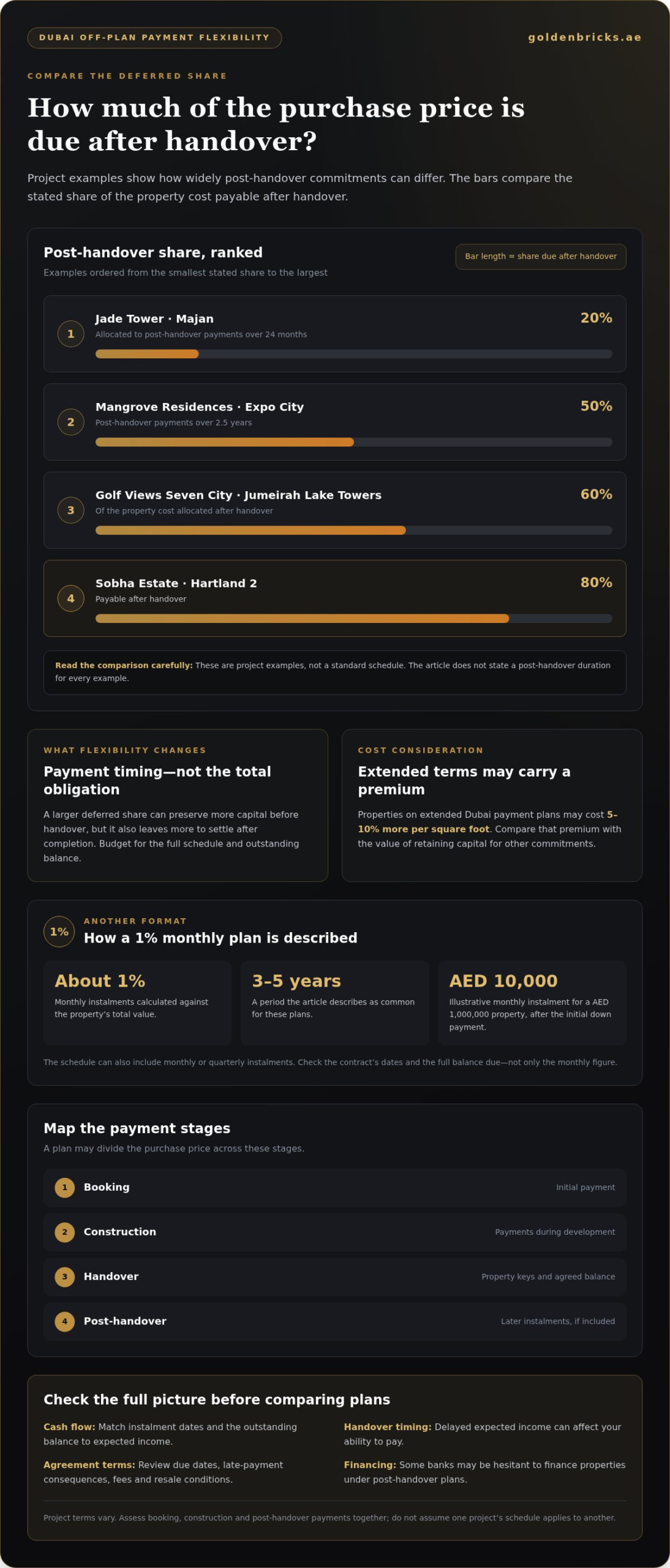
Project terms vary: Golf Views Seven City in Jumeirah Lake Towers allocates 60% of the property cost after handover, while Mangrove Residences at Expo City offers 50% post-handover payments over 2.5 years. Unlike a mortgage, a developer plan follows the agreed purchase schedule; some banks may be hesitant to provide mortgages for properties under these plans. Investors can compare the balance due after handover with their intended holding period and rental strategy.
Missed instalments may lead to penalties, late fees or legal action by the developer. Before choosing a plan, review the due dates and consequences alongside the project’s handover timeline. A delay in expected income can affect your ability to pay.
How does a 1% payment plan work in Dubai?
A 1% plan generally means monthly instalments equal to about 1% of the property’s total value for a specified period, often 3 to 5 years. Its affordability depends on the booking payment, construction schedule and remaining balance.
Down Payments and Construction Instalments
Booking and construction instalments establish how much capital buyers commit before handover. Dubai plans commonly require 10% to 20% at booking, while construction payments may cover 40% to 60% of the price. One example divides a purchase into 10% at booking, 50% during construction and 40% after handover. This breakdown helps buyers assess cash requirements before the property produces rental income.
Payment Percentages and Instalment Periods
A 1% monthly schedule is one payment format, not a guarantee that every monthly payment equals the same share of the remaining balance. For a property valued at AED 1,000,000, an illustrative 1% instalment is about AED 10,000 monthly after the initial down payment. Compare the full timeline with the contract’s payment dates, since monthly or quarterly instalments may apply. Some UAE plans also extend beyond handover, so assess total obligations, not just the monthly figure.
Title Deeds and Handover With Payments Due
Handover and title-deed arrangements are governed by the purchase and registration documents, while unpaid instalments remain obligations under the agreement. The documents and developer’s terms determine the conditions for transfer or resale; some UAE developers restrict resale while a plan is active. Rental permissions also depend on the terms. Before relying on rental income, match expected receipts against instalment dates and ownership costs.
Rental yield is not the same as spendable income. These are distinct cases, but they illustrate why investors should compare actual rental cash flow with scheduled payments. For the operational side of rental ownership, Dubai property management is relevant to investors planning to lease their property.
Off-plan property payment flexibility
Flexible payment terms change when you commit capital, not the total purchase obligation. For an off-plan property, payments may be divided between booking, construction, handover and a post-handover period. This can preserve liquidity during construction, but you still need to budget for every instalment and the outstanding balance.
Project terms illustrate how widely these structures can differ. Golf Place II at Dubai Hills Estate is described with a 10% down payment and the remaining balance spread over 3 years after handover. Jade Tower in Majan allocates 20% to post-handover payments over 24 months. These examples show why a typical schedule should not be assumed across different purchases.
Longer timelines can help investors align payments with income, but they may affect the purchase economics. Properties on extended Dubai payment plans may cost 5-10% more per square foot. Compare that premium with the value of retaining capital for other commitments, and assess whether the instalment dates fit expected cash flow rather than relying on projected appreciation.
A developer’s payment schedule is different from mortgage financing. Some banks may be hesitant to finance UAE properties with post-handover plans, so do not assume a future mortgage will automatically cover the balance. Payment dates, resale conditions and the outstanding amount all shape your options during the plan.
Luxury and mid-market purchases both require this timeline analysis. For example, Sobha Estate in Hartland 2 is described with 80% payable after handover, while Jade Tower assigns 20% to post-handover payments. A larger deferred share can preserve more upfront capital, yet it also leaves more to settle after completion. Compare the initial commitment, construction instalments and post-handover obligations together before judging which plan offers useful flexibility.
Do Dubai post-handover payment plans include interest or extra fees?
Dubai plans do not have one universal cost structure. Some are interest-free, while others include service fees. Distinguish interest on deferred payments from other charges: an interest-free schedule can still involve additional costs. The signed agreement sets the applicable terms.
Assess the full payment obligation, not only the advertised instalment. Review the agreement for whether interest applies, how any service fee is calculated, when charges fall due, and whether the stated purchase price includes them. Dubai handover fees typically range from 1% to 5% of the property value, so include handover-related costs in the overall cash-flow assessment.
Compare the payment schedule with your purchase timeline. A plan may defer part of the price until after handover, but instalments remain due on the dates stated in the agreement. A longer schedule changes payment timing; it does not mean the plan is interest-free or free of other costs. Read the payment terms alongside the clauses on fees and default.
Missed post-handover payments may result in penalties, late fees or legal action by the developer. The agreement governs the consequences, so identify due dates, the process for addressing missed instalments and any stated charges before signing. Build your payment calendar around those terms rather than relying on projected rental income or a later sale to cover a due amount.
For a disciplined comparison, record the purchase price, each instalment, handover costs, service fees and any interest in one cash-flow schedule. This makes it easier to compare two Dubai projects on their total obligations and payment timing, rather than headline percentages alone. Explore Dubai off-plan property opportunities as part of your investment comparison.
Golden Bricks Real Estate: Exclusive Off-Plan Projects
Golden Bricks Real Estate offers exclusive off-plan projects for buyers assessing how a development’s payment schedule fits their investment priorities. Its project curation helps narrow the selection by project, unit type and purchase timeline. This can help when comparing off-plan opportunities with different handover schedules and payment structures.
If immediate occupancy is a priority, consider exclusive ready properties. After purchase, Golden Bricks’ property management service supports owners with the ongoing oversight of their property. These offerings serve different stages of ownership, from assessing an off-plan opportunity to managing a completed asset.
For a considered discussion of off-plan options, contact Golden Bricks Real Estate.
Shape Your Next Property Decision
Next, decide what role the property should play in your wider portfolio. A post-handover payment plan for Dubai property should fit your investment horizon, liquidity priorities and ownership strategy, rather than dictate them. Consider how the commitment aligns with other planned investments and how much flexibility you want to retain after purchase.
Compare options against your priorities: location, asset type, timing and the level of ongoing involvement you expect. This can help distinguish a compelling property opportunity from a payment structure that merely appears convenient. Keep the decision grounded in the asset’s place within your broader investment plans.
Golden Bricks Real Estate can support your next property search through its available real estate offerings. Contact Golden Bricks Real Estate to discuss the direction you want to take. A considered next step can bring greater clarity to your Dubai property plans.
Frequently Asked Questions
Why Choose Post-Handover Over Traditional Financing?
A developer’s post-handover schedule can defer part of the purchase payment without making your plan depend entirely on mortgage borrowing. This may suit buyers prioritising liquidity during construction, but the unpaid balance remains a contractual obligation. Compare the schedule with your other capital commitments and income timing. A deferred payment does not reduce the property’s total purchase price.
What is a post-handover payment plan for Dubai property?
A post-handover payment plan is a developer’s arrangement that lets a buyer pay an agreed portion of the property price after handover. The contract sets the payment stages, dates and outstanding amount, so you can receive the property while still owing scheduled instalments. For investors, the key distinction is timing: possession can begin before the full purchase price has been paid.
Which Dubai developers offer post-handover payment plans in 2026?
Dubai project examples associated with post-handover plans include Celeste Tower, One by Nine, Elysian Mansions, Samana Mykonos and South Bay 1. Reported schedules allocate 30% after handover at Celeste Tower, 40% at One by Nine and Elysian Mansions, 32% at Samana Mykonos, and 30% at South Bay 1. These examples illustrate project-level structures, not a uniform developer policy.
What are typical post-handover payment plan terms and durations in Dubai?
Terms vary by project, and the duration determines how long the buyer carries the remaining purchase obligation. Dubai plans are commonly described as running 2 to 3 years after handover, while some extend to 5 to 8 years. Compare the full instalment calendar with the planned ownership period; a longer schedule can continue beyond the investor’s intended resale or refinancing timeline.
What deposit and installments are required for Dubai post-handover plans?
The booking deposit and later instalments depend on the project’s payment schedule. For example, J Haus Residences lists 10% on booking, 40% during construction, and three 10% instalments at two, five and eight months after booking. Its schedule also lists a 10-year post-handover period. Review the complete milestones together to understand which amounts fall before handover and which remain due afterward.
How do post-handover plans compare with mortgages and standard developer payment plans?
A mortgage is bank financing repaid under lender terms, while a developer plan follows the purchase agreement. Dubai mortgage examples list repayment periods of 15-25 years and interest rates of 4-6% per year. Standard developer plans generally allocate payments to the construction period; post-handover terms shift some payments beyond delivery. Compare financing costs, timing and outstanding obligations before choosing a structure.