

What if a project’s most consequential decision is made before construction begins? In property development advisory, the central challenge is not simply identifying demand. It is turning market evidence into a clear proposition before substantial resources are committed. Developers and investors may recognise the value of research yet still be unsure how advisory differs from brokerage or project delivery, and how insight should shape commercial choices.
Effective advisory connects these disciplines without confusing their roles. It helps frame the opportunity, test assumptions, position the project for its intended audience, and inform decisions as the development moves towards the market. This guide explains where advisory contributes across the project lifecycle, what evidence and decisions matter at each stage, and how to progress from an initial concept to a coherent market-facing strategy. It also considers how market intelligence, project curation, and broker engagement can support that process. The result is a practical framework for making considered decisions, not a promise of any particular sales or investment outcome.
Key Takeaways
- Understand how property development advisory dubai can connect market evidence with project positioning and commercial decisions.
- Distinguish strategic advice from project management, brokerage, legal counsel, valuation, and direct development responsibilities.
- Use a practical sequence to clarify the decision at hand, the project stage, evidence gaps, and intended advisory outputs.
- Separate established project facts from assumptions that require analysis or verification before committing resources.
- See how project curation, market intelligence, and broker engagement can inform a development’s go-to-market strategy.
What Property Development Advisory Means for Better Project Decisions
Property development advisory helps shape commercial and strategic decisions about a development by using market evidence to assess how a project could be positioned and taken forward. Development advisory is the structured use of market insight and commercial analysis to inform decisions across a property project’s lifecycle. For those exploring property development advisory dubai, it is useful to distinguish the advisory function from delivery responsibilities. An advisor can analyse an opportunity and recommend a direction, while ownership, construction, project delivery, and brokerage remain distinct responsibilities, even when a firm offers more than one of these services.
These responsibilities sit within a wider process. Real estate development coordinates activities such as design, financing, approvals, construction, and marketing. Advisory focuses on the strategic and commercial questions that help shape decisions around that process. Early assumptions about who the project is for, what differentiates it, and whether its proposition is commercially coherent can influence design priorities, the intended buyer or tenant, and the eventual market approach. Testing those assumptions early helps decision-makers identify where more evidence is needed, before choices become harder to revisit.
What does a property development advisor actually do?
An advisor starts by framing the decision: is the client assessing a concept, refining an existing proposition, or preparing a market launch? The work then connects relevant evidence to that question. Market intelligence can clarify demand signals and competing propositions. Project curation can help articulate the development’s defining qualities. Commercial strategy can translate those findings into positioning and market-facing choices.
The value lies in connecting these disciplines, rather than presenting research as an end in itself. For example, if an initial concept appears to serve several audiences, analysis can help the client compare their needs and decide which proposition merits further development. Recommendations inform the decision, but the client remains accountable for choices about ownership, investment, design, and delivery. Advisory supports judgement; it does not replace it.
Who uses development advisory and when?
Developers may use advisory when assessing a concept, reconsidering a project’s position, or preparing how it will be introduced to the market. Investors can use market context to support more informed commercial discussions, while brokers may use a clearer proposition to communicate a project’s intended audience and distinguishing features. In each case, the purpose is to strengthen the quality of the discussion, not to guarantee a particular outcome.
The questions evolve as the project advances. At concept stage, decision-makers may need to examine the intended audience and the logic of the proposition. As plans develop, attention can shift to how the project compares with alternatives and whether its positioning remains consistent with available evidence. Near market introduction, channel alignment and broker engagement may become more relevant. The appropriate depth of analysis depends on the project’s stage, asset type, and client objectives.
For property development advisory dubai, this decision-led perspective offers a practical starting point: define the commercial question before commissioning analysis, then connect each recommendation to a choice the project team must make. Market insight is most useful when it informs a specific decision and keeps responsibilities clear.
How Property Development Advisory Connects Market Evidence to Strategy
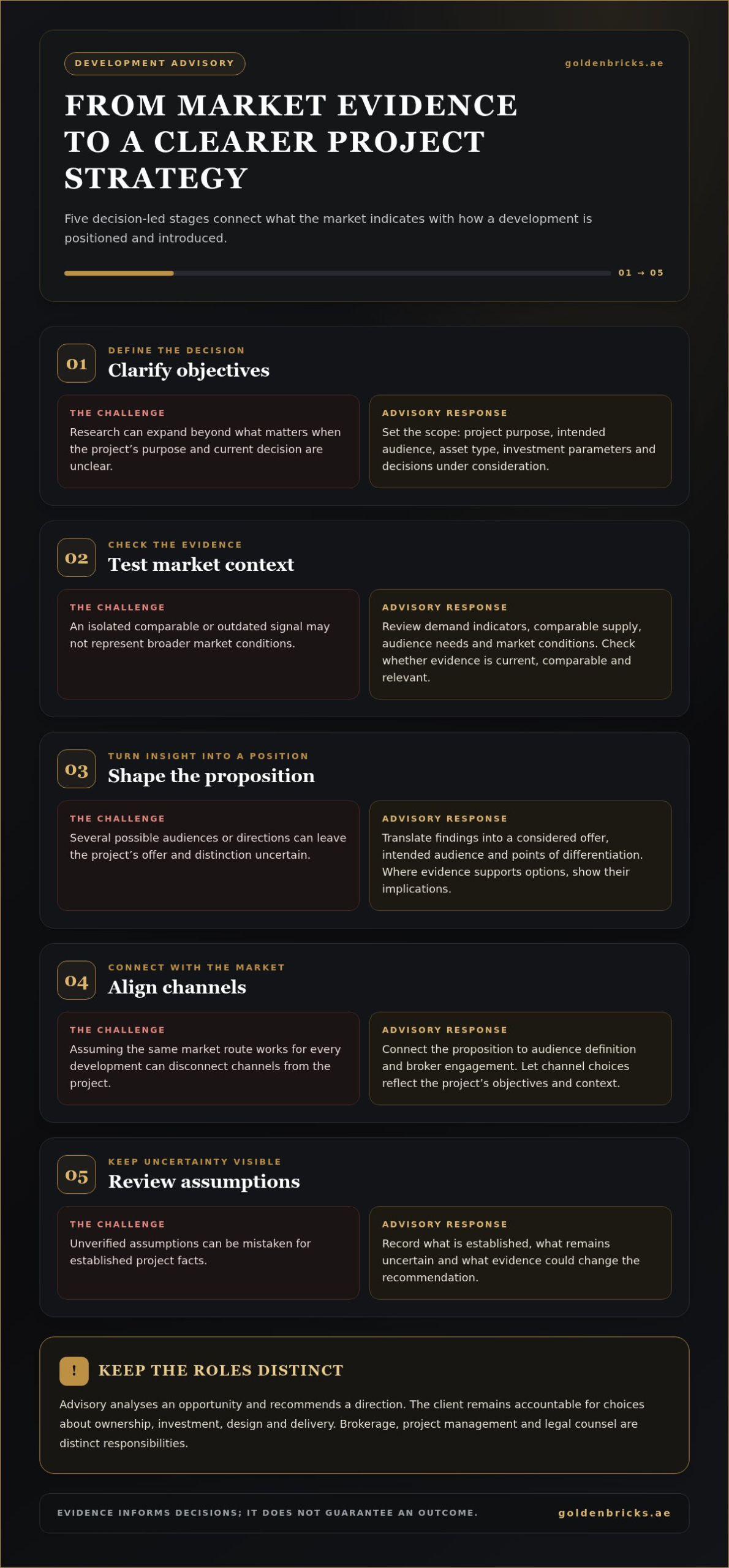
Market research becomes strategically useful when it is tied to a defined choice. Market evidence is useful when it changes or validates a defined project decision. For property development advisory dubai, that means moving from information to a reasoned position: what the project is intended to achieve, which audience it should serve, and how its proposition can be brought to market. The sequence below links evidence to action while keeping assumptions visible rather than presenting them as certain forecasts.
- Clarify objectives. Establish the project’s purpose, intended audience, asset type, investment parameters, and the decisions currently under consideration. This gives the analysis a clear scope and prevents research from expanding into findings that do not affect the project.
- Test market context. Review relevant demand indicators, comparable supply, audience needs, and market conditions. Assess whether the evidence is current, comparable, and relevant to the project rather than treating isolated examples as proof of a wider trend.
- Shape the proposition. Translate findings into a considered position on the project’s offer, intended audience, and points of differentiation. Where evidence supports more than one direction, present the options and their implications for the client to assess.
- Align channels. Connect the proposition with audience selection and broker engagement. The structure of market channels should reflect project objectives and context, not an assumption that the same route suits every development.
- Review assumptions. Record which inputs are established, which remain uncertain, and what evidence could change the recommendation. Revisit the analysis as project plans or market conditions evolve.
From market intelligence to a development proposition
Useful analysis considers demand indicators alongside comparable supply and the needs of the audience the project seeks to reach. Together, these inputs can inform decisions about asset mix, positioning, and differentiation. For instance, if comparable offerings appear to cluster around similar features, that pattern may prompt the team to test whether a distinct proposition is credible and relevant. It does not, by itself, establish demand or predict performance. Quantitative claims and current market datasets should be dated, sourced, and verified before publication or use in a decision paper.
From proposition to go-to-market planning
Once the proposition is defined, audience selection and broker engagement can be aligned with its commercial purpose. The appropriate channel structure depends on the project’s goals, target audience, and available evidence. Launch timing and sales-performance expectations should remain conditional on relevant, current analysis; neither should be presented as assured. This keeps the market plan credible and gives stakeholders a basis for reviewing it if assumptions change.
The depth of work should be proportionate to the project stage, asset type, and client objectives. At an early concept stage, the priority may be testing the audience and core proposition. Closer to launch, attention may turn to how that proposition is communicated through relevant channels. A concise record of the decision, evidence, options, and unresolved assumptions helps stakeholders distinguish analysis from forecast. Teams considering how market insight and broker engagement fit together can explore Golden Bricks’ market positioning.
Development Advisory Compared with Project Management, Brokerage, and Legal Advice
Property development brings together commercial judgement, delivery coordination, transaction expertise, legal analysis, and valuation. These disciplines may inform one another, but they do not perform the same function. In property development advisory dubai, clarity about scope helps a client understand which decisions strategic advice can inform and which require separate professional, technical, legal, or statutory input.
The comparison below describes typical roles. Actual responsibilities and outputs depend on the engagement, project requirements, and professionals appointed.
| Discipline | Primary purpose | Typical outputs | Accountable decision-makers |
|---|---|---|---|
| Strategic development advisory | Inform commercial direction and project positioning. | Market analysis, options, positioning recommendations, and documented assumptions. | The advisor is responsible for its analysis and recommendations; the client retains project and investment decisions. |
| Project or development management | Coordinate defined delivery activities and oversight. | Plans, coordination, progress reporting, and management of agreed workstreams. | The appointed manager is accountable for its defined duties; the client retains the responsibilities assigned to it. |
| Brokerage | Support property transactions and market distribution. | Buyer, seller, or tenant engagement and transaction-related activity. | The broker is accountable for brokerage duties; the client makes its commercial decisions. |
| Valuation | Form an opinion of value within an agreed scope. | A valuation opinion based on the relevant assignment and evidence. | The valuer is responsible for the opinion; the client determines how it informs wider decisions. |
| Legal counsel | Advise on legal questions and documents. | Legal analysis, advice, and relevant documentation. | Legal counsel is responsible for legal advice; the client retains its project decisions. |
Strategic advisory versus project and development management
Strategic advisory asks whether the project’s commercial direction and market position are coherent. Management focuses on coordinating delivery against an agreed scope, which may include oversight of defined activities. An advisor might assess whether a proposed proposition aligns with intended audiences; a project manager may coordinate workstreams once direction is set. The precise boundary depends on the engagement, so responsibilities should be explicit from the outset.
Advisory versus brokerage, valuation, and legal counsel
Brokerage brings a transaction and distribution perspective, including market-facing engagement. That insight can contribute to strategy, but brokerage alone does not determine a project’s overall positioning. Valuation addresses an opinion of value, not every question about audience, differentiation, or commercial direction. Legal counsel handles legal issues beyond a commercial advisor’s remit. These roles can collaborate while retaining their distinct expertise.
For example, market analysis may identify a question about the project proposition, a valuation may address a defined value question, and legal counsel may assess related legal matters. None should be treated as a substitute for the others. Strategic advice can help organise the commercial questions and connect relevant inputs, while technical assessments, legal advice, statutory processes, and delivery oversight remain with the appropriate accountable parties. Clear boundaries make collaboration more productive and keep responsibility for each decision visible.
Assessing Development Advisory Needs Before Committing
Before commissioning analysis or committing further resources, define the decision the work needs to inform. A broad request to “review the project” can produce information without resolving whether to refine the concept, reconsider its intended audience, or prepare for a market launch. A focused advisory brief names the decision, evidence gap, and expected output. This gives the work a clear purpose and makes its usefulness easier to assess.
Start with a concise set of working materials: the current concept brief, stated project objectives, available market research, and any existing plans or positioning documents. These provide context, but they should not all be treated as equally established. Label confirmed project facts separately from assumptions, estimates, and questions that need analysis or verification.
Define the decision and evidence gap
Clarify what choice is pending and what evidence could change the preferred option. For example, a team considering whether to retain its current audience may need to understand audience needs and comparable supply before settling its proposition. Identify gaps precisely rather than asking for research in general.
- Demand: Which indicators are relevant to the intended audience and asset type?
- Positioning: What comparable offerings are available, and where might the project be distinct?
- Channels: What is known about reaching the intended audience and engaging brokers?
- Boundaries: Which conclusions require separate technical, legal, valuation, or statutory expertise?
This last distinction matters. Commercial analysis can frame questions and inform options, but it should not stand in for specialist assessment where a decision depends on technical or legal judgement. A clear brief identifies those boundaries rather than implying that one advisory exercise can resolve every project issue.
Set useful outputs and review points
Specify what decision-ready work should contain. Depending on the project stage and objectives, useful outputs may include a concise account of relevant findings, strategic options with their implications, and a record of assumptions that remain untested. The aim is not to create certainty where the evidence does not support it. It is to make the basis for each recommendation visible.
Agree review points around meaningful project decisions, such as when the proposition is being refined or market-facing plans are being prepared. At each point, record what has changed, which assumptions still hold, and whether new evidence affects the preferred course. This makes the work a decision aid rather than a static report.
Keep measures tied to the project’s objectives. A forecast is an assumption-based view, not a guarantee; a single metric should not replace a broader assessment of commercial priorities. In property development advisory dubai, disciplined scoping helps distinguish what is known from what still needs to be tested before stakeholders act.
For a project shaped by market evidence and positioning, explore Golden Bricks’ market intelligence and project curation.
How Golden Bricks Connects Property Development Advisory with Market Positioning
Market insight has greatest commercial relevance when it helps shape a project’s position and the way that position reaches its intended audience. Golden Bricks Real Estate connects project curation, market intelligence, broker community engagement, and go-to-market strategy to support this process. Its role is advisory and market-facing: Golden Bricks Real Estate is a real estate firm, not a direct construction developer. For stakeholders considering property development advisory dubai, this distinction clarifies how commercial insight can contribute to a development without taking on ownership or construction responsibilities.
Connecting project curation with market context
Project curation brings a development’s characteristics into focus alongside market understanding and the audiences it is intended to serve. Market intelligence helps decision-makers consider how the proposition relates to comparable supply, audience priorities, and relevant conditions. Rather than treating every feature as equally important, a curated position clarifies which attributes have a meaningful role in the project’s market identity.
That process is evidence-led, not formulaic. An asset mix or positioning that suits one project brief may not suit another. Recommendations depend on the project’s characteristics, objectives, and available evidence. For instance, if a development has several potential differentiators, analysis can help stakeholders assess which ones are most relevant to the intended audience and how to communicate them coherently. It informs the choice, while the project’s decision-makers remain accountable for the final direction.
Bringing commercial channels into the advisory conversation
A clear proposition also provides a stronger basis for distribution planning. Broker community engagement can bring market-facing perspectives into discussions about how a development is presented and which channels align with its intended audience. This connects strategy with commercial communication: the proposition guides the message, while project goals and market context inform the channel structure.
Brokerage across ready and off-plan property can add practical context to those conversations. It does not establish that a launch will achieve a particular level of interest or sales performance. Instead, broker engagement can help stakeholders consider whether the project’s positioning is clear, what information is needed to represent it accurately, and how market feedback may inform subsequent decisions.
In practice, the capabilities work together as a considered sequence: market intelligence informs the understanding of context; project curation helps shape the proposition; and broker engagement contributes to go-to-market planning. The appropriate focus depends on the project brief and evidence available. As plans develop, stakeholders can use this connected perspective to examine whether the market-facing story remains consistent with the project’s intended audience and commercial objectives.
For developers and investors seeking a disciplined link between project context and market positioning, explore Golden Bricks Real Estate advisory and real estate services.
Put the Next Development Decision on a Clearer Footing
Apply a decision framework to the project’s immediate priorities. Before committing resources, agree on who owns the decision, what evidence would change the preferred direction, and when the choice should be reviewed. This creates a clear reference point as project information develops, helping stakeholders respond to new evidence without losing sight of the original objectives.
For teams considering property development advisory dubai, the value lies in making each strategic choice traceable to its rationale. A well-framed decision can support focused discussions between developers, investors, and commercial partners, while keeping responsibility and assumptions visible. It also gives the project a basis for adapting its market position as circumstances evolve, rather than relying on momentum alone.
Golden Bricks can bring a market-informed perspective to these considerations through project curation, market intelligence, and broker engagement. Explore Golden Bricks’ property advisory and real estate services to discuss your project’s market positioning.
Frequently Asked Questions
When should a developer bring in property development advisory?
Bring in advisory when a commercial decision could materially shape the project’s direction, ideally before key assumptions become difficult to revisit. That may be during concept assessment, when considering a change to an existing proposition, or ahead of a market launch. For example, if the intended audience is still unclear, a focused review can help assess whether the current concept and market evidence support that choice before communications are finalised.
Can an advisor support a project that already has a design?
Yes. An existing design can provide useful context for reviewing the project’s intended audience, market position, and commercial presentation. Advisory may identify questions for the project team to consider, such as whether the design’s defining features are clear to prospective buyers or tenants. Any proposed design changes remain subject to the client’s direction and appropriate design or technical review; commercial analysis does not itself validate technical feasibility.
Does property development advisory include construction management?
Is a feasibility study the same as property development advisory?
No. A feasibility study usually examines whether a defined proposal appears viable against specified assumptions and criteria. Development advisory is broader in purpose and may address positioning, audience, market context, and commercial strategy as a project evolves. The scopes can overlap: a feasibility assessment may inform advisory recommendations, while advisory work may identify the need for a separate, more detailed feasibility analysis. The agreed brief determines the work and conclusions.
What should a developer prepare before an advisory discussion?
Prepare a concise project brief stating the decision under consideration, project stage, objectives, and intended audience, alongside available concept or design materials. Include existing market research and note its source and date where known. A short list of assumptions, unresolved questions, and options already under consideration is also useful. This helps distinguish established information from items that need further analysis and keeps the discussion focused on decisions the project team can act upon.
Can property development advisory guarantee sales or investment returns?
No. Advisory can organise evidence, assess strategic options, and make assumptions more visible, but it cannot guarantee buyer demand, sales, yields, or investment returns. Outcomes depend on factors that may change, including market conditions and project decisions. Treat forecasts as conditional estimates tied to stated inputs, not promises. A sound recommendation should explain its basis and limitations, so stakeholders can make informed decisions and reassess their position as circumstances evolve.