

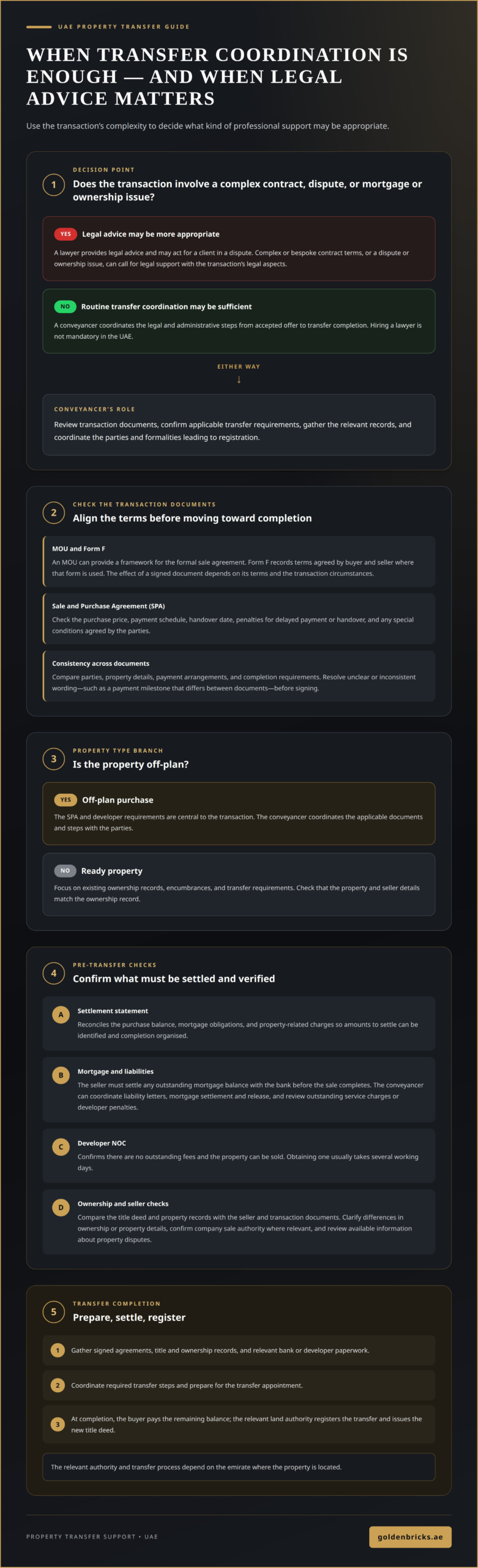
A conveyancer coordinates the legal and administrative steps of a property transfer; a lawyer provides legal advice and may act for a client in a dispute. Understanding the role of a conveyancer in UAE property deals means knowing that hiring a lawyer is not mandatory, though legal support can assist with a transaction’s legal aspects.
It’s reasonable to expect the distinction to matter most when a contract, mortgage or ownership issue makes a transaction more complex. This guide explains what conveyancing involves across the UAE, including document checks, title deed verification, encumbrances and transfer coordination, and clarifies when a lawyer’s advice may be more appropriate.
You’ll also learn how the process can differ between cash and financed purchases, and how a conveyancer coordinates the parties and formalities leading to registration. This provides a clearer basis for deciding what support fits your transaction.
Key Takeaways
- Map the transaction’s stages and identify where bank, developer or transfer requirements may affect timing.
- Understand how the MOU and sale agreement shape the parties’ obligations and the next steps toward completion.
- Learn which title, seller and liability checks can bring ownership risks or unresolved charges to light.
- Recognise when routine transfer coordination may be sufficient and when a complex contract or dispute calls for legal advice.
Q: What should I expect when hiring a professional to assist me in a real estate transaction?
A conveyancer coordinates the legal and administrative steps from an accepted offer to transfer completion. Hiring a lawyer is not mandatory in the UAE, although legal advice can help with a transaction’s legal aspects.
Conveyancer Duties and Transfer Planning
A conveyancer reviews transaction documents and plans the steps needed to transfer ownership. Buyers, sellers, banks and developers may each have requirements to meet before registration. The conveyancer gathers signed agreements, title and ownership records, and relevant bank or developer paperwork. They confirm the applicable transfer requirements and coordinate the steps from accepted offer to completion, helping the parties prepare for the transfer appointment.
Financial Settlement and Pre-Transfer Checks
A financial settlement statement reconciles the purchase balance, mortgage obligations and property-related charges before transfer. It helps the parties identify amounts to settle and organise completion. The seller must settle any outstanding mortgage balance with the bank before the sale completes. The conveyancer can coordinate liability letters, mortgage settlement and release, and review outstanding service charges or developer penalties. A developer NOC confirms there are no outstanding fees and the property can be sold. Obtaining one usually takes several working days.
Dubai Ownership Transfers and Title Deeds
A property transfer moves legal ownership into the buyer’s name through registration with the relevant land authority. The conveyancer prepares transfer documents and coordinates the required appointment and formalities. Once the authority registers the transfer, it issues the new title deed. At completion, the buyer pays the remaining balance, and the deed records the registered ownership. The relevant authority and transfer process depend on the emirate where the property is located.
Off-Plan and Ready Property Transfers
Conveyancing applies to both off-plan and ready properties, but the documents and checks differ. For an off-plan purchase, the Sale and Purchase Agreement and developer requirements are central to the transaction. For a ready property, the conveyancer focuses on existing ownership records, encumbrances and transfer requirements. Documents generally include signed agreements, title and ownership records, and relevant bank or developer paperwork. The conveyancer coordinates the applicable steps with the parties.
What is Property Conveyancing?
Property conveyancing is the process of transferring legal ownership from one person or entity to another. For buyers, understanding the role of a conveyancer in UAE property deals means knowing how contract terms and supporting documents fit into that transfer. A Memorandum of Understanding (MOU) can provide a framework for the formal sale agreement, while Form F records terms agreed by the buyer and seller where that form is used.
The legal effect depends on the document. An MOU may serve as a framework for a formal sale agreement, but its effect can depend on the transaction documents. The effect of a signed property document depends on its terms and the circumstances of the transaction. A conveyancer reviews the document for consistency in the parties, property details, payment arrangements and completion requirements before the transaction proceeds.
Reviewing a Sale and Purchase Agreement (SPA) means focusing on the clauses that set out each party’s obligations. The agreement should state the purchase price, payment schedule and handover date. It should also address penalties for delayed payments or handover, along with any special conditions agreed by the parties. For an off-plan purchase, the SPA records the buyer’s commitments and the developer’s stated obligations. Reviewing these provisions helps clarify what each party has agreed to deliver.
Contract review also means comparing the agreement with supporting documents and identifying unclear or inconsistent terms. If a payment milestone differs between documents, resolving the wording before signing can reduce uncertainty later. A conveyancer can review and draft sale agreements, while complex or bespoke terms may warrant legal advice. Understanding the role of a conveyancer in UAE property deals also means recognising that transaction coordination and legal advice are distinct forms of support.
Once the terms are aligned, the agreement provides a clearer basis for completing the remaining transaction steps and seeking any required approvals. The relevant wording depends on the property and the conditions agreed by the parties.
Title deed verification and property encumbrances
Before buying real estate in Dubai, due diligence examines the title deed, seller credentials and recorded or reported liabilities. These checks help the parties understand what ownership is being transferred and what may need to be resolved before completion.
Title Deed and Property Record Checks
Title deed verification compares the ownership record with the property and seller details presented for the transaction. The transfer must reflect the correct property and the person or entity entitled to sell it.
A conveyancer reviews the title deed and relevant property records, then checks the seller’s credentials against the transaction documents. Differences in the property description or ownership details may need clarification before transfer arrangements proceed. If a company is selling, the conveyancing process also needs to establish that the person handling the sale is authorised to act for that entity. These checks clarify the rights being transferred to the buyer.
Due diligence can also include checking for disputes connected with the property. A title document alone may not explain every issue affecting a transaction, so a conveyancer reviews available records alongside information from the seller and relevant parties. Identifying a discrepancy early gives the parties an opportunity to address it before registration.
Seller Authority and Property Encumbrances
Encumbrance checks identify financial liabilities or disputes that could affect a property transfer. Unresolved obligations can change the settlement required before the buyer receives ownership.
Examples include an outstanding mortgage, unpaid service charges and developer penalties. If a mortgage remains, the seller must settle the outstanding balance with the bank before completing the sale. A conveyancer can coordinate with the bank on liability letters, mortgage settlement and release, while reviewing service-charge and developer information relevant to completion.
The findings inform the financial settlement and transfer plan. For example, an unpaid charge may need to be cleared or accounted for before the parties proceed. A developer-issued No Objection Certificate confirms there are no outstanding fees and the property can be sold. By bringing title, seller-authority and liability checks together, the conveyancer helps the parties address issues before ownership registration.
Conveyancer responsibilities in Dubai
In Dubai, a conveyancer coordinates the administrative steps from agreed terms to property registration. Responsibilities can include confirming transfer requirements, aligning buyers, sellers, banks and developers, and preparing the trustee office appointment. This coordination matters because a mortgage release, developer approval or missing document can affect completion.
The conveyancer helps organise the transfer timetable around each party’s obligations. For a mortgage transaction, this may mean coordinating the lender, borrower and developer, arranging liability letters, and aligning settlement with the ownership transfer. The conveyancer can also oversee escrow and payment arrangements to support compliant fund transfers. Once the required documents are ready, a trustee office transfer and new title deed can often be completed within about one business day.
The Dubai Land Department regulates property ownership transfers, and the Real Estate Regulatory Agency is its regulatory arm. Trustee offices process property transfers on the Department’s behalf. The conveyancer prepares transfer documents and manager’s cheques, then supports the parties through the appointment and required formalities. This gives the process a defined administrative path, while the Department’s registration records the new ownership.
The role has limits. A conveyancer manages the property transfer process in Dubai, while a lawyer advises on the law and can act for a client if a dispute arises. A property lawyer can advise on contractual rights and obligations; only licensed advocates can represent clients before Dubai courts. Contract disputes, unusual ownership arrangements or inheritance matters may therefore require legal advice alongside transfer coordination.
Responsibilities can extend beyond registration. Conveyancing support may include coordinating Ejari, DEWA and service-charge matters after the ownership transfer. For buyers planning the next ownership phase, explore property management as a practical consideration after completion.
Golden Bricks Real Estate: Property Management
Golden Bricks Real Estate offers Property Management for owners seeking support beyond the transfer itself. Once ownership is registered, management becomes a practical consideration for overseeing a property as part of a wider investment portfolio. It may suit buyers who want continuity after acquiring a ready property, or investors planning the ongoing management of an asset.
For those still assessing an acquisition, Exclusive Ready Properties and Exclusive Off-Plan Projects provide distinct property pathways, while Project Curation supports considered selection. These offerings complement different stages of an investor’s decision-making; they do not replace legal advice on complex contracts or disputes. For a discussion of property management or investment options, contact Golden Bricks Real Estate.
Shape Your Next Property Decision
A property transfer is also a good time to consider what ownership should look like after completion. Your next decision may involve holding an asset, assessing another acquisition or deciding how it fits within a broader portfolio. Understanding the role of a conveyancer in UAE property deals helps distinguish transfer coordination from legal advice, so you can identify the support relevant to your plans.
Golden Bricks Real Estate supports property decisions through Exclusive Ready Properties, Exclusive Off-Plan Projects and Property Management. These options serve different stages, from evaluating an acquisition to planning ongoing ownership. The right direction depends on your objectives and the property’s place in your investment strategy.
When you are ready to discuss your next step, speak with Golden Bricks Real Estate. A clear plan can help bring your property decisions into sharper focus.
Frequently Asked Questions
Real Estate Lawyer or Conveyancer in Dubai: Which to Choose?
Choose a conveyancer for transaction coordination and a lawyer for legal advice or disputes. For example, a standard purchase may call for help aligning transfer documents and completion steps. If a contract contains unusual ownership terms or a disagreement arises over a party’s obligations, a lawyer can advise on legal rights and represent a client in a dispute where authorised. Some transactions benefit from both roles.
Do I need a lawyer for property transactions?
No, hiring a lawyer for a UAE property transaction isn’t mandatory. Legal advice may still be useful if you need guidance on a contract’s effect, a complex ownership structure or a disagreement with another party. For instance, a buyer considering joint ownership terms may seek legal advice while a conveyancer coordinates the administrative transfer. The right support depends on whether you need legal advice, transaction handling, or both.
How should I budget for conveyancing service in the UAE?
Set aside separate amounts for professional conveyancing and transaction charges, since they are different costs. UAE property transfer fees are typically 4% of the property value, paid to the Dubai Land Department or the relevant authority in another emirate. Conveyancing service fees vary with transaction type and complexity, especially where financing is involved. Ask for the professional fee and authority charges to be itemised separately in your transaction budget.
On what basis are conveyancing fees calculated?
Conveyancing fees depend on the work required, transaction type and complexity. A cash purchase may involve a different scope from a financed transaction requiring lender coordination, mortgage settlement and release. The buyer and seller each pay independent conveyancing fees for their part of a transfer resulting in title deed registration. A buyer’s costs may also include due diligence performed for the seller.
Shall I need assistance when purchasing a property in the UAE?
Professional assistance isn’t compulsory, but it can help coordinate documents, parties and transfer requirements. It may be especially useful when a mortgage, developer approval or outstanding property charge is involved. If you can’t attend in person, a representative can be appointed through a notarised power of attorney in the UAE. The support you need depends on the transaction arrangements and any legal questions that arise.
What is the estimated time frame I should expect when hiring a conveyancing specialist?
A UAE property transaction typically takes 30-60 days, depending on its complexity and how efficiently the parties complete their requirements. That overall period differs from the final appointment: a financed Dubai transfer with mortgage registration typically takes 60-90 minutes at the trustee office when everyone and the paperwork are ready. Bank, developer or document delays can affect the wider schedule, so distinguish preparation time from appointment duration.