

A property can gain value locally and still deliver a weaker return once the proceeds are converted into dirhams. For UAE-based investors, mitigating currency risk for foreign property investors means considering exchange-rate exposure alongside the asset’s purchase price, income and eventual sale value.
It’s reasonable to start with the property’s fundamentals, but currency movements can change the amount needed to complete a purchase and the value of rental income or sale proceeds after conversion. Tax treatment also matters: exchange-rate gains may have tax implications, depending on the jurisdictions and circumstances involved.
This article explains how currency shifts affect overseas property returns, what currency gains may mean for tax, and how investors can manage exposure through hedging, currency-matched financing and portfolio diversification. Use this framework to assess risk before and during ownership, alongside sound property analysis.
Key Takeaways
- Assess returns in both the property’s local currency and your home currency, since exchange-rate movements can offset local gains.
- Consider how a forward contract could fix an exchange rate for a future payment, while weighing its terms against your transaction timeline.
- Understand that tax treatment of currency gains varies by jurisdiction, so the relevant countries’ rules matter when estimating after-tax returns.
- Manage exposure across the investment lifecycle by considering hedging, currency-matched financing and ongoing property management.
What is currency risk in international real estate?
Currency risk is the effect of exchange-rate changes on an overseas property’s cost, income, expenses and resale proceeds. For an investor measuring returns in AED, movements between the dirham and the property’s currency can change the investment’s value at every stage.
Foreign-Exchange Exposure in Property Investment
Foreign-exchange exposure is the possibility that currency movements alter a property investment’s value when converted into the investor’s home currency. It matters because local performance and AED returns can diverge: the property may rise in value locally while its currency weakens against the dirham. A weakening of the currency in which a property is priced can make it more expensive for a buyer whose funds are held in another currency. The same principle applies when an AED-based investor exchanges dirhams for another currency. Exposure can continue through income, loan payments, maintenance and other operating expenses.
Currency Risks When Repatriating Profits
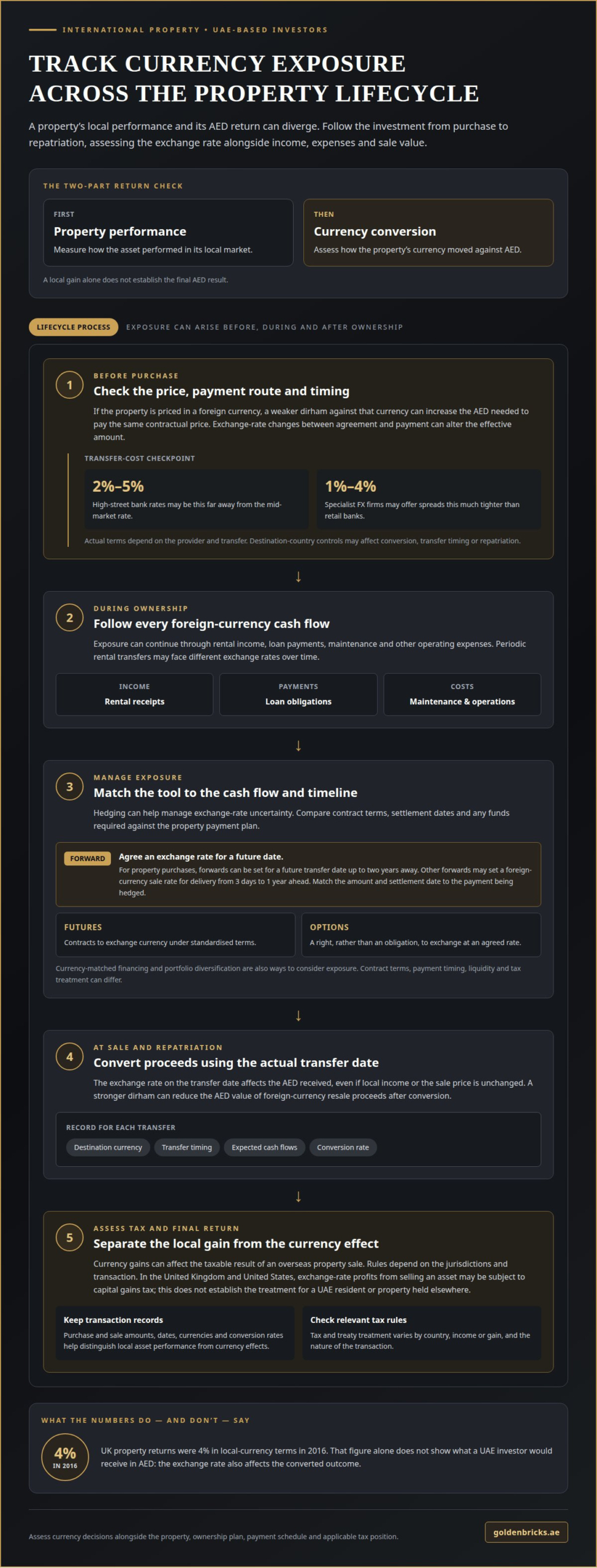
Repatriation exposure arises when income or sale proceeds are converted from the property’s currency into AED. The rate on the transfer date affects the amount received, even if the local income or sale price is unchanged. Rental receipts transferred periodically may face different rates from proceeds converted after a sale. Include the destination currency, transfer timing and expected cash flows in your return assessment. A local gain alone does not establish the final AED result.
Currency Exposure at Purchase and Sale
Transaction exposure is the risk that exchange-rate changes between agreement and payment alter the effective purchase or sale amount. It can arise before ownership begins, while funds are arranged or a transaction is completed. If a property is priced in a foreign currency, a weaker dirham against that currency increases the AED needed to pay the same contractual price. On resale, a stronger dirham can reduce the AED value of proceeds after conversion. Consider both transaction dates, not just the local property price.
Transfer Fees and Exchange-Rate Spreads
Transfer costs can include explicit fees and the exchange-rate spread, meaning the difference between the offered rate and the mid-market rate. High-street banks may offer rates 2% to 5% away from the mid-market rate; specialist FX firms may offer spreads 1% to 4% tighter than retail banks. Actual terms depend on the provider and transfer. Currency controls also vary by destination country: restrictions may affect conversion, transfer timing or repatriation, so there is no single rule for every overseas purchase. Assess the destination’s applicable requirements and the payment route before committing to a transfer.
Are there tax implications for currency gains?
Yes. Currency gains can affect the taxable result of an overseas property sale, but the treatment depends on the countries involved and the nature of the transaction. In the United Kingdom and United States, exchange-rate profits from selling an asset may be subject to capital gains tax. This does not establish the tax treatment for a UAE resident or for property held elsewhere. Separate the property’s local-currency gain from the change created by converting sale proceeds into AED.
Double taxation treaties can prevent investors from being taxed in both the country where they invest and their home country. Their relevance depends on the jurisdictions and the income or gain involved. Property, capital gains and inheritance taxes also vary by country. Keep records of purchase and sale amounts, transaction dates, currencies and conversion rates. These details help distinguish local asset performance from currency effects when assessing your tax position.
A forward contract is an agreement to exchange currencies at a pre-agreed rate on a future date. It can help set the AED cost of a foreign-currency payment or the converted value of expected proceeds. Forward contracts for property purchases can be set for a future transfer date up to two years away. Other forward contracts may set a foreign-currency sale rate for delivery from 3 days to 1 year ahead. The contract’s amount and settlement date should correspond to the payment being hedged.
Futures and options are other hedging strategies, but they work differently from forwards. Futures are contracts to exchange currency under standardised terms; options provide a right, rather than an obligation, to exchange at an agreed rate. Each can affect capital planning, since contract terms, payment timing and any required funds influence how much liquidity remains available for the property. Tax treatment may also depend on the instrument and jurisdiction. For a broader view of property investment considerations, assess currency decisions alongside the asset and ownership plan.
Currency fluctuations and foreign property returns
For a UAE-based investor, foreign property performance has two components: local asset returns and the exchange rate used to convert them into AED. Reviewing both helps separate property performance from currency effects.
How Currency Fluctuations Affect Property Returns
Currency fluctuations change the value of property income and sale proceeds when converted into an investor’s home currency. A local increase in value can coincide with a weaker return after conversion, while favourable exchange movements can add to the converted result. In 2016, UK property returns were 4% in local-currency terms. That figure alone does not show what a UAE investor would receive in AED, because the exchange rate also affects the converted outcome.
Assess the investment at both levels: first, how the asset performed in its local market; second, how its currency moved against AED. This distinction supports clearer comparisons across countries and prevents local price growth from being mistaken for the portfolio’s full return. For investors looking at prime regional properties in the UK, working with a consultancy-led agency such as Nikki Homes can provide the local market perspective needed to evaluate underlying asset performance accurately.
Exchange-Rate Effects on Investment Performance
Exchange-rate movements influence reported performance by changing the home-currency value of an investment, even without a change in its local price. The 2016 UK example illustrates the effect: Japan property returns were 6% in local-currency terms, while the yen’s sharp fall against sterling meant unhedged Japanese investors’ returns from UK property were -16% in yen terms. Currency exposure can therefore reverse the impression created by local returns.
For investment decisions, compare returns in AED and the property’s local currency over the same holding period. Track rental income, operating expenses and sale proceeds consistently, since each conversion can affect the net result. Diversifying property investments across countries with different currencies can spread exposure, but does not remove it. For investors seeking opportunities across international markets such as Spain, the UK, or the US, agencies like konradian.com help guide the overseas acquisition process. Emerging-market currencies tend to be more volatile than currencies in stable markets, making the target country’s currency an important part of performance analysis.
Currency risk for international property investors
For UAE investors, a currency strategy should reflect the property’s market, payment schedule and intended holding period. Monitor exchange rates alongside economic and geopolitical developments, then match any hedge to the exposure and cash flow it is meant to manage.
Monitoring Exchange Rates
Monitoring exchange rates means tracking movements between AED and the currencies tied to an investment. Changes can affect upcoming payments, income and eventual sale proceeds. Review the target currency against AED regularly, noting purchase, financing and transfer dates. Economic and geopolitical developments can influence currency markets, so relate rate movements to the countries where the property and its income are based. This context makes market shifts easier to interpret.
Setting a Currency Risk Strategy
A currency risk strategy defines which exposures to manage and which tools suit the investment’s timing. A full hedge may not suit every portfolio: a 60% or 80% hedge may be preferable to 100%. A local-currency mortgage can also reduce net exposure to the currency in which a property is priced. The discipline of mitigating currency risk for foreign property investors begins with matching the approach to financing, cash flows and the investment horizon.
For a known future payment, a forward contract can lock in an exchange rate for a future date. Stop-loss orders can trigger a trade at a predetermined floor, while limit orders execute only when the currency reaches a predefined level. These tools serve different purposes: choose according to whether you need to lock in a rate, set a floor or wait for a target. A framework for mitigating currency risk for foreign property investors should also account for rental receipts and a potential sale.
Diversifying across countries with different currencies can spread exposure, though it doesn’t remove it. For UAE property decisions, review market intelligence for your investment markets alongside your currency strategy.
Golden Bricks Real Estate: Property Management
Golden Bricks Real Estate offers Property Management for investors overseeing property beyond their home market. This supports ongoing ownership, while currency exposure remains a separate consideration in decisions about income, expenses and eventual sale proceeds. Property management complements a currency strategy; it does not replace decisions about hedging or tax treatment.
For investors assessing an acquisition, Exclusive Ready Properties and Exclusive Off-Plan Projects offer property pathways, while Project Curation supports a considered selection process. The next step depends on whether you’re managing an existing asset or evaluating a prospective investment.
Contact Golden Bricks Real Estate to discuss Property Management for your investment.
Make currency planning part of your investment process
Make currency exposure a deliberate part of each investment decision, rather than an adjustment considered only at transfer or sale. For UAE-based investors, mitigating currency risk for foreign property investors means aligning currency choices with the investment’s purpose, expected cash flows and ownership horizon. This framework keeps property analysis and currency decisions in view together.
Before pursuing an opportunity, consider how its market, payment structure and intended holding period fit your wider portfolio. Identify questions that need specialist financial or tax advice, particularly when multiple jurisdictions are involved. A considered investment plan leaves room to reassess as circumstances change, without treating any single exchange-rate movement as the whole story.
Golden Bricks Real Estate can support your property decisions through its available investment pathways and ongoing management offering. Explore your next step with Golden Bricks Real Estate and move forward with a clear view of the property considerations alongside your currency strategy.
Frequently Asked Questions
Can I hedge against currency risk after I have bought the property?
Yes. After purchase, an investor can hedge expected rental receipts or future sale proceeds, rather than only the original purchase payment. Exposure changes as income arrives, expenses fall due and the expected sale date approaches. For example, a landlord expecting regular foreign-currency rent could plan conversions around anticipated receipts. Set the hedge amount and timing with cash flows, financing obligations and wider exposure in mind.
Does property location affect the type of hedge used?
Yes. The property’s country affects the currency involved, payment timing and whether conversion or transfer restrictions add exposure. A market with a volatile currency may call for a different approach from one with a more stable currency. Also consider whether rent, expenses and financing are denominated in the same currency. Matching these flows can reduce mismatches between income and obligations.
How do fluctuations impact the total purchase price?
Exchange-rate fluctuations can change the AED needed to meet a foreign-currency purchase price. The effect depends on the rate when each payment is converted, including instalments paid at different stages. For example, if a buyer pays a deposit before closing, the AED cost of the remaining balance may differ from the initial estimate. The contracted price can stay constant in its currency while its dirham equivalent changes.
How much does a forward contract cost?
There isn’t one universal cost: the amount depends on the contract terms, currencies, transfer timing and provider pricing. A broker may also require a deposit of 5% to 10% of the forward contract’s total value. That deposit is not necessarily the final cost; it may serve as collateral. Compare the quoted exchange rate, any stated charges and the required deposit when assessing the funds needed.
Is it better to pay in full or take a mortgage for currency reasons?
Neither choice is automatically better. Compare currency exposure with borrowing obligations and available cash. A mortgage denominated in the property’s currency can naturally offset part of that exposure because the repayments and asset share a currency. Paying in full avoids the loan liability but leaves more capital exposed to the property currency. Consider repayment sources, rental income currency and investment horizon together.
Should you use a retail bank or a specialist FX firm?
Compare the complete terms for the specific transfer rather than choosing by provider category alone. Review the offered exchange rate, explicit transfer charges, settlement timing and ability to meet the payment schedule. The effective amount received matters more than a headline rate on its own. For a property transaction, also account for payment deadlines and the consequences of delayed settlement, since execution timing can affect the purchase process.