

What if a property with the strongest advertised rental yield doesn’t deliver the most dependable income? Investors searching for a high yield rental property often start with gross yield because it offers a quick basis for comparison. Market estimates put average gross residential yields at competitive levels across the country, according to leading industry data. But that figure doesn’t show what remains after service charges, maintenance, management, vacancy and tenant turnover.
To assess a property’s income potential, test the advertised yield against the purchase price, achievable rent, recurring ownership costs and the work involved in leasing and oversight. A headline percentage can help you screen opportunities, but it is only a starting point when working with Golden Bricks Real Estate.
This guide explains how to calculate gross and net yield consistently, identify the assumptions behind a yield claim and assess risks that may erode returns. It also covers how brokerage, market intelligence and property management, including tenant relations, maintenance supervision and lease administration, can inform an investment decision. The aim is not simply to pursue the highest percentage, but to understand whether a property’s income profile suits your priorities over time.
Key Takeaways
- Distinguish rental yield from capital appreciation, total return and monthly cash flow before judging an investment.
- Compare a high yield rental property dubai opportunity using consistent rent, cost and net-income assumptions.
- Test projected income against lease evidence, recurring expenses and operational risks such as vacancy and maintenance.
- Separate verifiable documents and property observations from forecasts or promotional claims during due diligence.
- Understand how tenant relations, maintenance oversight and lease administration support ongoing ownership without guaranteeing returns.
What makes a rental property high-yield, and what the headline figure leaves out
A rental property is commonly described as high-yield when its annual rental income is large relative to the investment required to acquire it. The percentage is a useful screening measure, not a complete account of investment performance. When assessing a high yield rental property dubai opportunity, consider whether the figure reflects achievable rent, recurring costs and realistic periods without a tenant.
Yield is distinct from other measures. Capital appreciation is a change in the property’s value over time, not rental income. Total return considers income alongside changes in value and relevant costs. Monthly cash flow measures money left over during a period after income and outgoings, and may vary with payment timing and ownership circumstances. These concepts sit within broader real estate investing fundamentals, but each answers a different question.
Gross yield versus net yield: the essential distinction
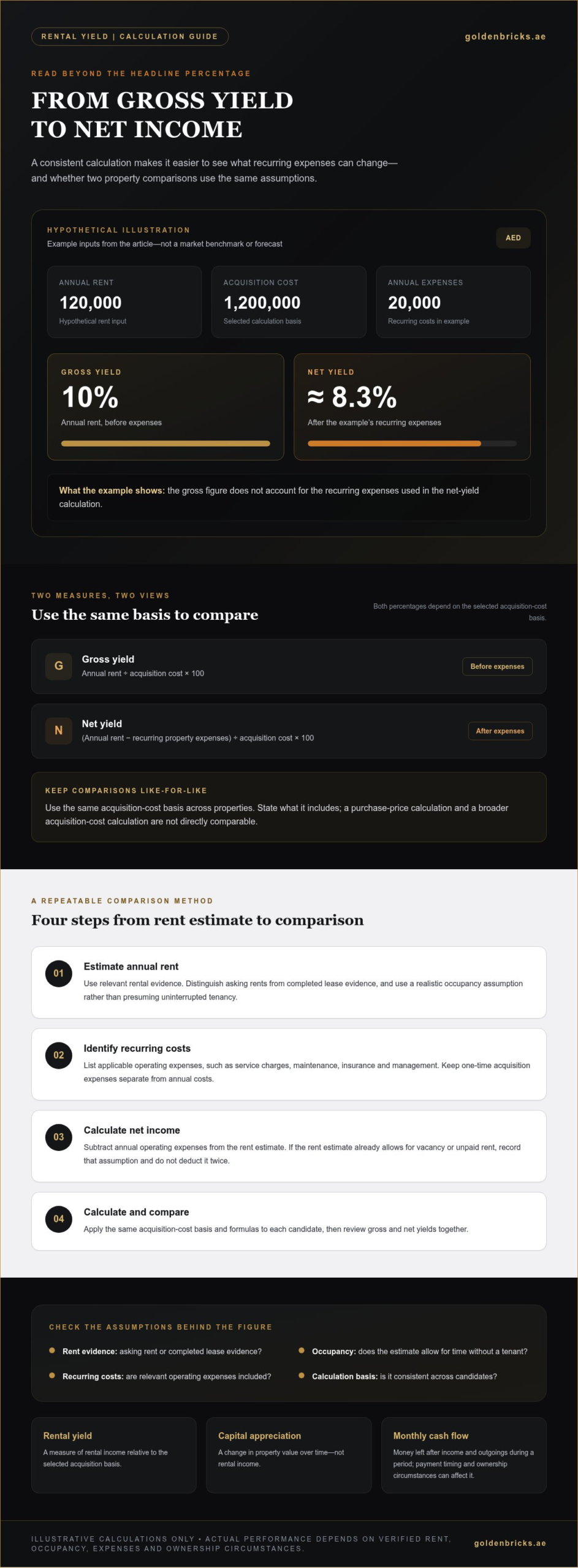
Gross yield is annual rent divided by the selected acquisition-cost basis; net yield is income remaining after relevant recurring property and operating expenses, divided by that same basis. Express either result as a percentage. For example, if a hypothetical property has annual rent of د.إ 100,000 and an acquisition basis of د.إ 1,000,000, its gross yield is 10% before expenses. This is an illustration, not a market benchmark.
The denominator matters. If one comparison uses the purchase price and another uses a broader acquisition-cost basis, the percentages are not directly comparable. Use the same basis across properties and state what it includes. For net yield, account for applicable recurring expenses such as service charges, maintenance, insurance and management costs. The relevant categories depend on the property and ownership arrangement.
Why a high headline yield can mislead
An advertised figure may use an asking rent rather than evidence of rent achieved for comparable properties. It may also assume full occupancy and timely payment throughout the year. If a unit stands vacant between tenancies, takes time to re-let, experiences tenant turnover or has unpaid rent, collected income falls below the projection. Treat a rent estimate as an assumption until it is supported by relevant evidence.
Gross yield is a starting point, not a promised outcome. Actual performance depends on verified rent, occupancy, expenses and the investor’s ownership circumstances. A useful comparison makes those inputs visible instead of presenting a single percentage without context. Before treating a property as high-yield, examine what the calculation includes, what it excludes and how the result changes if rent is lower or occupancy is interrupted.
How to calculate rental yield and compare properties on consistent terms
A reliable comparison uses a repeatable method, not a market average detached from its assumptions. For each property, use the same measurement period, occupancy approach, expense categories and acquisition-cost basis. This helps reveal whether a high yield rental property dubai claim reflects a meaningful income advantage or simply a different calculation.
A practical gross and net yield formula
Calculate gross yield by dividing annual rent by acquisition cost, then multiplying by 100. Calculate net yield by subtracting recurring property expenses from annual rent, dividing the remainder by acquisition cost and multiplying by 100. Wall Street Prep outlines how to calculate rental yield using gross and net measures.
Use this sequence for each property:
- Estimate annual rent. Base the estimate on relevant rental evidence. Distinguish asking rents from completed lease evidence, and use a realistic occupancy assumption rather than presuming uninterrupted tenancy.
- Identify costs. List recurring operating expenses such as service charges, maintenance, insurance and management, where applicable. Keep one-time acquisition expenses separate from annual costs.
- Calculate net income. Subtract annual operating expenses from the rent estimate. If your rent estimate already allows for vacancy or unpaid rent, record that assumption and do not deduct it twice.
- Calculate and compare. Apply the same acquisition-cost basis and formulas to every candidate, then review gross and net yields together.
Illustrative example only, not a market figure: if annual rent is د.إ 120,000, acquisition cost is د.إ 1,200,000 and recurring annual expenses are د.إ 20,000, gross yield is 10%, while net yield is approximately 8.3%. These hypothetical inputs demonstrate the calculation, not a forecast or benchmark.
Build a like-for-like rental property comparison
Use a simple template for each candidate: evidence for expected rent, occupancy assumption, annual recurring expenses, estimated net income, acquisition-cost basis and measurement period. Record the source and date of rent evidence, and label projections separately from documented lease information. If you use a proposed 2026 benchmark, verify it against a named, current source before relying on it.
Include one-time acquisition expenses consistently in the acquisition basis if that is your chosen method. Don’t use the purchase price as the denominator for one property and a broader cost basis for another. Keep the annual operating-cost list consistent too, while noting property-specific items separately.
Comparable assumptions matter more than headline percentages because only a like-for-like calculation shows which property may produce stronger net income under similar conditions. Market intelligence and advisory can help you examine rent assumptions and property fit before making a decision. Review rental-income assumptions as part of that assessment.
Which income, expense and risk assumptions deserve closer scrutiny?
A high gross yield does not establish a strong net result. The figure may rely on rent that has not been achieved, uninterrupted occupancy or costs that have been left out. When assessing a high yield rental property dubai, make each assumption visible and test how changes in income or expenses affect the outcome.
Income assumptions: rent, occupancy and lease continuity
Ground expected rent in recent, relevant evidence, and distinguish asking prices from completed lease information. Consider whether the property’s condition, layout and features suit likely tenants rather than assuming every advertised rent is attainable. Allow for time between tenancies and possible tenant turnover. A full-year rent projection can overstate collected income if it assumes continuous occupancy.
Use a comparison table to separate projections from costs and operational uncertainties:
| Category | Assumptions to examine | Questions for comparison |
|---|---|---|
| Income | Expected rent, occupancy, lease continuity and rent collection | Is rent supported by relevant lease evidence? Does the estimate allow for vacancy or unpaid rent? |
| Recurring expenses | Service charges, maintenance, insurance, management and applicable taxes | Which costs apply to this asset and ownership arrangement? Are estimates based on current information? |
| Operational risks | Tenant turnover, maintenance needs, leasing delays and property suitability | Could condition or management requirements affect occupancy, collected rent or costs? |
Recurring costs, regulation and downside scenarios
Expense categories aren’t universal. Service charges may differ between assets, maintenance needs depend on condition, and insurance and management costs depend on the property and ownership circumstances. Tax treatment can also vary with the investor’s circumstances. Confirm which costs apply, how often they arise and whether they belong in recurring operations or a separate acquisition-cost calculation.
Check current property, tenancy, registration and rental requirements against authoritative sources before relying on an assumption. The official land department website provides a starting point for property information. Don’t treat a projected rent increase or a registration step as established without reviewing the current applicable rules.
Build two scenarios using the same calculation method. A base case can use evidence-supported rent and expected operating costs. A cautious case might assume lower achievable rent, a longer vacancy between leases, additional maintenance or higher recurring expenses. Disclose each change instead of hiding uncertainty inside one yield figure. This comparison helps show how resilient the projected income may be, without implying a guaranteed outcome.
A due-diligence framework for assessing rental property potential
A disciplined review moves from evidence to assumptions, then tests whether the property and its operating requirements fit your investment plan. For a high yield rental property dubai acquisition, keep documents and observable facts separate from forecasts, estimates and sales language. A projected rent is not the same as a signed lease, and an advertised yield is not proof of future income.
Validate the asset, rent evidence and ownership costs
For a ready property, review its physical condition, available lease documentation and relevant ownership records. Compare the proposed rent with recent, relevant rental evidence, and establish whether that evidence reflects asking prices or completed leases. Examine current documentation for service charges and maintenance needs, then identify which costs recur and which are one-time acquisition expenses.
Use a consistent sequence:
- Verify the asset. Review property records and inspect its condition, noting issues that could affect leasing or require maintenance.
- Substantiate the rent. Compare the proposed rent with relevant evidence and clarify the intended tenancy approach. Don’t treat an optimistic asking rent as assured income.
- Document ownership costs. Review available service-charge, maintenance, insurance and management information, and identify the scope and timing of each cost.
- Check applicable requirements. Verify current UAE and relevant tenancy, registration and rental requirements using authoritative sources. Rules and obligations can depend on the asset and ownership circumstances.
- Classify each input. Mark items as verified documents, direct observations, estimates or forecasts. Keep promotional claims distinct from evidence.
Off-plan purchase terms and rental potential require particular scrutiny when assessing income. Rental income before completion is a projection, not current lease evidence. Separate documented project and delivery information from assumptions about future rent, occupancy, operating costs and the eventual leasing market. Don’t apply a ready-property income calculation as though an uncompleted asset were already generating rent.
Stress-test the investment before making a decision
Test how the result changes if achievable rent is lower than projected, a lease transition takes longer or unexpected maintenance arises. These are scenarios for assessing resilience, not predictions. Then consider whether the resulting net income profile suits your intended holding period and liquidity needs, including the possibility that the property may not produce income continuously.
Verify the rent evidence, occupancy assumption, recurring costs, property condition, lease position and ownership requirements before relying on a yield projection. Advisory and market intelligence can help bring these inputs into a consistent assessment. Discuss rental property due diligence with Golden Bricks Real Estate.
From yield analysis to ongoing rental performance
A yield calculation is a point-in-time assessment. Rental ownership is ongoing: tenant communication, maintenance decisions and lease administration all shape the information an investor has about income and costs. For a high yield rental property dubai investment, disciplined oversight helps keep actual performance visible against the assumptions used to assess the property.
How management discipline supports income oversight
Tenant relations are part of the operational picture. Clear communication and consistent handling of tenancy matters can help identify concerns early and support an orderly leasing relationship, although they can’t ensure renewal or uninterrupted rent. Maintenance supervision helps track the property’s condition, coordinate attention to reported issues and record related expenses. That information can inform future operating estimates instead of leaving maintenance as an unexamined allowance.
A considered next step for rental property investors
Before moving from analysis to acquisition, verify the rent evidence, calculate net yield using a consistent cost basis and test how the result changes under cautious assumptions. Then consider whether the expected income profile, management requirements and potential variability align with your objectives and ownership horizon.
Brokerage and market intelligence can support your assessment of property fit and rental-income assumptions. Ongoing property management can address tenant relations, maintenance supervision and lease administration once ownership begins. Golden Bricks Real Estate brings over 25 years of global industry experience to its brokerage and consultancy work, alongside investor-focused property management. The right support should complement careful analysis, not replace it.
If you’re ready to consider how an acquisition and its ongoing oversight fit your plans, discuss your rental property objectives.
Make your next rental decision with greater clarity
A sound rental investment assessment looks beyond a headline percentage. Verify achievable rent, apply consistent assumptions to gross and net yield, and test how vacancy, recurring expenses and maintenance could affect income. For a high yield rental property dubai investment, the aim is to understand the conditions behind the projected return, not treat it as a promise.
Ongoing oversight matters too. Tenant relations, maintenance supervision and lease administration help investors monitor operations and costs, while no management approach can guarantee occupancy or returns. Golden Bricks Real Estate brings over 25 years of global industry experience, with ready-property brokerage and market intelligence to inform property decisions and property management to support ownership.
Bring your income assumptions and investment horizon into a considered discussion. Discuss your rental property investment objectives with Golden Bricks Real Estate, and take your next step with greater confidence.
Frequently Asked Questions
What is a good rental yield for a property in Dubai?
There’s no universal threshold that makes a rental yield good for every investor. Assess net yield alongside the property’s condition, realistic occupancy assumptions, risk profile and your investment horizon. A percentage that looks attractive before expenses may tell a different story after recurring costs and potential vacancy are considered. Compare equivalent properties using the same calculation method, and verify current rent evidence and expense inputs before relying on projections.
How do you calculate rental yield on a property?
Calculate gross yield by dividing annual rent by acquisition cost, then multiplying by 100. To calculate net yield, subtract relevant recurring property expenses from annual rent, divide the remainder by the chosen acquisition-cost basis and multiply by 100. State which costs are included and apply the same assumptions to each property. Keep one-time acquisition expenses distinct from annual operating costs so the comparison remains consistent and clear.
What is the difference between gross and net rental yield?
Gross yield compares expected annual rent with acquisition cost before operating expenses. Net yield first deducts relevant recurring expenses, giving a more complete view of income from property operations. Neither figure captures every risk, financing choice or tax circumstance. For meaningful comparisons, use consistent rent and cost assumptions, identify the acquisition-cost basis and state what the calculation includes. Net yield is more informative, but it is still not a complete measure of investment performance.
Does a higher rental yield mean a better investment?
No. A higher projected yield doesn’t automatically make a property a better investment. Rent assumptions, vacancy, maintenance, service charges and property condition can affect the income profile, while resale considerations may influence suitability for an investor’s plans. Compare estimated net income and cautious downside scenarios, then consider whether the asset fits your holding period and liquidity needs. Treat yield as one decision measure, not guaranteed performance or standalone financial advice.
Which expenses should be included when calculating net rental yield?
Consider relevant recurring expenses such as service charges, maintenance, insurance, property management and applicable taxes. Which costs apply, and how they’re treated, can vary with the asset and ownership circumstances. Keep annual operating expenses separate from one-time acquisition costs, and review current documents and applicable rules to establish the relevant inputs. For a fair comparison, apply the same expense categories and method to each property, noting property-specific costs separately.
How can I verify expected rent before buying a rental property?
Review recent, relevant lease evidence and compare similar properties, distinguishing rents achieved from advertised asking rents. Consider condition, lease terms, likely tenant demand and the intended tenancy approach when assessing whether a proposed rent is realistic. Treat projections as assumptions, not confirmed income, and test how lower rent or a vacancy period would affect the result. Verify current information rather than relying solely on promotional claims or unsubstantiated estimates.