
In Dubai, property owners pay annual service charges toward building or community maintenance, management and upkeep. Article 25(a) of Dubai Law No. 6 of 2019 requires owners to pay their share of these charges. A clear understanding of service charges and maintenance fees also means knowing that the annual amount is generally calculated using an approved rate per square foot and the property’s applicable area.
It’s reasonable to want a clear view of what ongoing property costs cover. Service charges can fund shared-area cleaning, repairs, security, landscaping, waste disposal, management and common-area utilities, but the services included vary by development.
This guide explains what service charges fund, how Dubai’s Service Charge Index helps owners and buyers understand approved fees, and what may happen if charges go unpaid. It also shows how these recurring costs fit into wider ownership and investment decisions.
Key Takeaways
- Factor recurring service charges into purchase and rental-yield calculations to assess an investment beyond its headline price and rent.
- Understand how unpaid balances can escalate, and why keeping payment obligations current matters to property ownership.
- Use Dubai’s Service Charge Index to compare approved rates for a specific development with its location and property type.
- Assess which shared services and maintenance responsibilities sit behind a building’s charges when evaluating its ongoing operating costs.
What are Service Charges?
Dubai property service charges are annual owner payments for shared building or community upkeep. Article 25(a) of Dubai Law No. 6 of 2019 requires property owners to pay their applicable share. Rates are generally applied per square foot, so property area and building services shape the annual amount.
Costs Included in Property Calculations
Understanding service charges and maintenance fees starts with including them in your ownership-cost calculation. Add annual charges, recurring insurance and property-management expenses to your purchase assessment. To estimate rental yield, subtract operating costs from expected rent. The result is not net profit.
Management Fees and Service Charges
Service charges fund shared building operations, while property-management fees cover oversight of an individual property or rental arrangement. Across the region, real estate and property management specialists like ARW Trading assist owners with individual asset administration, whereas shared service charges specifically cover collective building upkeep. Dubai service charges may pay for cleaning, repairs, security, landscaping, waste disposal, administration and common-area utilities. A sinking fund reserves owners’ contributions for major future repairs and replacements. Keeping these costs distinct helps owners assess building expenses without confusing them with individual property management. The Dubai Land Department’s Services Fees Indicator shows approved project charges.
Annual Costs by Property Type
Annual charges depend on the applicable area, approved rate, property type and services included. Compare properties by their project rates, not size alone.
Consequences of non-payment
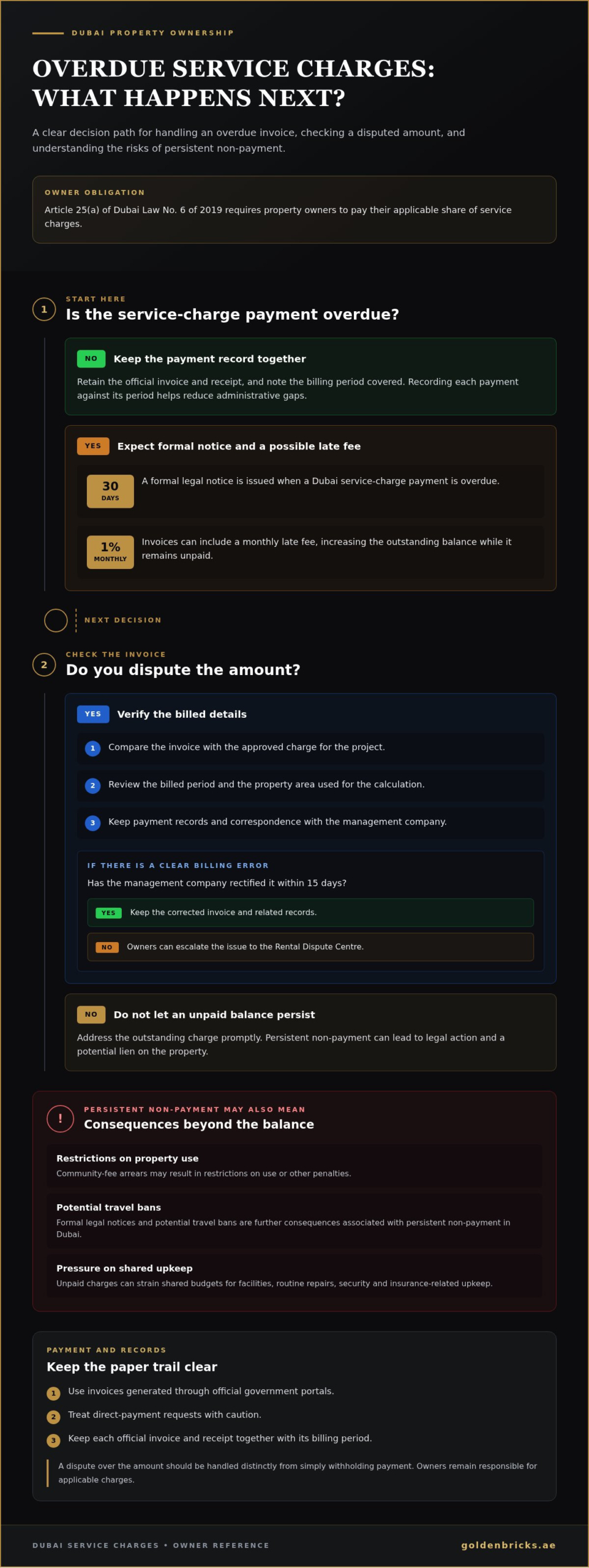
An overdue service-charge balance is more than an unpaid invoice; it can affect building upkeep and an owner’s legal position. A formal 30-day legal notice is issued when a Dubai service-charge payment is overdue. Invoices can also include a 1% monthly late fee, increasing the outstanding balance while it remains unpaid.
Persistent non-payment can lead to legal action and a potential lien on the property. Community-fee arrears may also result in restrictions on property use or other penalties. Formal legal notices and potential travel bans are further consequences associated with persistent non-payment in Dubai. Promptly addressing overdue charges matters to owners, residents and property interests.
A dispute over the amount should be handled distinctly from simply withholding payment. Compare the invoice with the approved project charge, review the billed period and area, and retain payment records and management correspondence. If a management company does not rectify a clear billing error within 15 days, owners can escalate it to the Rental Dispute Centre. This creates a documented path for addressing the discrepancy.
Pay using invoices generated through official government portals, and treat direct-payment requests with caution. Keep each official invoice and receipt together, noting the billing period covered. Unpaid charges can strain shared budgets for facilities, routine repairs, security and insurance-related upkeep. Funding shortfalls can complicate maintenance planning and affect shared areas residents use.
Property owners can reduce administrative gaps by retaining notices, invoices and receipts and recording each payment against its billing period. For rental assets, property management oversight can support organised records and recurring obligations, while owners remain responsible for applicable charges.
Dubai Service Charge Index
The Dubai Service Charge Index helps owners and prospective buyers assess approved charges for individual developments. Dubai’s Real Estate Regulatory Agency (RERA) oversees service-charge regulation, while the Dubai Land Department’s Services Fees Indicator presents approved project rates. The index is a reference for a specific building, not a universal rate for every Dubai property. Building type, amenities and operating costs all affect comparisons.
RERA requires developers and management companies to submit service-charge proposals for approval before implementation. The Mollak System supports the regulation and management of jointly owned properties and service-charge budgets. In the Services Fees Indicator, users can search by title deed number, select a project, property usage and year, or find a development on a map. Matching the year and usage keeps comparisons relevant.
Rates vary with building type and services.
Invoice items can include cleaning, maintenance, security, landscaping, waste disposal, management, administration and shared-area utilities. A sinking-fund contribution supports major future repairs and replacements. Additional services may be billed separately rather than included in the total service-charge figure. The stated VAT rate on UAE property service-charge invoices is 5%. Compare each invoice’s project, property usage, year, area and included items with the relevant index entry. If the approved rate and invoice differ, the comparison gives owners a clearer basis for follow-up action with the management agency or owners’ association.
Service charges for building maintenance and shared services
Dubai service charges fund shared building and community expenses. They can cover cleaning, repairs, security, landscaping, waste disposal, management, administration and common-area utilities. Community fees may also support amenities used by residents across a development.
Building Maintenance Expenses
Shared Community Services
Community service charges fund services and amenities shared across a development, not just within one building. Landscaping, waste disposal, security and shared-area utilities can benefit residents throughout a community. The service mix depends on the development: a community with maintained outdoor spaces has different operating needs from a single apartment block. For owners assessing rental costs, these shared expenses add to ongoing outgoings alongside insurance and individual property management.
Charges are generally calculated using an approved rate per square foot and the applicable property area. This allocates shared expenses across owners, while separate services may be billed independently. District cooling, for example, can involve recurring consumption and capacity charges outside the service-charge total. Review the invoice items to distinguish common-area upkeep from separate utility costs. This also gives rental-property owners a clearer picture of recurring expenses when assessing yield.
For a considered view of how ongoing upkeep relates to an investment, discuss property management requirements.
Golden Bricks Real Estate: Exclusive Off-Plan Projects
Golden Bricks Real Estate can help investors assess property options alongside ongoing ownership costs. Its Exclusive Off-Plan Projects and Exclusive Ready Properties give buyers options at different stages of the property market. Project Curation supports a considered comparison of development and investment opportunities, including relevant service-charge implications.
For owners planning ongoing property oversight, Golden Bricks Real Estate also offers Property Management. This can be a useful next step when considering recurring obligations, rental arrangements and building charges as part of ownership. The right conversation depends on whether you are evaluating a purchase, selecting a project or managing an existing asset.
To discuss your property requirements, visit goldenbricks.ae.
Make Your Next Property Decision with Clarity
Understanding service charges and maintenance fees can support a more disciplined property decision. Consider how an asset’s ongoing obligations fit your ownership plans, intended use and investment priorities. This helps you frame the right questions before committing, whether you are assessing a purchase or reviewing an existing holding.
Golden Bricks Real Estate offers Exclusive Off-Plan Projects, Exclusive Ready Properties and Property Management. These services can support different stages of a property journey, from evaluating a purchase to planning ongoing oversight. The focus is on finding a considered fit between the property and your objectives, rather than viewing the purchase price in isolation.
If you are weighing a property decision in the UAE, contact Golden Bricks Real Estate to discuss your requirements. A clear view of the asset and its ownership context can help you move forward with greater confidence.
Frequently Asked Questions
What is a sinking fund in Dubai property?
A sinking fund is money collected from property owners and reserved for major future repairs, replacements and capital expenditure. For example, it may fund the replacement of a substantial shared-building component rather than routine cleaning. It is a planned reserve, not another name for everyday operating expenses. Reviewing its purpose helps owners understand how current contributions support the property’s long-term condition.
What are Community Fees?
Community fees are owner contributions toward services and amenities shared across a residential community. They apply to the wider development, not just one apartment building. For instance, a gated community may budget for shared landscaping or communal facilities. The fee’s scope depends on the community’s services and ownership arrangements, so consider it alongside any separate building-level costs.
What do they cover?
Community fees can support services and amenities that benefit residents across a development, including shared outdoor spaces, landscaping and community facilities. The precise allocation depends on the services in the community’s operating budget. Compare the fee description with the facilities you use, and distinguish community-wide expenses from separately billed utilities or services tied to an individual property.
What is the difference between a general fund and a sinking fund?
A general fund pays for recurring operations, while a sinking fund reserves contributions for substantial future repairs, replacements and capital expenditure. Routine cleaning, for example, is an ongoing operating cost, while replacing a major building system is a long-term capital expense. Distinguishing the two helps owners interpret budget allocations and understand whether a charge supports current upkeep or future asset needs.
Why do two flats the same size pay different amounts?
The same floor area does not necessarily mean the same service charge. Approved rates can vary by development, property usage, amenities and services provided. A flat in a building with extensive shared facilities may have a different rate from one in a simpler block. Applicable area calculations can also affect the amount billed, so compare each unit’s project rate and invoice basis.
What are service charges and maintenance fees in the UAE?
In Dubai, these terms generally refer to owner payments for maintaining and managing shared building or community property. 6 of 2019 requires owners to pay their share of annual service charges for maintenance. Charges relate to common property, not automatically to repairs or improvements inside an individual owner’s unit, which are arranged independently through providers like MMA Maintenance & Cleaning Services. The approved budget and project determine the allocation.