
A Dubai property can be a worthwhile overseas investment, but it isn’t automatically a tax advantage. Foreign buyers may own freehold property in government-designated areas, and Dubai has no annual property tax on residential property. Budget roughly 7-10% of the purchase price for transaction costs, and factor in any tax obligations that continue in your home country when comparing investing in UAE property instead of buying there.
Dubai’s ownership framework and tax environment can make it an attractive option for international investors. But the decision involves more than the purchase price: location, total acquisition costs, intended use, and your home-country tax position all matter.
This guide covers where foreign buyers can own property in Dubai, the purchase and ongoing costs to consider, and how overseas rental income or gains may relate to home-country tax obligations. Use it to assess a cross-border investment, rather than comparing property prices alone.
Key Takeaways
- Foreign buyers can purchase freehold property in Dubai’s designated areas, so location is central to understanding ownership rights.
- According to Dubai Land Department, a property investment of AED 2 million or more can qualify for a renewable 10-year Golden Visa.
- Build transfer and other transaction charges into your investment calculation, alongside ongoing property expenses.
- Compare Dubai’s property-tax position with your home country’s rules, since overseas income and gains may still affect your tax obligations.
Is It Worth Buying Property in Dubai as a Foreigner?
Dubai may suit foreign investors seeking property exposure beyond their home market, but returns depend on the asset and how it is managed. Compare ownership eligibility, costs, rental prospects, and cross-border tax treatment before deciding.
Market Activity and Price Comparisons
Market activity measures transaction volume and value; price growth tracks changes in property values. Prices increased by an average of 4.4% during 2021. These figures offer context, not a forecast for an individual property.
Market Trends and Price Forecasts
Market trends describe recent activity, while forecasts estimate possible future direction. Dubai’s 2021 price increase and Q4 2023 transaction volume reflect different periods, so they shouldn’t be treated as a continuous growth pattern. Your home country’s trajectory may also differ by city and property type.
For a meaningful comparison, examine local supply, tenant demand, and recent prices for comparable properties in both markets. Past growth does not show what either market will deliver next.
Economic Policies, Residency, and Quality of Life
Dubai’s residency framework can form part of an investment decision. A property investment of AED 2 million or more can qualify for a renewable 10-year Golden Visa, according to Dubai Land Department. Eligibility is a potential benefit, not a substitute for assessing the property’s income and costs.
Dubai has no annual property tax on residential property. For an overseas owner, practical considerations include access to transport, healthcare, schools, and reliable property management. Weigh these against your intended use, whether rental income, personal stays, or a longer-term residence.
Vacancy, Oversupply, and Price Volatility
Vacancies can interrupt rental income, while oversupply may increase competition for tenants and pressure returns. Dubai property prices were hit hard during the 2008 crisis, demonstrating that values can fall as well as rise. Consider how your finances would withstand lower occupancy or a delayed sale.
Before buying, compare the seller’s identity, title details, project registration, escrow information, and payment terms with official records and transaction documents. For an off-plan purchase, review construction milestones and contractual delivery terms. Pause due diligence if these records contain inconsistencies.
Foreign ownership in designated freehold areas
Foreign buyers can own property in Dubai freehold areas designated by the government. The key decision is whether the specific property’s location and ownership terms align with your investment plans.
Foreign Ownership Rules
Dubai’s foreign ownership rules allow international buyers to acquire freehold property in designated areas. Ownership rights depend on the property’s location, not simply its Dubai address.
Dubai’s Freehold Law of 2002 opened designated areas to international property buyers. Foreign buyers don’t need special permission to purchase in those areas, and they can own an unlimited number of properties there. However, freehold ownership is available only in areas designated by the government.
Before proceeding, match the property’s exact location to the applicable designated-area records, then review the title and sale documents. This distinction matters when investing in UAE property instead of your home country: assuming ownership rules apply citywide can lead to a poor comparison.
Designated Freehold Investment Areas
Designated freehold areas are locations where foreign buyers can acquire property with freehold ownership. Dubai had over 60 designated freehold zones as of 2026, giving buyers a broad choice of locations and property types.
There is no single best investment area for every buyer. Compare each property’s intended use, tenant demand, access to daily amenities, and suitability for long-term ownership. An investor prioritising rental income may focus on tenant appeal, while someone buying for personal use may value proximity to work or services.
Check that the specific plot or unit falls within a designated zone; nearby properties can have different ownership arrangements. Then assess the title documents and purchase terms alongside the property’s management needs. For overseas owners, property management support can help address the practical responsibilities of holding an asset from abroad.
Property transaction costs and ongoing charges
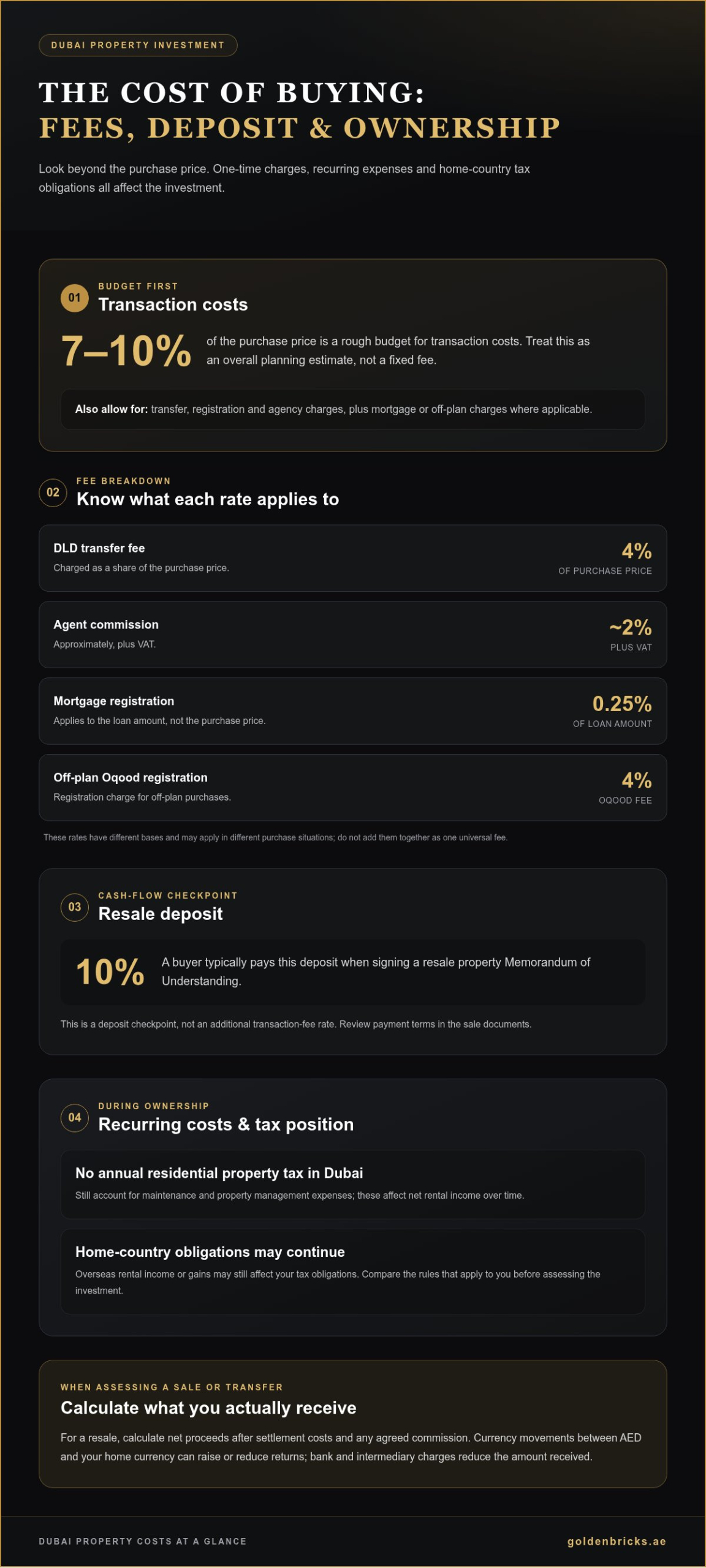
Dubai purchase costs include transfer, registration, and agency charges, plus mortgage or off-plan charges where applicable. For a resale, calculate net proceeds after settlement costs and any agreed commission. Transfer arrangements depend on the receiving bank and destination. Currency movements between AED and your home currency can raise or reduce returns, while bank and intermediary charges reduce the amount received.
Purchase Fees and Ongoing Costs
Purchase fees are one-time charges, while ongoing costs recur during ownership; both shape the investment’s total cost. Dubai’s DLD transfer fee is 4% of the purchase price, and agent commission is approximately 2% plus VAT.
Mortgage registration costs 0.25% of the loan amount. Off-plan purchases incur a 4% Oqood registration fee. A buyer typically pays a 10% deposit when signing a resale property Memorandum of Understanding. Owners should also account for maintenance and management expenses, which affect net rental income over time.
Property Taxes and Investment Costs
Taxes and ownership costs determine how much income remains after expenses. Dubai has no annual property tax on residential property, and property ownership carries no income tax, capital gains tax, council tax, or inheritance tax.
Renters are charged a 5% housing fee on rental value through utility bills. This is distinct from an owner’s purchase charges, but it matters when assessing the overall cost of renting or tenant demand. For an investment comparison, separate one-time acquisition costs from recurring expenses and any tax obligations in your home country.
Currency Exchange and Transfer Costs
Currency exchange and transfer costs affect the amount ultimately received in your home currency. When rental income or sale proceeds are converted from AED, exchange-rate movements can change their translated value, even if the property’s AED value stays the same.
Bank and intermediary charges also reduce transferred funds. Compare the amount credited after conversion, not just the exchange rate. For a sale, estimate net proceeds after applicable settlement costs, then account for transfer charges and the destination currency’s rate. This gives you a clearer basis for comparing returns across countries.
Home-country tax obligations for overseas investors
Dubai’s tax treatment is only part of the calculation. Your home country’s rules may affect rental income, sale proceeds, reporting duties, and the final return from an overseas property. Ask yourself: “Am I investing in UAE property instead of my home country for reasons that fit my tax position?” Answering means looking beyond the tax charged where the property is located.
Tax on Rental Income
Rental-income tax is the tax treatment of rent received from a property. Dubai property ownership carries no income tax, but your home country may tax foreign rental income under its own rules.
If you remain tax-resident in your home country, its rules may require you to report Dubai rental income. The result depends on local residency tests, rules for overseas income, and allowable deductions. Keep rental statements, management invoices, maintenance records, and bank-transfer documents together. These records help separate gross rent from expenses when preparing a home-country tax return and document income received in AED.
Tax on Capital Gains
Capital-gains tax applies to profit made when a property is sold. Dubai property ownership carries no capital gains tax, but your home country may tax a gain under its domestic rules.
The calculation may depend on purchase cost, eligible improvement expenses, sale proceeds, and your tax status. Keep the purchase contract, transfer documents, renovation invoices, and sale statement to document the transaction. A gain measured in AED may look different after conversion into your home currency, so retain exchange records with the sale paperwork.
For both rent and sale gains, distinguish the UAE tax position from your home-country obligations. Any applicable treaty depends on the countries involved and the type of income. Don’t assume that the absence of Dubai income or capital-gains tax removes reporting duties at home.
Golden Bricks Real Estate: Exclusive Off-Plan Projects
Golden Bricks Real Estate helps investors assess Dubai property options through project curation, Exclusive Off-Plan Projects, and Exclusive Ready Properties. These services are useful after you have considered ownership rules, transaction expenses, and home-country tax obligations, and are ready to compare properties against your investment objectives.
For an off-plan purchase, project curation helps structure comparisons around location, intended use, and fit with your investment strategy. For a completed property, Exclusive Ready Properties offer a way to consider existing assets. Property Management helps owners oversee property responsibilities from overseas.
To discuss property options aligned with your investment priorities, contact Golden Bricks Real Estate.
Make Your Next Property Decision With Clarity
Choosing an overseas property also means deciding how actively you want to manage an asset across borders. Consider its role in your wider portfolio, the level of involvement you prefer, and how well it aligns with your long-term priorities. If you are investing in UAE property instead of your home country, that strategic fit matters as much as the individual property.
Golden Bricks Real Estate offers Exclusive Off-Plan Projects and Exclusive Ready Properties for investors weighing different acquisition routes. Its Property Management service helps owners oversee a Dubai asset from abroad. Define your objectives, then compare suitable options against them.
Explore property opportunities with Golden Bricks Real Estate and take a considered step toward your investment goals.
Frequently Asked Questions
What are the costs of buying property in the UAE, including transfer fees, agent fees, and service charges?
For a Dubai purchase, budget for the 4% transfer fee, agent commission of approximately 2% plus VAT, and applicable registration charges. Service charges depend on the property and building, so include them in your ownership budget rather than treating them as part of the transfer. For example, compare building charges alongside expected rent when assessing two similar units.
Which UAE emirates and areas allow foreign nationals to buy freehold property?
In Dubai, foreign nationals can buy freehold property only in government-designated areas, which numbered over 60 as of 2026. Freehold designations are emirate-specific, so a Dubai designation does not establish ownership rights elsewhere in the UAE. Check the precise emirate, area, and property before proceeding; a nearby address may not have the same ownership status.
What are the UAE rules for foreign property ownership and residency visas?
Foreigners may purchase freehold property in Dubai’s designated areas without special permission. A Dubai property purchase of AED 750,000 or more can qualify for a renewable two-year investor property visa. According to Dubai Land Department, an investment of AED 2 million or more can qualify for a renewable 10-year Golden Visa. Ownership and visa eligibility are separate considerations.
What financing options and mortgage requirements apply to foreign property buyers in the UAE?
Non-resident foreign buyers are typically capped at around 50-60% loan-to-value on a first property, so plan for substantial equity alongside purchase costs. Lenders assess the applicant’s income, liabilities, and the property used as security. Dubai mortgage registration costs 0.25% of the loan amount. Compare the borrowing structure with a cash purchase, including how repayment affects expected rental cash flow.
What are the steps to buy and rent out property in the UAE as a foreign investor?
What are UAE property prices and rental yields compared with my home country?
There is no universal price or rental-yield comparison with your home country. Compare similar locations and property types, accounting for vacancy, maintenance, and management costs. Past price growth is not a forecast.