

A property manager isn’t the only alternative to managing a block yourself. Self-management means leaseholders handle maintenance, finances and administration; alternatives to DIY property management include sharing duties among owners, using software to organise operations, or appointing a property manager. The right setup depends on the block’s workload and how much oversight owners want to retain.
Managing a property directly can preserve control, but owners must also coordinate the work and see it through. This can become difficult as maintenance, resident communication and financial administration increase. A management firm can handle day-to-day responsibilities, while a limited or hybrid arrangement lets owners retain selected decisions—an approach often seen with residential specialists such as Winfields Block Management, who coordinate block operations on behalf of freeholders and resident management companies.
This guide compares practical options for UAE apartment blocks, including their benefits and limitations. You’ll see what self-management involves, where manual processes become demanding, and how professional property management differs. Use the comparison to identify an approach that fits your block’s responsibilities and your preferred level of involvement.
Key Takeaways
- Compare owner-led coordination, shared responsibilities, software support and professional management against your block’s actual workload.
- Keep maintenance requests, repair decisions and follow-up in a consistent tracking process to reduce overlooked tasks.
- Assess whether leaseholders have the time and clear arrangements to manage finances, administration and resident communication themselves.
- Use organised records for income and expenses so financial reporting and tax preparation are easier to manage.
- Consider a property manager when day-to-day coordination is taking significant owner time or the block requires more consistent oversight.
Maintenance tracking and repair coordination
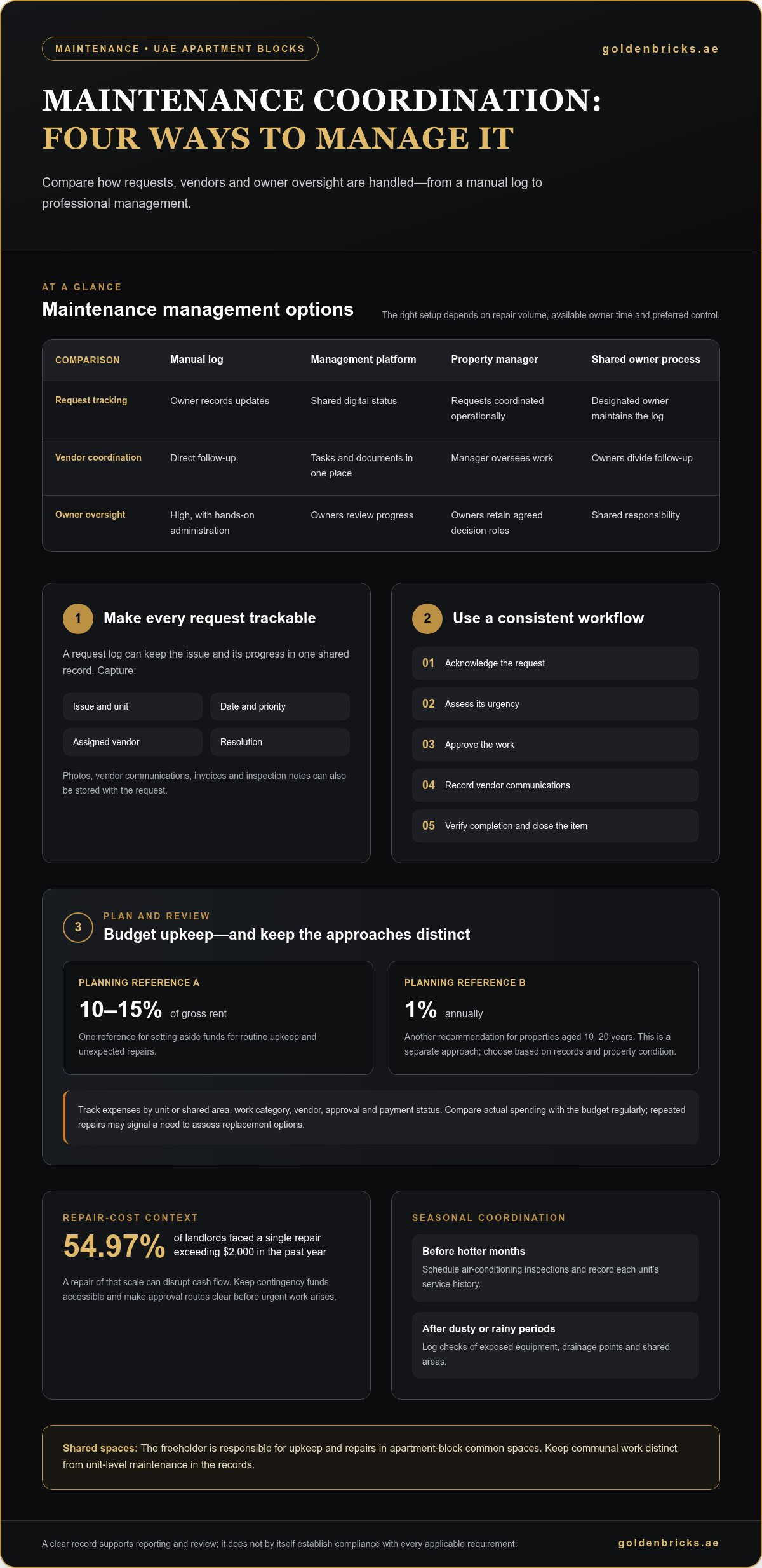
Online property management platforms and apps let owners log maintenance requests, attach photos, assign tasks to vendors and track progress in one shared record. In the UAE, they can centralise coordination, but owners still need to define who approves work and reviews its completion.
Maintenance Requests and Vendor Tracking
A request log can record the issue, unit, date, priority, assigned vendor and resolution. For example, a tenant can report an air-conditioning fault with a photo; an owner assigns a technician and records the outcome. This makes responsibility visible, unlike scattered messages or separate spreadsheets, where updates can be missed.
Use a consistent workflow: acknowledge each request, assess its urgency, approve the work, record vendor communications and close the item after completion. A platform can send status notifications and store invoices or inspection notes. These records support reporting and review, but do not by themselves establish that a property meets every applicable requirement.
Seasonal planning can reduce reactive coordination. Before hotter months in the UAE, owners can schedule air-conditioning inspections and record each unit’s service history. After dusty or rainy periods, they can log checks of exposed equipment, drainage points and shared areas. A calendar linked to the request log helps distinguish scheduled servicing from tenant-reported faults.
Maintenance Costs and Budgeting
A maintenance budget sets aside funds for routine upkeep and unexpected repairs. One planning reference allocates 10-15% of gross rent for property upkeep. For properties aged 10-20 years, another recommends budgeting 1% annually for maintenance. These are separate planning approaches, so owners should apply the one suited to their records and property condition.
Track each expense by unit or shared area, work category, vendor, approval and payment status. Compare actual spending with the budget at regular intervals; repeated air-conditioning repairs, for example, may signal a need to assess replacement options. For apartment-block common spaces, the freeholder is responsible for upkeep and repairs, so records should distinguish communal work from unit-level maintenance.
| Option | Request tracking | Vendor coordination | Owner oversight |
|---|---|---|---|
| Manual log | Owner records updates | Direct follow-up | High, with hands-on administration |
| Management platform | Shared digital status | Tasks and documents in one place | Owners review progress |
| Property manager | Requests coordinated operationally | Manager oversees work | Owners retain agreed decision roles |
| Shared owner process | Designated owner maintains the log | Owners divide follow-up | Shared responsibility |
Choose an approach that matches the block’s repair volume, owners’ available time and preferred level of control over approvals.
54.97% of landlords faced a single repair exceeding $2,000 in the past year. A repair of that scale can disrupt cash flow, so owners may want to keep contingency funds accessible and make sure approval routes are clear before urgent work arises. Recording the reason for each approval alongside the final invoice also makes later budget reviews more useful.
When a repair requires several visits or parts, keep the request open until the work is verified and supporting documents are attached. If the responsibility or scope changes, update the shared record and notify the relevant parties instead of relying on an informal exchange. A concise record of decisions, costs and completion helps owners identify recurring issues, compare vendor performance and plan follow-up without confusing outstanding work with resolved requests.
What is self management for an apartment block?
Self-management means leaseholders handle an apartment block’s maintenance, finances and administration themselves. A management firm is not essential, but owners must agree who collects rent, monitors payments and prepares financial reports. For a small rental estate, this can preserve direct oversight while assigning clear responsibility for routine tasks.
Rent collection works best with a consistent process. Owners can record each tenancy’s payment schedule, send reminders before due dates and log receipts when funds arrive. A shared ledger should identify the unit, rental period, amount received in AED, payment date and any outstanding balance. For example, one designated owner can reconcile the ledger against bank statements monthly and flag discrepancies for follow-up.
Keep payment reminders factual, timely and consistent across tenants. An owner can send a courtesy reminder before the agreed due date, then record any follow-up after a missed payment. Store messages and payment records together rather than relying on separate inboxes. This creates a clear history for owners and supports accurate reporting without confusing reminders with formal notices.
Payment fees depend on the chosen payment channel and its terms. Bank transfers, payment platforms and other methods may involve different charges or processing steps. Record transaction charges separately from rental income, and give tenants clear payment instructions before collection begins. Owners should also agree how shared costs are approved, documented and reflected in the estate’s accounts.
Financial reporting turns individual transactions into a useful operating picture. At each reporting interval, reconcile expected rent with receipts, note late or partial payments, and list maintenance and shared-area expenses separately. A simple report can show the opening balance, rental income, expenses, unpaid amounts and closing balance. Owners can then see whether income covers planned upkeep and identify entries that need clarification.
- Assign one owner to maintain the rent ledger and payment records.
- Use consistent reminders and preserve the correspondence with each unit’s records.
- Separate rental receipts, transaction fees and shared expenses in reports.
- Agree who reviews reconciliations and follows up on outstanding payments.
Manual collection may suit landlords with 1-3 rental units and straightforward leases. An apartment block with several owners adds coordination: leaseholders need an agreed reporting rhythm, access to records and a process for resolving differences. If collection and reporting begin to absorb owner capacity, compare self-management with structured property oversight against the block’s needs.
Manual self-management and its operational limits
Manual management gives residential landlords direct control over tenant communication, records, and operational decisions. It also makes the owner responsible for keeping each task moving. DIY rental management can require availability 24 hours a day, 7 days a week, particularly when a tenant reports an urgent problem outside normal routines. Owners should therefore define who monitors messages, who can approve work, and how updates reach the rest of the ownership group.
Time demands vary with the property and its activity. Managing a small apartment block with few problems is estimated to require 40 to 80 hours annually. That estimate can rise when owners handle recurring requests, coordinate vendors, or resolve payment questions. Before choosing manual administration, list recurring duties by frequency, then assign an owner and a backup for each one. A written rota makes gaps visible before a task is delayed.
Manual effort can grow sharply across a portfolio. Managing 10 properties takes roughly 10 times the effort of managing one property with manual administration. A landlord handling several residences might maintain separate calendars, tenant files, expense records, and maintenance histories. Without a consistent naming and filing method, the same update may be entered in different places, while another record remains out of date.
Version control becomes a practical concern for portfolios of more than 3-5 rental units. For example, two owners might retain different copies of a spreadsheet, each showing a different payment or repair status. Tax reporting can also become more complex when receipts, invoices, and income records are spread across files. A single shared document, clear editing responsibilities, and regular reconciliation reduce duplication, but they still require owner attention.
Use these signals to assess whether manual processes are still workable:
- Requests, payment records, or vendor updates are routinely entered in several places.
- Owners cannot identify the current version of a rental or maintenance record.
- Follow-ups depend on one person remembering every deadline and conversation.
- Portfolio growth can make it harder for owners to keep records organised.
For landlords managing 4 or more units or planning portfolio growth, property management software becomes non-negotiable in the research guidance. Software can centralise documents, reminders, and status updates, while owners retain oversight of decisions. The alternatives to DIY property management therefore range from better-organised manual processes to digital support or delegated management. Choose based on portfolio size, record complexity, and the time owners can reliably commit.
Expense tracking, bookkeeping, and tax preparation
Reliable accounting starts with a consistent record for every property and transaction. For each rental, record the unit, date, amount in AED, category, payment method and supporting document. Separate rent received from maintenance, shared-area costs, insurance and other operating expenses. A portfolio ledger then shows performance by property instead of blending all activity into one balance.
Follow a regular close process. At each month-end, reconcile rent receipts against bank statements, match supplier invoices to payments and flag missing documents. For example, an air-conditioning invoice should identify the property, work performed, date and vendor. Keep leases alongside each unit’s income records so owners can connect payments to the relevant tenancy without searching through unrelated files.
For portfolios of 10 rental units, paid software can save 5 hours per month, according to the research provided. Automation also saves hours each month for investors managing 10 or more rental units across multiple properties. These tools can categorise transactions, organise receipts, and produce summaries. Owners still need to review entries, correct misclassifications, and retain records that support each figure.
Tax preparation depends on complete, retrievable documentation. UAE property owners can organise annual income and expense schedules, lease copies, invoices, bank statements and transaction records for review. This does not replace professional tax advice; it gives an adviser a coherent file to assess. Keep tenant screening records separate from accounting documents, while linking approved tenancy details to the correct lease and property ledger.
- Use one accounting category list across every property.
- Save invoices and receipts under the property and transaction date.
- Reconcile bank activity against rent and expense records monthly.
- Review tenant and lease details when opening or closing a rental account.
Software can become more valuable as a portfolio grows: automated records reduce repetitive entry and make trends easier to compare. A landlord with several properties can review recurring repair expenses separately from one-off costs, then plan budgets using actual records. Manual bookkeeping may remain practical for a simple portfolio, but inconsistent spreadsheets make reviews and year-end preparation more demanding.
Choose a system by checking whether it can maintain property-level records, attach source documents and export clear reports. Set access and review roles before entering portfolio data, then migrate records in a controlled sequence. A clear accounting trail supports better decisions about leases, rental performance and ongoing ownership costs.
Audit-ready reports alongside source documents can be generated seamlessly when partnering with professionals like Golden Bricks Real Estate. Cost should be weighed against the time saved and the clarity of records, not treated as a substitute for review. For an owner near that level, this comparison can help frame the software expense against rental income; the useful choice is still the system that keeps transactions traceable and makes records easy to retrieve. Retain a consistent process whether records are entered manually or through software, and check that summaries agree with the underlying bank activity and supporting documents before using them for planning or tax review.
Hiring a property manager
A real estate agent or leasing-only service can support a specific transaction, such as finding a tenant for a vacant unit. It does not replace a property manager for ongoing duties unless the agreed scope includes those responsibilities.
For UAE landlords, the management agreement should specify delegated tasks, authority limits, rent handling, reporting, maintenance approvals and record-keeping. Align those responsibilities with existing tenancy documents and applicable emirate requirements.
To assess a company’s licence and credentials, match its legal name and stated activity against the relevant UAE licensing authority’s records. Before signing, also review the written scope, named points of contact, reporting process and responsibility for tenant funds.
There is no single fee applicable to every UAE property management arrangement. The price depends on the case and is given after a quote request; factors include the property, service scope, portfolio complexity and required coordination.
Fees may cover agreed functions such as rent administration, tenant communication, maintenance coordination and financial reporting. Placement-only arrangements typically focus on letting, while ongoing management may include broader operational duties. The written scope determines what is included.
Outsourcing can reduce owners’ direct workload, but it also reduces their control over routine decisions and adds a management cost. Risks include unclear authority, delayed updates and mismatched expectations. Define escalation steps, approval limits and reporting intervals in writing.
Compare proposals by mapping each service against the work owners currently handle. A block with frequent maintenance requests may prioritise repair coordination, while an owner with a vacant unit may need tenant placement alone. Review the scope, communication route and financial reporting together rather than judging the arrangement by one feature.
Compare proposals by mapping each service against the work owners currently handle. A block with frequent maintenance requests may prioritise repair coordination, while an owner with a vacant unit may need tenant placement alone. Review the scope, communication route and financial reporting together rather than judging the arrangement by one feature. For examples of how integrated property and facilities management is structured across portfolios, resources like citaclerealtors.com show how dedicated teams coordinate ongoing maintenance and tenant administration.
For ongoing oversight of a UAE property, explore property management support and define the responsibilities that matter to your portfolio.
Landlords should align a manager’s responsibilities with existing tenancy documents and applicable emirate requirements. The written management agreement should define delegated tasks, authority limits, rent handling, reporting, maintenance approvals and record-keeping.
Golden Bricks Real Estate: Exclusive Off-Plan Projects
Golden Bricks Real Estate offers Property Management for owners seeking support with ongoing property operations. It also presents Exclusive Off-Plan Projects and Exclusive Ready Properties for investors assessing acquisition opportunities alongside management needs. Project Curation helps clients consider property opportunities within a broader investment strategy.
Turn to Golden Bricks Real Estate when comparing self-management with professional oversight, or evaluating a property purchase and its future management needs. The next step depends on whether your priority is operational support, an off-plan opportunity, a ready property or project curation.
Contact Golden Bricks Real Estate to discuss your property management or investment priorities, or visit goldenbricks.ae.
Set the right direction for your property
Treat management as part of a property’s long-term strategy, not just a sequence of administrative tasks. Decide which responsibilities owners should retain, where consistent operational support matters and how management choices fit wider investment objectives. That clarity can guide decisions about existing properties as well as future acquisitions.
Golden Bricks Real Estate offers Property Management for owners seeking professional support, alongside Exclusive Ready Properties and Exclusive Off-Plan Projects for those considering their next investment. The right path depends on whether your priority is oversight of a current asset or evaluating a new opportunity.
Discuss your property priorities and explore a considered next step with Golden Bricks Real Estate. A clear direction can help you manage your portfolio with greater purpose and confidence.
Frequently Asked Questions
What are the alternatives to managing a rental property yourself?
Common alternatives include hiring a full-service property manager, using a tenant-placement service, sharing duties among co-owners or adopting management software. For example, an owner might use software for records but delegate tenant communication and maintenance coordination. The right arrangement depends on which tasks need support and how much decision-making control you want to retain.
How do I compare property management companies in the UAE?
No single company is the best fit for every UAE property; it depends on the property and the scope required. Compare whether each option handles ongoing management or only tenant placement, and assess its reporting, maintenance coordination and communication processes. A company suited to an individual rental may not meet an apartment block’s shared responsibilities. Compare written service scopes rather than relying on a general ranking.
How do I choose a property manager and compare management agreements?
Choose by matching the agreement’s responsibilities to the work you want delegated. Check how it defines tenant communication, rent administration, maintenance approvals, reporting, access to records and the manager’s authority to act. Compare exclusions and additional-charge terms alongside the core fee schedule. For example, an agreement covering tenant placement may not include ongoing repair coordination, so distinguish initial letting from continuing oversight before signing.