
Handover is a process, not a single key-collection date. The off plan property handover process typically takes five weeks from the completion notice to receiving the keys, and buyers generally have 30 days from the notice date to complete handover. The timing depends on inspection, defect rectification and the required documents and payments.
It’s natural to focus on the completion date, but the property’s condition and the details recorded before acceptance matter just as much. This guide explains the off plan property handover process, including the inspection sequence, how to document defects, and what the defect liability period and project retention may mean after completion. You’ll also learn how to prepare for the appointment and distinguish routine snags from issues needing prompt attention, so you can approach each step from notice to keys with clarity.
Key Takeaways
- Use the inspection to record defects in a snag list before accepting the property; snagging is a standard step, though it isn’t legally mandatory in Dubai.
- Read the SPA and completion notice carefully, and document discrepancies before signing handover documents.
- Distinguish the developer’s one-year defect liability period from the escrow agent’s retention of 5% of the total project value for one year after completion.
- Prepare for handover by organizing the required documents and accounting for outstanding instalments, service charges and utility registrations.
- If you are considering a future off-plan purchase, Golden Bricks Real Estate’s Exclusive Off-Plan Projects can support your property selection process.
When Does the Property Handover Happen?
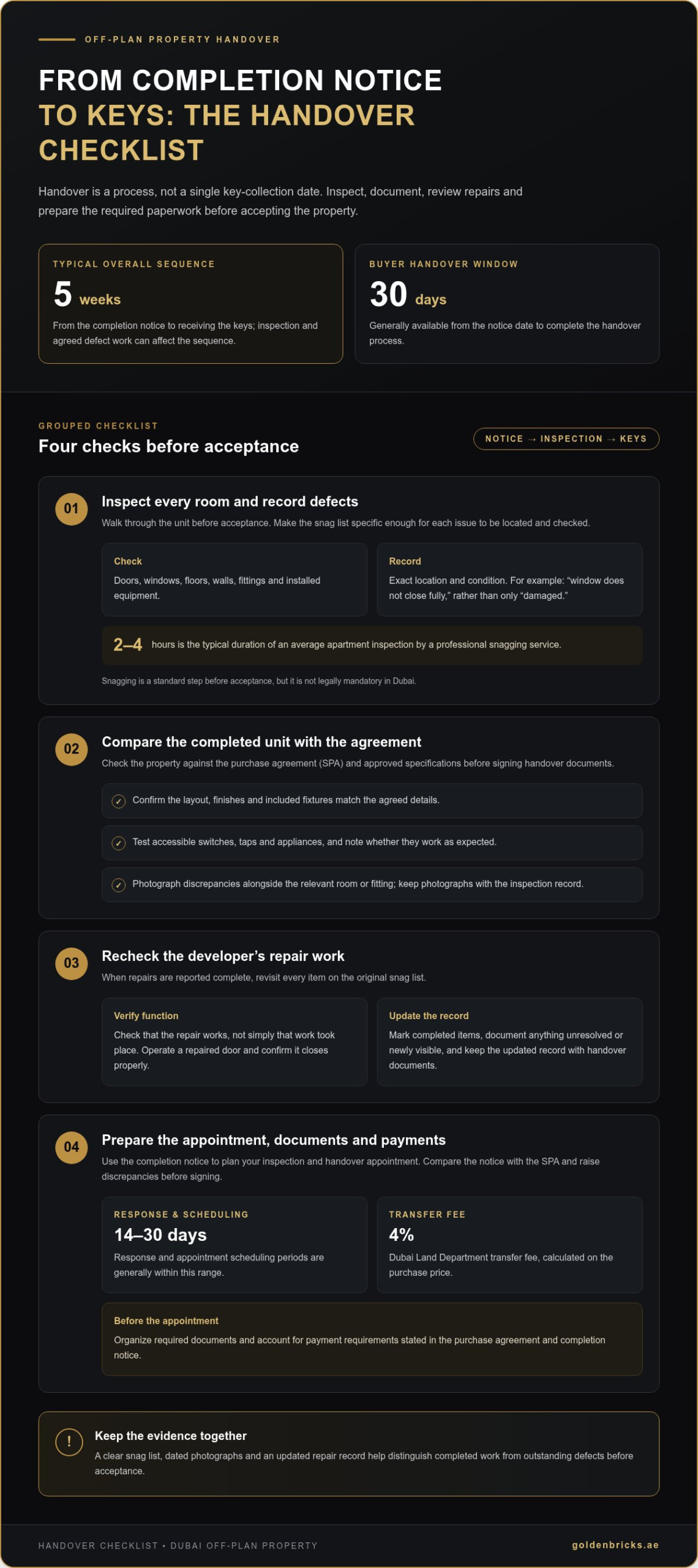
Before accepting handover in Dubai, inspect the unit, record defects in a snag list, and review the developer’s rectification work. The typical timeline from completion notice to key collection is five weeks, although inspection findings and agreed repairs affect the sequence.
-
Identify Defects During Snagging
Walk through every room during the pre-handover inspection and document each visible defect. Check doors, windows, floors, walls, fittings, and installed equipment, then note the exact location and condition of each issue. For example, record that a window does not close fully rather than describing it only as “damaged.” A clear snag list gives the developer specific items to review and address.
- Compare the completed unit with the purchase agreement and approved specifications. Check that the layout, finishes, and included fixtures match the agreed details, and photograph any discrepancy alongside the relevant room or fitting. Test accessible switches, taps, and appliances, and record whether they work as expected. Keep the inspection record and photographs together so each defect can be matched to a location and discussed with the developer before acceptance.
-
Review Defect Rectification Before Acceptance
Reinspect each item after the developer reports that repairs are complete. Compare the result with the original snag list, and document anything unresolved or newly visible. Confirming a repair means checking that it works, not merely noting that work took place. For example, operate a repaired door and check that it closes properly. Keep the updated record with your handover documents so outstanding defects remain clearly distinguished from completed work.
- Arrange professional snagging if an independent, detailed inspection would help assess the unit. An average apartment inspection typically takes 2 to 4 hours. Snagging is not legally mandatory in Dubai, but it is a standard step before acceptance. The written report can help organize defects for discussion with the developer.
- Use the completion notice to plan your inspection and handover appointment. Buyers typically have 30 days from the notice date to complete the handover process, while response and appointment scheduling periods are generally 14 to 30 days. The overall sequence from notice to keys is typically five weeks, including inspection and agreed defect work. Review the purchase agreement and notice for payment requirements; the Dubai Land Department transfer fee is 4% of the purchase price.
Common handover issues and prevention
Use the completion notice, sale and purchase agreement (SPA), and inspection record to identify discrepancies before signing. Buyers in Dubai should distinguish repairable snags from serious readiness or contractual concerns.
-
Identify Common Handover Problems
Compare the unit and handover notice with the SPA, then list each mismatch clearly. Examples include a missing agreed fixture, an incomplete finish, an outstanding payment entry, or a service charge that differs from the stated arrangement. Check the notice carefully for the correct unit details and completion information. Keep dated photographs and written correspondence with your records so each issue can be linked to a specific document or location.
-
Check for Handover Red Flags
Assess whether the property is legally ready for occupancy and whether major functional defects remain. A buyer can refuse handover if either condition is unmet. Record the reason in writing, supported by photographs and a snag list, rather than relying on a verbal explanation. Distinguish a major issue, such as a failed essential system, from a minor finish defect. This record explains why acceptance was withheld and what remains unresolved.
-
Prevent Handover Delays
Respond to the completion notice within its stated timeframe and organize required documents and payments before the appointment. Missing paperwork, unsettled instalments, or unresolved questions about charges can delay the transfer. Compare the notice with the SPA and raise discrepancies before signing. Developers typically have a 12-month grace period beyond the SPA completion date before buyers can take formal action over delays. Preserve notices and dated responses to establish the timeline.
- Review how the SPA describes shared facilities and common areas, then compare those terms with the completed development. Dubai Law No. 6 of 2019 is identified as governing home ownership in Dubai. If the notice, plans, or handover material appear inconsistent with the agreement’s description of shared spaces, record the specific difference and raise it in writing. Avoid treating an informal explanation as a replacement for the relevant contractual wording.
- Keep the handover decision proportionate to the issue. For unresolved defects, identify the affected area, explain the practical impact, and attach photographs or inspection notes. For a disputed charge or missing item, cite the relevant SPA clause and request a written response before signing. If the concern is minor, separate it from any major readiness issue and track its rectification in the handover record. For broader ownership planning, review Dubai property investment guidance.
Defects-liability retention after completion
After completion, report defects promptly and track repairs against the applicable terms. Dubai’s defect liability period and project escrow retention are separate mechanisms, not funds held by the buyer.
-
Report Defects for Resolution
Send the developer a written defect report with the unit details, date, location, and a clear description of each issue. Attach photographs where they help show the condition, such as a ceiling stain or faulty fitting. Keep the report and the developer’s replies together. This record helps you track remaining defects, agreed actions, and any delays through to resolution.
-
Review Defect Liability and Retention
Read the SPA and defect terms to identify the applicable reporting route and coverage. Dubai developers are stated to provide a 1-year defect liability period. Separately, the escrow agent retains 5% of the total project value for one year after completion to cover defects or liabilities emerging after handover. This is project-level escrow retention, not a percentage automatically held from an individual buyer’s payment.
-
Arrange Rectification and Re-Inspection
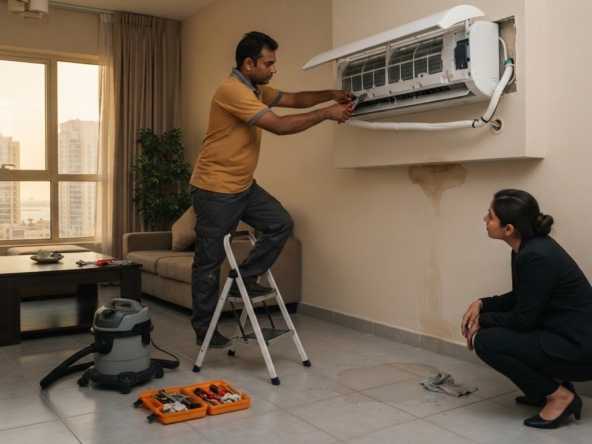
Agree a practical access arrangement with the developer, then compare completed repairs against your original report. Minor snags may take 7 to 14 days to fix; defect rectification for most Dubai projects is expected to take 7 to 21 days. Urgent issues, including leaks, electrical hazards or AC failure, should be addressed within 24 to 72 hours when possible. Record the outcome of each re-inspection and retain the developer’s defect list confirming completed work.
-
Check Insurance and Defect Warranties
Review the insurance policy and SPA separately, because insurance terms and the developer’s defect obligations serve different purposes. Identify covered events, exclusions, reporting conditions, and documents required for a claim. The developer is responsible for defects covered by the warranty or defect terms during construction completion and the defect liability period. The buyer remains responsible for damage caused by misuse, later alterations, or items not covered.
- Track structural concerns separately from ordinary snags. Dubai developers must fix major structural problems for ten years. If a crack, persistent leak, or other concern appears, document its location and condition, notify the developer in writing, and keep inspection records. Don’t treat routine cosmetic repairs as proof that a structural issue has been resolved. After work is complete, obtain the updated defect list and check the affected area again.
Checking the developer’s reputation and registration
Use a document-based checklist to assess project registration, contractual terms, and the developer’s recorded progress. In Dubai, registration details and the SPA help clarify responsibilities before handover or resale decisions.
- Confirm the project’s registration status and keep the relevant certificate with your purchase records. The Oqood certificate shows that an off-plan buyer is registered in Dubai’s interim property registry before a title deed is issued. The developer must register the off-plan sales contract through the Oqood portal within 90 days of signing the SPA. Compare the certificate and contract details, including the buyer, project and unit, for consistency.
- Review the project status recorded by Dubai’s Real Estate Regulatory Agency, which follows the status of real estate projects. Compare available project information with the completion date and milestone provisions in your SPA. Dubai’s RERA Law No. 13 of 2008 governs the relationship between developers and buyers for off-plan properties. Keep notices, payment receipts and dated correspondence together, so you can track progress against the contractual schedule.
- Read the SPA’s completion date and grace-period clauses before treating a delay as a breach. Developers typically have a 12-month grace period beyond the SPA completion date before buyers can take formal action over delays. Record the stated completion date, any notices received and the dates of developer updates. This timeline helps distinguish a delay within the stated grace period from a matter arising after it.
- Check the SPA and developer’s resale policy before planning an off-plan assignment. Whether a unit can be resold before handover depends on the developer’s policy, payment progress, SPA terms and developer approval. Developers commonly set a minimum payment threshold of 30% to 40% of the purchase price before allowing resale. In most cases, a formal assignment approval is required, and the developer may issue a No Objection Certificate as part of the process.
- Set out your responsibilities beside the developer’s obligations in a practical checklist. Track instalments, document requests, completion notices, and any mortgage arrangements against the SPA, and retain proof of each payment. Outstanding instalments due before a transfer must be settled for the transfer to proceed. Attempting an assignment without required developer approval can invalidate the transaction and expose the seller to contractual penalties, so obtain approval before proceeding.
What happens during an off-plan property handover in Dubai
Handover proceeds from the developer’s completion notice through inspection, document review, settlement, and key collection. Review each stage against the SPA and project status before completing the transfer.
-
Receive the Developer’s Handover Notice
Read the completion notice and compare its unit details with your contract. The developer shares the notice with the buyer and the Dubai Land Department to confirm project completion. Check the stated response deadline, appointment instructions and payment requirements. The notice should include the Property Index Number (PIN), which is needed for Ejari registration and utility connections. Buyers typically have 30 days from its issue to complete handover.
-
Prepare the Required Handover Documents
Prepare proof of payments, your passport and Emirates ID, the developer’s NOC, and the signed sale and purchase agreement. These are key documents for the handover appointment. Match names and unit details across the records, and keep copies of the completion notice and payment receipts. For a mortgaged purchase, coordinate the final settlement with your lender and follow the SPA’s payment terms. Outstanding instalments due before a transfer must be settled.
-
Review Handover Fees and Ongoing Costs
Review the handover statement line by line before paying. It may include remaining purchase-price instalments, administration charges, title deed or Oqood fees, service charges and utility registration. The DLD title deed fee at off-plan handover is AED 250, and the map fee is AED 250 for a unit or villa.
Budget separately for ongoing charges. Buyers may need to pay one year of service charges at handover.
- Match the final balance to the payment schedule in your SPA. The final instalment is typically 5% to 10% of the purchase price and is due upon completion. If a mortgage forms part of the purchase, coordinate lender requirements and settlement timing alongside the developer’s instructions. A post-handover payment plan may also be discussed with the developer where offered.
After inspection and any agreed defect work, sign the handover documents and receive the keys. An approved Oqood certificate converts to a full title deed at handover. Title deed registration typically takes 7 to 14 working days afterward. Keep the signed documents, receipts and PIN details together for utility connections and future property records.
For support managing a completed investment, explore property management options.
Golden Bricks Real Estate: Exclusive Off-Plan Projects
Golden Bricks Real Estate offers Exclusive Off-Plan Projects for investors assessing a future purchase against handover timing, payment milestones and project details. Its Project Curation offering helps bring a considered perspective to comparing off-plan opportunities, while Exclusive Ready Properties may suit buyers whose priorities favour an already completed home. After handover, Property Management is relevant for owners seeking ongoing oversight of their property. These offerings support different stages of a property decision, from selecting an opportunity to managing an asset after completion. For a considered discussion of your Dubai property plans, contact Golden Bricks Real Estate.
Make Your Next Property Decision With Clarity
Dubai’s off-plan property handover process is one stage in a longer investment journey. As you plan your next move, consider how your handover experience informs decisions about timing, property type, and ownership priorities. The aim is to align your next purchase or management choice with the role you want your property to play over time.
Golden Bricks Real Estate offers exclusive off-plan projects for buyers considering a future purchase, alongside exclusive ready properties for those focused on completed homes. Its property management service supports owners seeking ongoing oversight. Whether you’re planning around Dubai’s off-plan property handover process or considering another stage of ownership, these options can help shape your next property decision.
When you are ready to discuss your plans, contact Golden Bricks Real Estate. A clear brief on your objectives can focus the conversation and help you consider a suitable property pathway. Move forward with care and confidence.
Frequently Asked Questions
How long does the property transfer take in Dubai?
A Dubai property transfer commonly takes 1 to 2 weeks after documents are complete and appointments are scheduled. The timeline depends on having the required paperwork ready, settling outstanding instalments and securing the relevant appointment. For example, an incomplete payment record can hold up processing even when the buyer and developer are otherwise prepared. Keep the signed documents and payment evidence organized to reduce avoidable administrative delays.
Can I refuse handover?
Yes, a buyer can refuse handover if the unit isn’t legally ready for occupancy or has major functional defects. Set out the reason in writing, with dated photographs and a snag list identifying the affected areas. For example, a serious fault that prevents an essential system from working is different from a minor cosmetic mark. Keep the refusal record and related correspondence with the developer together for a clear account of the issue.
How long does snag fixing take?
Minor snags may take 7 to 14 days to fix, while rectification for most Dubai projects is expected to take 7 to 21 days. Urgent issues such as leaks, electrical hazards or AC failure should be addressed within 24 to 72 hours when possible. The repair timeline depends on the defect’s nature and the work required. Record the original issue and inspect the repair before marking it resolved.
How to Report Snags to the Developer?
Report each snag to the developer in writing, using the contact route provided in your handover documents. Describe the defect, identify its room or location, and attach a clear photograph where useful. For example, specify which bedroom window sticks rather than reporting a “window problem.” Keep a dated copy of the report and subsequent replies. After repairs, compare the developer’s defect list with your original entries.
What are the steps in the Dubai off-plan property handover process?
The sequence is completion notice, inspection, written defect record, agreed repairs, handover documents, final settlement, and key collection. At each stage, match the unit details and payment status to your sale and purchase agreement. For example, resolve any discrepancy in an instalment statement before signing the final paperwork. Keep copies of notices, receipts, and signed documents, as they support later title registration, utility connections, and ownership records.
How long does the Dubai off-plan handover process take after the completion notice?
The full process typically takes five weeks from the completion notice to key collection. Buyers generally have 30 days from the notice date to complete handover, while response and appointment scheduling periods are generally 14 to 30 days. Handover appointments are typically scheduled within 7 to 14 days after defects are cleared. Inspection findings, repair progress and appointment coordination affect how the stages align in practice.
Can buyers delay or refuse handover for defects in a Dubai off-plan property?
Buyers can refuse handover when the unit isn’t legally ready for occupancy or has major functional defects. A minor snag alone doesn’t establish either condition. Identify the defect’s practical impact, photograph it, and describe it in writing before deciding how to proceed. For instance, distinguish an inoperative essential system from a small paint blemish. A precise record clarifies the basis for refusal and which repairs remain outstanding.
What are developers’ defect liability and maintenance obligations after handover in Dubai?
Dubai developers are stated to provide a 1-year defect liability period, with coverage governed by the applicable warranty or defect terms. Developers must fix major structural problems for ten years. The developer’s defect list can document completed repairs, while damage caused by misuse, later alterations or non-covered items remains the buyer’s responsibility. Review the SPA for reporting procedures and coverage, and distinguish defect rectification from routine property maintenance after handover.