

When searching online for commercial real estate for lease dubai, it is easy to focus on the most attractive listing. But a polished space is only one part of the decision. Property type, permitted business activity, lease inclusions and operating obligations all shape whether premises will work in practice.
Listings can be difficult to compare when rent, service arrangements and tenant responsibilities are presented differently. Start with your business requirements, then assess each property and lease against the same criteria.
This guide from Golden Bricks Real Estate explains how to distinguish between common commercial premises, evaluate lease structures and identify operational needs before committing. It also outlines the documents, costs and contractual terms to review carefully, including relevant licensing and registration considerations in the UAE. A consistent framework makes it easier to compare offers and focus on a lease that supports your business throughout the term.
Key Takeaways
- Start with your business activity and operating requirements to identify premises that are suitable in practice.
- For commercial property leases in the UAE, compare lease duration, payment terms, inclusions and tenant obligations, not headline rent alone.
- Use a consistent framework to assess usable area, access, utilities, fit-out and permitted use across shortlisted properties.
- Follow a structured due diligence sequence, from evaluating the premises to reviewing documents and final lease terms before signing.
- Market intelligence, commercial leasing brokerage and property management can support informed decisions at different stages of a commercial tenancy.
Commercial Real Estate for Lease: Match the Premises to Your Business
Start with the work your business needs to do, not the property category that looks most attractive in a listing. A consultancy with scheduled client meetings has different requirements from a retailer serving walk-in customers or a business holding bulky stock. Define the intended activity first to narrow the search to premises that can support daily operations.
Commercial leasing is an arrangement in which a business occupies premises for an agreed period under tenancy terms set out between tenant and landlord. The tenant’s objective is operational use, not ownership as an investment or accommodation as a home. Lease practices and requirements can vary across the Emirates, so avoid assuming one set of rules applies everywhere. The intended use must align with applicable licensing and the lease conditions.
Which commercial property type fits your operation?
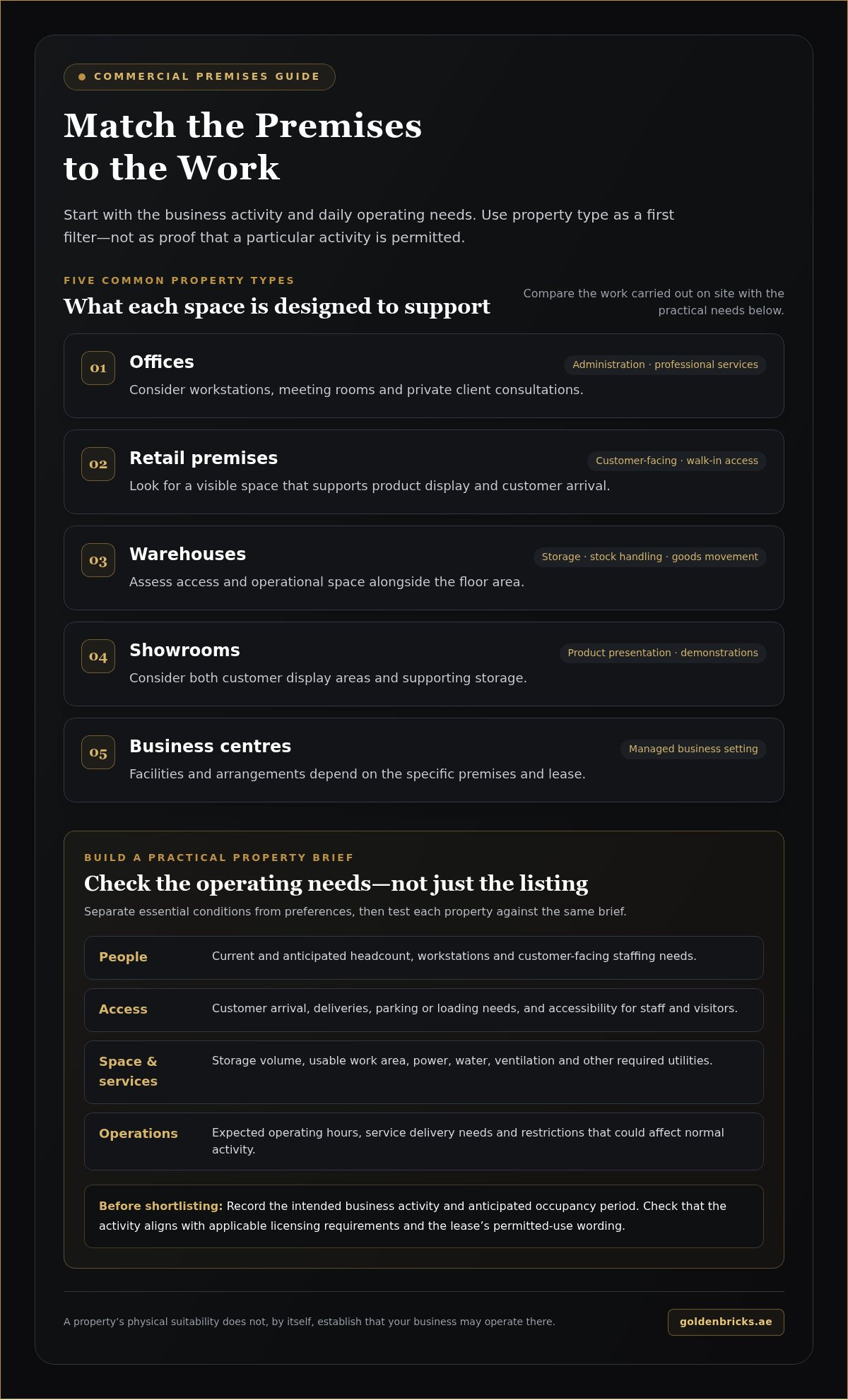
Consider how each space supports customer access, storage, staffing and service delivery. A useful first filter is the work carried out on site:
- Offices suit administration, professional services and teams that need workstations, meeting rooms or private client consultations.
- Retail premises support businesses that depend on a visible, customer-facing space, product display and walk-in access.
- Warehouses are designed around storage, stock handling and the movement of goods. Assess access and operational space alongside floor area.
- Showrooms provide space to present or demonstrate products to customers, often requiring both display areas and supporting storage.
- Business centres can suit organisations seeking a managed business setting, with facilities and arrangements shaped by the premises and lease.
These categories are starting points, not approval for a particular activity. A property’s physical suitability does not establish that your business may operate there. Assess the intended activity alongside licensing requirements and the permitted-use wording in the lease. Lease structures also allocate costs differently; understanding net leases can help clarify how tenant responsibilities may vary.
Turn business needs into a property brief
Before reviewing listings, write a brief that separates essential operating conditions from preferences. This makes comparisons more consistent and prevents a strong first impression from overshadowing practical requirements.
- People: current and anticipated headcount, workstations and customer-facing staffing needs.
- Access: customer arrival, deliveries, parking or loading needs, and accessibility for staff and visitors.
- Space and services: storage volume, usable work area, power, water, ventilation and other utilities required for the activity.
- Operations: expected operating hours, service delivery needs and restrictions that could affect normal activity.
Mark each item as essential or preferred, then record the intended business activity and anticipated occupancy period. For example, a product business may need display space and secure stock storage, while a client-service firm may prioritise meeting areas and straightforward visitor access. Test each listing against the brief before moving on to detailed lease comparisons.
How Commercial Leases Work: Understand the Terms Before Signing
A listing’s advertised rent is only one part of the financial and operational commitment. Advertised rent is not the full cost of occupying a property; the lease defines the wider set of payments, responsibilities and conditions. Compare the written offer and draft agreement rather than relying on a headline figure or verbal summary.
Separate the core terms before assessing an offer: rent is the amount charged for occupation; the payment schedule sets when and how it is paid; a deposit is a separate amount subject to the agreement’s terms; and other costs may be charged separately. The names used for charges, their calculation and the legal requirements that apply can differ by jurisdiction and contract.
Lease terms that shape day-to-day operations
Permitted use determines the activity allowed under the agreement, while access provisions can affect staff, customers and deliveries. Maintenance clauses allocate responsibility for upkeep. Fit-out terms can specify what changes are allowed, who bears the expense and what must happen to alterations when the tenancy ends.
Read duration, renewal wording, notice periods and early termination provisions together. A renewal option may depend on stated conditions; a break clause may set when and how a party can end the agreement. These terms are contract-specific, not universal rules. Map each obligation to the responsible party and its timing, including:
- Use and access: permitted activity, entry arrangements and any stated restrictions.
- Maintenance: which party handles particular repairs or routine upkeep, and when.
- Changes to the premises: fit-out approvals, costs and end-of-lease requirements.
- Key dates: commencement, payment deadlines, notice windows and renewal or termination milestones.
Understand rent and other lease-related charges
Review each financial item as its own obligation. Rent pays for occupation; a deposit is handled under the agreement’s deposit terms; service charges may relate to shared building costs; utilities cover consumption or supply; and fit-out expenses arise from preparing the premises for the business. Whether an item is included, billed separately or allocated between parties depends on the specific offer and contract.
Before signing, identify the payment dates, any rent adjustment mechanism, how variable charges are calculated and which party is responsible for each amount. If a charge is described broadly, ask for written wording that makes its basis and timing clear. Compare the complete occupancy obligations, not just rent.
A disciplined lease review can bring greater clarity to the commercial decision. Golden Bricks Real Estate’s commercial leasing brokerage and market intelligence connect premises decisions with market context.
Compare Commercial Properties for Lease With a Consistent Framework
Once your requirements are defined, assess each shortlisted property against the same criteria. A structured comparison makes trade-offs visible and reduces the risk of choosing on presentation or headline rent alone. The best-fit unit is not always the largest or most prominent; it is the one whose space, access and obligations align with the way your business operates.
Use the table as a working record, completing one column per property. Note facts separately from assumptions, and mark unanswered points for follow-up rather than treating them as settled.
| Criterion | Property A | Property B | What to assess |
|---|---|---|---|
| Intended use | Record proposed activity | Record proposed activity | Does the use align with the lease conditions and applicable licensing? |
| Usable area | Record usable space | Record usable space | Does the layout support workstations, display, storage or service delivery? |
| Access | Record staff, customer and delivery access | Record staff, customer and delivery access | Can the people and goods your operation depends on reach the premises? |
| Utilities and services | Record required provisions | Record required provisions | Are essential services suitable and clearly allocated? |
| Fit-out and condition | Record existing condition and work needed | Record existing condition and work needed | Separate physical condition from readiness for your intended layout. |
| Lease terms | Record term, renewal and notice | Record term, renewal and notice | Compare the written conditions side by side. |
| Occupancy obligations | Record rent, charges and responsibilities | Record rent, charges and responsibilities | Capture payment schedule, deposits, services and maintenance allocation. |
Compare premises by operational suitability
Look beyond floor area. Assess whether the layout supports your staffing pattern, customer flow, loading needs and parking requirements. Record essential services and inspect the property’s physical condition separately from its fit-out readiness: a well-maintained unit may still require substantial adaptation. Review building conditions and permitted activities for the specific property, and document what is established and what remains unresolved.
Give each criterion a priority based on your operating model and business stage. A growing team may value flexibility and usable area, while a customer-facing operation may place greater weight on access and display. A storage-led business may prioritise loading and services over prominence. Avoid assigning equal importance to every feature; a desirable extra should not outweigh a requirement essential to opening and operating the premises.
Compare offers by lease structure and occupancy obligations
Place each offer’s term, renewal wording, notice periods, payment schedule, deposits and separately charged items in adjacent columns. Record which services and maintenance responsibilities are included or allocated to each party, along with the stated calculation method for variable charges. This makes differences visible even when offers use different terminology.
Flag unclear wording, missing figures or unassigned responsibilities for clarification before commitment. Keep a short decision note explaining why a property meets or falls short of essential criteria. That record supports a considered choice based on operational suitability and the full occupancy commitment, not one appealing feature.
Commercial Lease Due Diligence: A Practical Review Sequence
A measured review helps separate what a property appears to offer from what the premises and lease actually provide. Use the following sequence to move from business suitability to signing readiness. Treat general preparation as a framework, and verify legal or regulatory details against current official sources for the applicable jurisdiction.
- Confirm the intended use. Define the business activity planned at the premises and compare it with the proposed permitted-use wording. Note any licensing conditions that could affect whether the operation can proceed there.
- Inspect the property. Record visible condition, access, utilities, fit-out status and operational constraints. Consider how staff, customers, deliveries or equipment would use the space in practice.
- Assess commercial suitability. Compare inspection findings with the business’s operating requirements. Identify adaptation work, service needs or access limitations that could affect readiness or day-to-day use.
- Review the supporting information. Compare listing statements with property information and documents provided for review. Keep a written log of differences, unanswered questions and responses agreed during discussions.
- Review the final lease and signing readiness. Check that the final document reflects the agreed premises, use, term, payment arrangements and allocation of obligations. Verify relevant licensing, registration, tax and signing requirements for the applicable jurisdiction before proceeding.
Review the property and supporting information
Keep inspection notes distinct from the commercial assessment. For example, record the physical condition of a unit separately from whether its existing fit-out suits the intended operation. A listing description can guide questions, but it should not replace a review of property information and lease documents. Transaction preparation also benefits from an organised record of parties, documents and open items, as outlined in this guide to real estate transaction services.
Review lease documents and readiness to commit
Read the agreement as a complete document, not as a collection of headline terms. Confirm that the parties and premises are accurately identified, then review permitted use, duration, payment schedule, renewal or notice provisions, and each party’s allocated responsibilities. Requirements can vary by jurisdiction and contract, so distinguish general document checks from details that need current local verification.
Before signing, resolve inconsistencies between discussions, property information and the final lease. Keep the latest agreed version and supporting responses together, and make sure decision-makers understand outstanding obligations and dates. Brokerage can help tenants organise the property search and transaction review; this overview of choosing a real estate agency offers related context.
Golden Bricks supports commercial leasing decisions through brokerage informed by market intelligence and over 25 years of global industry experience.
How Golden Bricks Supports a More Informed Commercial Lease
A clear evaluation framework helps turn a property search into a considered business decision. Golden Bricks Real Estate supports commercial leasing through brokerage, market intelligence and advisory support, drawing on over 25 years of global industry experience. These capabilities help businesses relate their premises requirements to market context and assess leasing opportunities with greater discipline.
Brokerage and market intelligence for commercial property decisions
Commercial property leasing brokerage can support the process of exploring opportunities against a tenant’s intended use, operational requirements and preferred lease parameters. Market intelligence adds context for assessing available information and comparing options. It does not replace review of the specific property or its lease; instead, it can inform the questions a business brings to that review and help frame its decision in a broader market setting.
Market context is most useful when connected to a defined business brief. A company considering premises for customer service, for example, may weigh access and layout differently from an operation focused on storage or administration. Golden Bricks Real Estate market intelligence provides a related perspective for assessing commercial property signals and trends. The decision remains specific to the business, property and contract under consideration.
From lease transaction to property oversight
Leasing support and property management serve different points in a property relationship. Brokerage relates to exploring and progressing a commercial lease transaction. Property management is directed towards owners and can support ongoing matters such as tenant relations and lease administration. Keeping this distinction clear helps businesses separate considerations about their own occupancy from an owner’s continuing oversight of an asset.
For a tenant, the immediate focus is whether the premises and written terms fit the operating brief. For an owner, attention may extend beyond the transaction to the ongoing management of the property and tenant relationship. Where the same asset moves from leasing into ongoing oversight, these functions are distinct stages rather than a single undifferentiated service. Golden Bricks Real Estate provides both commercial leasing brokerage and property management, alongside market intelligence and advisory support.
The right support should complement, not replace, the tenant’s own review of permitted use, lease obligations and relevant jurisdiction-specific requirements. Golden Bricks Real Estate brings an established UAE brokerage and consultancy perspective to commercial property decisions. To learn more about its wider real estate offering, explore Golden Bricks Real Estate services.
Make Your Next Lease Decision With Clarity
A commercial lease shapes more than where your team works. It sets the conditions under which your business will operate, adapt and serve its clients. Before progressing with a lease, bring the people responsible for operations, finance and business licensing into the decision. A shared understanding of priorities can help prevent a suitable-looking space from becoming an operational compromise.
Golden Bricks Real Estate brings commercial property brokerage, market intelligence and property management together with over 25 years of global industry experience. This perspective can support decisions across the leasing process and the property relationship that follows.
Use your requirements and review framework as the basis for a considered next step. Explore Golden Bricks’ commercial property services for support with your leasing decision.
Frequently Asked Questions
What types of commercial property can businesses lease in the UAE?
Businesses can lease offices, retail units, warehouses, showrooms and premises in business centres, among other commercial spaces. The appropriate category depends on how the business serves customers and handles people, goods or equipment. A design consultancy might need client meeting rooms, while a distributor may prioritise stock handling and delivery access. Property labels can be broad, so assess the actual layout and the activity the premises are intended to accommodate.
How do I compare commercial properties for lease?
Compare each option against the same business priorities, then separate deal-breakers from preferences. Start by ruling out premises that cannot support a core activity, then compare viable options for access, fit-out needs, payment timing and lease flexibility. Record the source of each detail, such as a listing, inspection or draft agreement, so assumptions don’t become decision facts.
What documents are commonly reviewed before signing a commercial lease?
Common review materials may include the draft lease, property identification or ownership information, the tenant company’s trade licence, and evidence that the person signing can act for the company. Fit-out proposals or plans may also matter if alterations are intended. The exact documents depend on the transaction and applicable jurisdiction. Keep the versions reviewed together, and check that names, premises details and agreed terms are consistent before execution.
How much does it cost to lease commercial property?
There is no single cost for leasing commercial premises. The financial commitment depends on the specific offer and may extend beyond rent to a deposit, service charges, utilities, fit-out work and other contractually allocated expenses. To estimate the business’s occupancy budget, map each payment to its amount, due date, calculation basis and responsible party. Review any variable or adjustable charges in writing, rather than relying on a headline rental figure.
Can a commercial property be used for any business activity?
No. A unit’s physical layout does not by itself mean every business activity is permitted there. The proposed use should align with the lease’s permitted-use terms and the licensing conditions that apply to the business. For example, a space suitable for product display may not automatically be suitable for storage or another activity. Resolve any mismatch before committing, and verify applicable requirements with current official sources for the jurisdiction.
Are commercial lease registration requirements the same across the UAE?
Not necessarily. Registration procedures and requirements can depend on the relevant jurisdiction, the property and the type of tenancy arrangement. Don’t assume that a process applicable in one Emirate or regulatory area automatically applies elsewhere. Before execution, identify which authority or registration system governs the particular lease and verify the current requirements through official sources. Keep evidence of any completed registration with the final lease and related transaction records.
Who is responsible for maintenance in a commercial lease?
The lease should specify how maintenance responsibilities are divided; there is no safe assumption that every agreement allocates them in the same way. It may distinguish routine upkeep, repairs to internal areas, building systems and shared spaces, while also setting out notification or approval procedures. Before signing, identify who arranges each type of work, who bears its cost and how urgent issues are handled under the written terms.