

What if rising asking prices are masking weaker transaction evidence, or a surge in sales is concentrated in one property segment? Across the national real estate landscape, headline figures can point in different directions. Reliable real estate market intelligence dubai means examining those signals together rather than treating any single metric as a forecast.
That distinction matters when data comes from reports with different timeframes and definitions. Asking prices, completed transactions, new supply and occupancy each answer a different question. Read in isolation, they can encourage premature conclusions. Interpreted in context, they help investors, owners and brokers assess demand, pricing resilience and exposure by asset type.
This article explains which indicators to monitor, what each can reveal, and how to compare them before making a property decision. It also covers segment-level performance and data limitations. The aim isn’t to predict outcomes, but to establish a repeatable framework for more disciplined choices. Golden Bricks Real Estate’s market intelligence and project curation connect analysis with ready and off-plan opportunities.
Key Takeaways
- Use real estate market intelligence dubai to turn scattered property evidence into decision support, not a prediction of future performance.
- Track transactions, pricing, supply, occupancy and ownership costs, matching each indicator to the decision it can inform.
- Compare like with like: reporting period, property type, data coverage and transaction status can change what a headline figure means.
- Apply a repeatable process: define the decision, select relevant indicators, validate sources, compare evidence and document assumptions.
- Use market analysis to inform project curation and property discussions, while grounding decisions in context rather than certainty.
What Dubai Real Estate Market Intelligence Reveals Beyond Headlines
Real estate market intelligence dubai is most useful when it turns disconnected property evidence into a view shaped around a specific decision. Market intelligence is the structured collection, comparison and interpretation of relevant property evidence to inform decisions, not to predict future performance. It considers what the information measures, where it comes from and how well it applies to the asset or question at hand.
A transaction count, asking-price trend or supply estimate is descriptive data: it reports an observation. Analysis goes further by testing an assumption. If an investor believes a particular asset type offers stronger leasing prospects, for example, relevant evidence might include comparable completed transactions, available supply and occupancy conditions. The analysis can show whether the assumption is supported, incomplete or needs further scrutiny.
Property decisions also sit within a wider economic context. The Economy of Dubai overview provides background on the emirate’s economic structure and real estate’s role within it. For a property decision, that context is a starting point, not a substitute for examining evidence specific to the asset, segment and investment objective.
Which property decisions benefit from market intelligence?
Different participants need different evidence. The goal isn’t to collect every available metric, but to choose information that can clarify a consequential decision.
- Investors can test acquisition assumptions, compare asset types and examine whether their view remains consistent with observed pricing and leasing conditions.
- Developers can assess project positioning, launch planning and whether a proposition aligns with its intended audience. Evidence informs planning; it doesn’t assure demand.
- Brokers and owners can put pricing in context, assess leasing conditions and support ongoing oversight of ready or off-plan assets.
Define the decision first. An investor weighing alternatives needs comparable evidence; an owner reviewing a lease needs information relevant to rental conditions and the property itself.
Why a single market headline can mislead
A broad average compresses different property types, price bands, transaction conditions and individual characteristics into one figure. It may describe the overall market while saying little about a specific asset. A headline showing rising prices, for instance, cannot establish that every segment has appreciated or that a particular property is appropriately priced.
Asking prices and completed transaction evidence also represent different things. Asking prices show seller expectations; completed transactions indicate agreed outcomes, subject to the definition and coverage of the underlying data. Neither alone explains a property’s condition, terms or comparability.
- Separate market-wide averages from evidence for the relevant asset type and segment.
- Compare asking prices with completed transactions, noting differences in timing and property characteristics.
- Treat forecasts as assumptions to test against observed evidence, not as certain outcomes.
This discipline keeps a headline in proportion. It can inform a decision only when its scope and limitations are clear.
Which Dubai Property Market Indicators Should You Track?
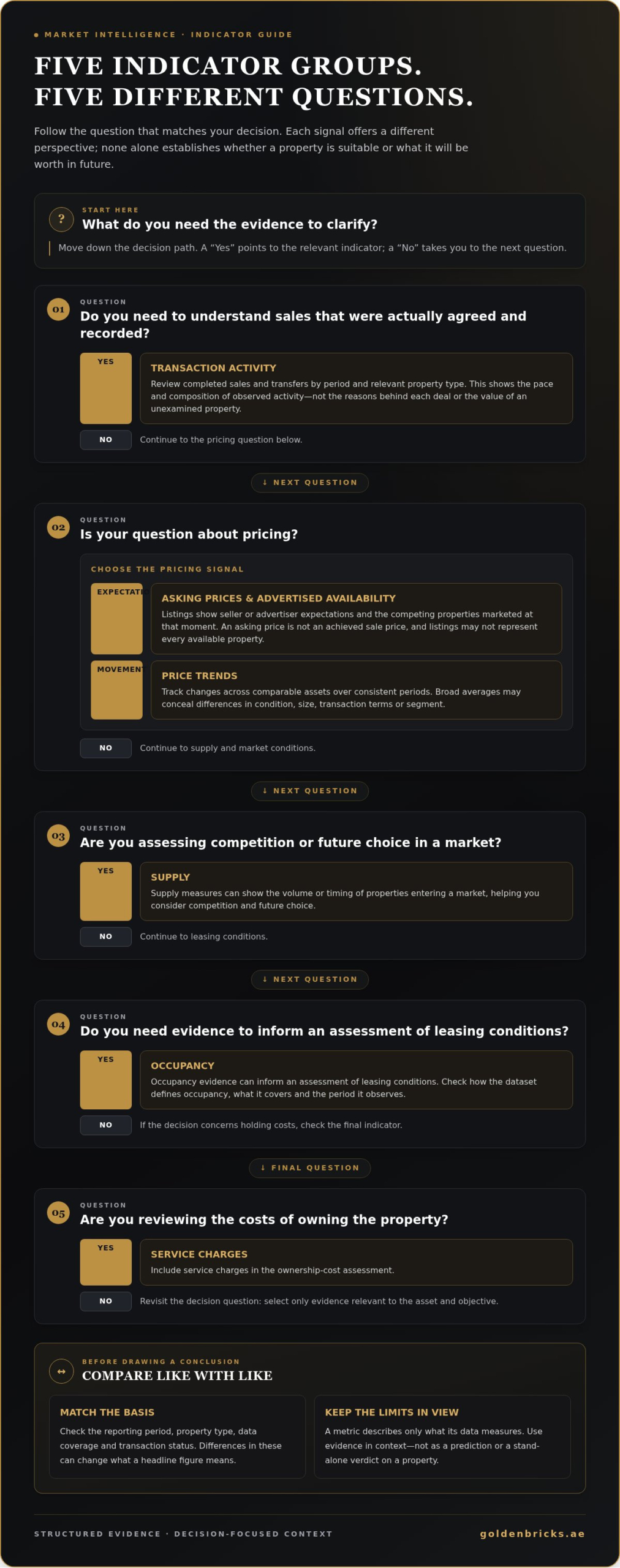
A useful set of indicators connects market activity to the decision under review. For real estate market intelligence dubai, organise evidence into five groups: transactions, pricing, supply, occupancy and ownership costs. Each offers a different perspective. None, on its own, establishes whether a property is suitable or what it will be worth in future.
Transaction activity, asking prices, and price trends
Completed transactions show that sales were agreed and recorded during a defined period. They can help investors assess observed activity and compare relevant assets. Asking prices, by contrast, reflect seller or advertiser expectations, while advertised availability shows what is being marketed at that moment. Price trends summarise movement within a dataset, so compare similar property attributes and consistent reporting periods before drawing conclusions.
- Transaction activity: Review completed sales and transfers by period and relevant property type. This indicates the pace and composition of observed activity, but not the reasons behind each deal or the value of an unexamined property.
- Asking prices: Use listings to understand current advertised expectations and the range of competing properties. An asking price isn’t evidence of an achieved sale price, and listings may not represent every available property.
- Price trends: Track changes across comparable assets over consistent periods. Trends can help test pricing assumptions, but broad averages may conceal differences in condition, size, transaction terms or segment.
Supply, occupancy, and service-charge signals
Supply measures can show the volume or timing of properties entering a market, helping investors consider competition and future choice. Occupancy evidence can inform an assessment of leasing conditions, but datasets may use different definitions, coverage and observation periods. Service charges belong in the ownership-cost assessment: they affect an asset’s cost profile, but a charge figure alone doesn’t establish its overall suitability.
- Supply pipeline: Examine advertised inventory or planned completions where the dataset defines them. These measures can indicate potential choice and competition, but plans and advertisements aren’t the same as completed, available properties.
- Occupancy: Consider reported occupied units or comparable leasing evidence, checking exactly what is counted. A single occupancy measure cannot prove that a specific property will secure a tenant.
- Service charges: Include applicable charges when assessing ongoing ownership costs and comparing properties. Check that the period and property basis are comparable; the figure doesn’t capture every cost or determine the asset’s value.
For broader economic context alongside property-specific evidence, the UAE Ministry of Economy & Tourism Open Data provides access to national statistics, reports and analyses. Check the source, period and definitions before using a dataset in a property assessment.
Several independent indicators provide stronger context than one metric because they can reveal whether activity, pricing, supply and occupancy point in the same direction. A disciplined review supports clearer property comparisons and transaction discussions. Golden Bricks’ market intelligence and project curation connect analytical context with property decisions without implying certainty of outcome.
How to Interpret Dubai Real Estate Trends Without Overreading the Data
Conflicting figures don’t automatically mean one source is wrong. In real estate market intelligence dubai, first establish whether each indicator describes the same market, period and type of evidence. A reported increase in advertised prices, for example, can coexist with stable or lower completed transaction values if listings and sales cover different properties, timeframes or groups of participants.
Use a comparison framework before drawing a conclusion. It separates what a signal may suggest from what it can establish, and identifies a practical cross-check.
| Signal | Possible interpretation | Caveat | Useful cross-check |
|---|---|---|---|
| Asking prices rise | Sellers or advertisers may be setting higher expectations. | Asking prices aren’t completed sale values, and listings may change or be withdrawn. | Compare completed transactions for similar properties over a matching period. |
| Completed transaction values change | Observed sale outcomes may be shifting. | Results can reflect a different mix of asset types, quality or transaction terms. | Review transaction counts and compare like-for-like property groups. |
| Advertised availability increases | Buyers or tenants may have more visible options. | Listings may be duplicated, outdated or unrepresentative of total supply. | Check data coverage and distinguish current listings from pipeline estimates. |
| Occupancy measures vary | Reported leasing conditions may differ across covered properties. | Definitions, coverage and observation dates can vary by dataset. | Compare the measure’s methodology and period with relevant leasing evidence. |
When market indicators point in different directions
Start by aligning reporting periods, property definitions and segments. A quarterly listing measure and a monthly record of completed sales aren’t direct counterparts. Nor should a broad residential average be assumed to describe a particular property type. Differences may reflect asking behaviour, timing or sample composition rather than a single market movement. Treat the mismatch as a question to investigate.
Rising asking prices alongside different transaction evidence need not be contradictory. Advertisers can adjust expectations before a sale is completed, while recorded transactions reflect agreements from a particular set of buyers and sellers. Compare the same asset characteristics and transaction status, then check whether the pattern holds across more than one independent measure. Don’t call a difference a definitive trend without that context.
How to assess evidence quality and limitations
For each data point, record its source, publication date, measurement, reporting period and coverage. Note whether values are advertised, agreed or completed, and whether the source specifies the property types included. This compact record makes comparisons auditable and helps prevent a change in definitions from appearing to be a change in the market.
Look for gaps, revisions, small samples and changes in reporting methodology. Where these limit comparison, state the limitation rather than filling it with an assumption. Mark time-sensitive or incomplete claims for verification before publication, particularly when figures may have been updated. A sound conclusion reflects both the evidence and its boundaries.
A Practical Framework for Applying Real Estate Market Intelligence
Analysis becomes useful when it is tied to a decision and can be revisited as evidence changes. For real estate market intelligence dubai, a concise workflow helps investors, developers, brokers and owners focus on relevant information instead of accumulating data without a clear purpose.
- Define the decision. State the choice to be made, such as comparing two assets, reviewing a pricing assumption or assessing project positioning.
- Select relevant indicators. Choose measures that can inform the question, and set a time horizon appropriate to the decision.
- Validate sources. Record where each figure comes from, when it was published and what it measures.
- Compare evidence. Check whether different indicators cover comparable periods, property types and transaction stages.
- Document assumptions. Distinguish observed information from interpretation, note remaining uncertainty and set a point to review the analysis.
A short worksheet makes the process repeatable and gives each data point a defined role. For every decision question, capture:
- Question: What choice or assumption is under review?
- Metric: Which indicator is relevant, and what does it measure?
- Source date: Who published the evidence, and when?
- Caveat: What limits its coverage or comparability?
- Implication: How does it affect the decision under consideration?
- Next research step: What evidence would clarify an open question?
Adapt the analysis to the decision-maker
Investors can use the worksheet to test acquisition assumptions against observed evidence, while keeping historical performance separate from a forecast. Developers can examine whether positioning and go-to-market assumptions fit relevant evidence and the intended audience. Brokers and owners can use comparable information to support pricing and asset discussions. Match indicators to both the decision-maker’s role and the time horizon of the choice.
Turn indicators into explicit assumptions
Write each assumption plainly, then identify the evidence that supports it and where uncertainty remains. Keep observed facts, interpretation and scenario assumptions distinct so the reasoning is easier to review when new information becomes available. Set a review point linked to the decision, such as before progressing with an acquisition or revisiting a pricing discussion. Updated evidence may strengthen, qualify or change the working view.
Golden Bricks connects market intelligence and project curation with property decision-making. Explore Golden Bricks’ market intelligence and advisory services to see how analytical context can inform property discussions without promising a particular outcome.
How Golden Bricks Connects Market Intelligence to Property Decisions
Market evidence gains practical value when considered alongside the decision it needs to inform. Golden Bricks brings together market intelligence, project curation, brokerage, a broker community and property management across ready and off-plan residential and commercial properties. These connected capabilities offer investors, developers, brokers and property owners perspectives on how market context relates to project positioning, transactions and ongoing asset oversight.
Golden Bricks brings more than 25 years of global industry experience. That experience informs its approach to real estate market intelligence dubai, treating analysis as decision support rather than a promise of returns. Evidence can clarify assumptions and frame a discussion, while outcomes remain subject to market conditions and each property’s characteristics.
From market context to curated project decisions
Project curation connects market context with project positioning. For developers considering go-to-market choices, relevant evidence can frame questions about the intended audience, the project’s proposition and how it compares with available alternatives. Analysis doesn’t guarantee demand or sales; it provides a structured basis for evaluating assumptions and refining the discussion around positioning.
The same discipline can help investors examine whether a project’s stated proposition aligns with their objectives and time horizon. Comparing relevant evidence with the features of an off-plan opportunity can surface questions to explore before a transaction discussion advances. For ready properties, the focus may instead be on how comparable evidence relates to the asset’s individual attributes. Curation brings these considerations into view without treating unlike properties as interchangeable.
A connected perspective for investors and professionals
Brokerage adds a transaction perspective to the analysis, helping frame discussions around buying, selling or leasing. The broker community brings together professional perspectives, while property management adds an operational lens to the oversight of ready and off-plan assets. Together, these viewpoints help decision-makers distinguish market-level signals from practical considerations attached to a specific property. For guidance on evaluating brokerage support, see this strategic guide to choosing a Dubai real estate agency.
For investors, this connection can support a more considered comparison of ready and off-plan opportunities. For brokers and owners, it can inform pricing or leasing discussions and ongoing asset oversight. The objective isn’t to replace judgement with a headline or dataset, but to connect evidence with the relevant question, make assumptions visible and identify where further consideration is warranted.
A useful starting point is to define the decision, the property or project in scope and the time horizon that matters. Discuss your real estate market intelligence requirements with Golden Bricks to explore how market context can support that decision with measured, relevant analysis.
Make Your Next Property Decision More Deliberate
The value of market intelligence lies not in the volume of data collected, but in whether it clarifies the decision ahead. Use real estate market intelligence dubai to frame the question, identify evidence that could change your view and make your assumptions explicit. Then set a point to revisit them as reliable information evolves.
This approach gives investors and property professionals a stronger basis for weighing alternatives without mistaking analysis for certainty. A clear decision objective also makes advisory discussions more focused: define the asset or project in scope, the outcome you are assessing and the uncertainties that matter most.
Golden Bricks brings market intelligence and project curation into property decision-making. Explore Golden Bricks’ market intelligence and advisory services to take the next step with a clearer view of the decision you need to make. Thoughtful analysis can help you move forward with greater discipline and confidence.
Frequently Asked Questions
What is real estate market intelligence?
Real estate market intelligence applies relevant property evidence to a specific decision. For example, an investor considering a ready property might examine comparable sales alongside leasing information and the asset’s condition, rather than relying on a general market headline. The analysis should make clear what was observed, what is inferred and what remains uncertain. That distinction helps decision-makers use information carefully without mistaking it for a guaranteed outcome.
Which data sources are useful for real estate market analysis?
Useful sources depend on the question. Official transaction information can help establish recorded activity, while published research may provide broader context; listing information, supply measures and property-level comparables can address other aspects. For real estate market intelligence dubai, note whether a source covers residential or commercial assets and whether its figures concern asking, agreed or completed transactions. A source log makes it easier to identify evidence that is outdated or unsuitable for comparison.
Why can asking prices differ from completed transaction prices?
Asking and completed prices describe different stages of a potential sale. Imagine two similar properties advertised at comparable prices, while recorded sales for similar assets show a different range. The listings communicate current seller expectations, but they don’t establish what buyers have agreed to pay. Differences may also reflect condition, features, timing or terms. Before using either figure to assess a property, compare the attributes and status of the underlying examples.
How often should property market intelligence be updated?
Update analysis according to the decision’s time horizon and how quickly relevant evidence changes. A strategic portfolio review may be revisited periodically, while an active purchase discussion may require more recent comparables before a decision. Keep the publication date and underlying reporting period beside each figure. If either is unclear, treat the evidence cautiously rather than describing it as current. Revisit the analysis when new information could materially alter an assumption.
Can real estate market intelligence predict property prices?
No. It can help assess observed conditions and test assumptions, but it can’t guarantee future prices. An investor can set out alternative scenarios, such as a change in achievable rent or a different resale assumption, and examine how each would affect the decision. Label scenario inputs clearly and separate them from verified historical evidence. This makes uncertainty visible and helps prevent a model or forecast from being presented as an established outcome.
What is the difference between market intelligence and a property valuation?
Market intelligence examines evidence across a market, segment or decision, while a property valuation estimates the value of a particular asset under defined assumptions and methods. For example, a market review may identify comparable transactions, but that information alone isn’t a valuation of a specific unit. Keep the terms precise in presentations: identify whether a figure is a market indicator, listing, recorded transaction or valuation, and state its relevant date and scope.
How can investors compare data from different real estate reports?
First check that the reports refer to comparable periods, property categories, geographies, transaction stages and measurement methods. For instance, one report may include off-plan registrations while another focuses on completed resale transactions; their totals shouldn’t be averaged as though they describe the same activity. Note each report’s coverage and stated methodology limits. If the figures still differ, explain the gap and use evidence that matches the decision rather than selecting a preferred result.