

Four factors shape a family-focused property investment: your financial goals, risk tolerance, investment horizon and chosen route to property exposure. Securing a property investment for my family’s future means weighing these factors together, rather than treating a purchase as an isolated decision. The right strategy should reflect your family’s priorities today and allow for changing needs over time.
Real estate can support long-term goals such as education, healthcare and retirement planning, while providing a tangible asset that may be used, rented or sold as circumstances change. Direct ownership is not the only route: indirect options offer property exposure without owning a physical home, with different levels of control and liquidity.
This article explains how to align an investment with family goals, compare direct and indirect approaches, assess off-plan developers and project risks, and consider economic conditions that influence property decisions in the UAE. Use it as a framework for evaluating opportunities with discipline, so your choice reflects your family’s priorities rather than a single market trend.
Key Takeaways
- Match the property strategy to your family’s goals, risk tolerance and investment horizon, while accounting for how needs may change over time.
- Compare direct ownership with indirect options by weighing control and physical ownership against capital requirements, liquidity and decision-making influence.
- For an off-plan purchase, assess the developer’s delivery record alongside construction and handover risk, payment obligations, and future rental or resale demand.
- Evaluate market conditions through demand, potential price appreciation and regulatory changes, while considering location factors such as schools and public transport.
- Compare Dubai and Abu Dhabi opportunities by looking beyond asking prices and headline rental yields to net returns, including financing, service charges, vacancy and management costs.
1. Choosing a strategy based on financial goals, risk tolerance and investment horizon
Start with the investment’s purpose, then choose a strategy that serves it. A family saving for future education may value rental income and the option to sell later. A household planning for retirement may prioritise a property it can occupy or retain for long-term income. Property can support goals such as education, healthcare and retirement, but timing matters. Write down each goal, when you may need the funds, and whether you expect to use, rent or sell the property.
Match the investment horizon to the risk you can carry. If you may need funds soon, an illiquid property can be difficult to manage, especially if you need to sell at an inconvenient time. A longer horizon may allow more room for market fluctuations, but it does not remove costs such as maintenance, financing and periods without tenants. A family buying a home for an adult child may prioritise future use; a family seeking income may focus on rental demand and ongoing management.
For UAE residents and non-residents, mortgage approval, rates and eligibility depend on the lender, borrower and property. Lenders typically assess residency, documented income, existing liabilities, credit history and the proposed down payment. Rates and terms vary, so compare repayment structures and total borrowing costs before committing rather than relying on a headline rate.
Test affordability against more than expected rent. Include mortgage payments, insurance, service charges, maintenance, vacancy and potential renovation costs in your household plan. Consider whether your income can cover these outgoings if rental demand softens. A manageable property can give first-time investors a more controlled entry point before they expand their holdings. Leave room for family expenses so the investment does not depend on rental income every month.
Structure ownership around who contributes, who makes decisions and how proceeds will be shared. If family members buy together, agree in writing on responsibilities, expenses, property use and the process for selling or resolving disagreements. Rental income can support a family’s future if owners decide how to allocate it after property expenses and retain funds for agreed goals. Families considering a trust should seek financial advice before establishing one, and joint owners should put a robust legal agreement in place.
Review the plan as family circumstances change. A property may be occupied, rented for income or sold to release capital as needs evolve. In the UAE, property management can help owners oversee a rental asset, while a clear ownership plan can support continuity for future generations. This is the practical foundation of securing a property investment for my family’s future: choose an asset and ownership approach that fit your family’s objectives, capacity and time horizon.
2. Direct versus indirect real estate investing
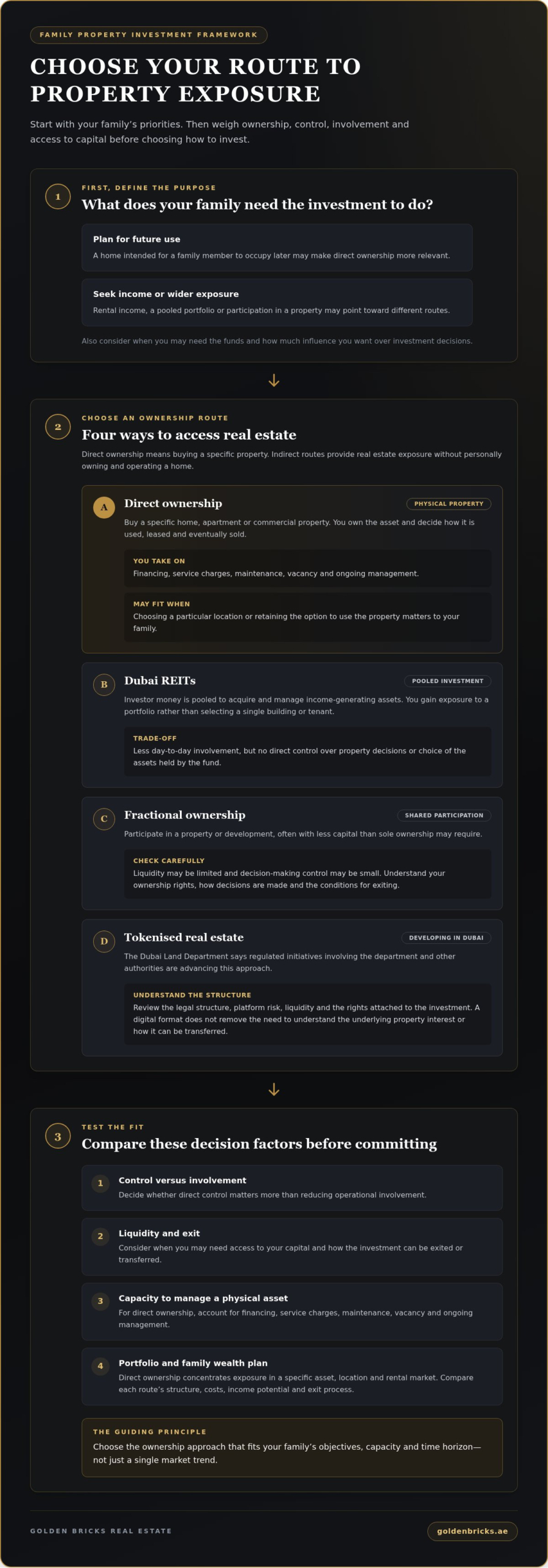
Direct investment means buying a specific home, apartment or commercial property in the UAE. You own the asset and make decisions about its use, leasing and eventual sale. For example, a family buying an apartment can select its location and oversee the tenancy. That control also brings responsibility for financing, service charges, maintenance, vacancy and ongoing management.
Indirect investment provides real estate exposure without personally owning and operating a property. Dubai REITs pool investor money to acquire and manage income-generating assets. Investors gain exposure to a portfolio rather than selecting a single building or tenant. This approach can reduce day-to-day involvement, but investors do not directly control property decisions or choose the assets held by the fund.
Fractional ownership offers another way to participate in a property or development, often with less capital than sole ownership may require. In Dubai, liquidity may be limited and investors may have little decision-making control. Before investing, identify the rights attached to the ownership interest, how decisions are made and the conditions for exiting.
Tokenised real estate is also developing in Dubai. According to the Dubai Land Department, regulated initiatives involving the department and other authorities are advancing this approach. Consider the legal structure, platform risk, liquidity and rights attached to the investment. A digital format does not remove the need to understand the underlying property interest or how you can transfer it.
Use a practical comparison before choosing a route. Decide whether direct control matters more than reduced operational involvement. Then assess how soon you may need access to your capital, whether you can manage a physical asset and how much influence you expect over investment decisions. A family prioritising a chosen home for future use may favour direct ownership. One seeking wider real estate exposure may consider a pooled investment.
Finally, consider how each route fits the rest of your portfolio and family’s wealth plan. Direct ownership concentrates exposure in a specific asset, location and rental market. Indirect options can change the form of exposure, but each has its own liquidity and control considerations. Compare the investment’s structure, costs, income potential and exit process before committing. To explore Dubai property opportunities alongside these considerations, review property investment options.
3. Developer reputation and project due diligence
A first-time UAE property investor should define the investment’s purpose, assess affordability, compare suitable locations, and review the developer and project before committing. For an off-plan purchase, examine delivery history, construction and handover risks, payment obligations, and the future rental or resale market.
Start by reviewing the developer’s record of delivering projects on time. Compare completed developments with stated delivery commitments, and consider whether their quality and location suit your investment objective. Completed handovers can inform your assessment, but they do not replace project-specific due diligence. Examine the development you are considering, not only the developer’s best-known project.
Assess what is being built and how the property fits its setting. Review the unit layout, facilities, access to public transport, nearby schools and the surrounding area’s likely appeal to residents or tenants. A family-focused apartment may attract a different tenant profile from a compact unit near business districts. Consider whether that demand aligns with your intended holding period.
Read the payment schedule alongside your household’s available funds and any mortgage commitments. Map each instalment against its due date and your expected cash flow, then consider how you would meet payments if your income or rental plans changed. Do not rely on projected rent alone to fund every obligation. Include ongoing costs, possible vacancy and maintenance in your assessment of the property’s financial exposure.
Assess construction and handover risk separately. Consider how a delay could affect your planned move-in date, rental start, financing arrangements or eventual resale timing. Compare the project’s stated schedule with your family’s needs, and do not treat a planned completion date as a guaranteed income date. If the investment is intended for future family use, a mismatch between the handover date and that need may change your strategy.
Assess the exit as carefully as the purchase. Consider who might rent or buy the property, what comparable homes offer and whether the location suits your intended use. Evaluate future rental or resale demand based on the property’s features and area, not broad market optimism. Reviewing developer delivery, project details, payment obligations, mortgage exposure and exit prospects gives first-time investors a clear basis for comparing off-plan opportunities.
4. Economic conditions that may support property investment
Property values may appreciate over time, particularly in well-developed, high-demand locations. This can support family wealth, but the purchase price still shapes an investment’s potential. Assess demand, expected holding period, rental prospects and ongoing costs together. A location attracting growing interest may still be unsuitable if its purchase price strains household cash flow.
Ownership terms for foreign buyers vary by emirate and property location, so assess the registered ownership structure and contractual rights. Legal protections depend on the ownership arrangement and transaction documents, making it essential to understand both before investing.
The upfront deposit and purchase costs depend on the property, transaction and mortgage arrangement. Build a budget that includes the initial payment, financing costs, registration expenses and any immediate maintenance or renovation needs.
UAE property investors should account for applicable taxes and registration fees, as well as recurring service charges, maintenance, financing costs, vacancy and management fees. Costs depend on the transaction and property, so include each category when estimating net returns.
For location analysis, compare demand with practical infrastructure and family needs. Consider access to schools and public transport, then assess the area’s growth potential and the property’s appeal to likely tenants. These factors help distinguish a durable rental market from a location chosen only for current interest.
Evaluate opportunities in Dubai and Abu Dhabi against local demand, price appreciation and regulatory changes. A well-developed area with strong demand may support value growth, while inflation and rising rents can make ownership more attractive. Neither factor replaces careful assessment of the purchase price, financing and net rental income.
Vacancy can interrupt rental income, while service charges and maintenance continue to reduce net returns. Property values may also decline when market conditions shift, so assess how a weaker resale price would affect your intended holding period. An investor relying on a sale to fund a family expense faces different risks from one planning long-term ownership.
Before investing, compare the initial cost with likely holding costs and the property’s demand drivers. Track rental demand, price movements and regulatory changes as conditions evolve. A property that fits your family’s horizon and can withstand periods of vacancy is better positioned to contribute to lasting financial security.
5. What are current property prices and rental yields in Dubai and Abu Dhabi?
The national property market does not have one representative property price or rental yield. Values vary by location, property type, size, condition and demand, while net returns also reflect financing, service charges, vacancy and management costs when securing a property investment for my family’s future. Compare similar properties: an apartment in a central urban district is not a useful benchmark for a suburban family home.
Define the property profile before making a purchase comparison. Set the region, neighbourhood, residential type, size and condition, then compare homes with similar features. A ready apartment and an off-plan unit have different payment timings and delivery risks. Asking prices alone do not show the total cash commitment or whether an asset suits your intended holding period.
Calculate rental yield consistently. Divide expected rental income over the chosen period by the property’s purchase price, then assess the result against costs. For example, compare two similar apartments using their expected annual rent and purchase prices, then subtract financing costs, service charges, maintenance, vacancy and management fees. The net figure is more useful for decisions than gross rent alone.
Different regions contain varied neighbourhoods, so nationwide averages can obscure an investor’s choices. Assess a specific area’s tenant demand, access to transport, nearby schools and growth prospects. A property near public transport may attract a different tenant profile from a larger home designed for family living. Match local demand to the property’s layout and intended audience.
For buy-and-hold ownership, performance depends on the purchase price, rental demand, financing costs, service charges and market conditions. Consider how these factors interact. Higher rent does not automatically make an investment stronger if acquisition or operating costs are also higher. Likewise, a lower-priced property may still deliver weak net returns if vacancy is persistent or tenant demand is limited.
Build a comparison sheet for each property you evaluate. Record its asking price, expected rent, financing assumptions, recurring costs and likely tenant profile. Keep gross income separate from net income, and test the calculation against periods without a tenant. Then compare the result with your family’s holding horizon and intended use, whether rental income, future occupation or eventual sale.
Property management is relevant when you want support overseeing a rental asset and its ongoing requirements. To discuss property management for rental properties through Golden Bricks Real Estate, connect the expected income and operating costs to the property’s location and tenant demand. This keeps the comparison focused on the asset’s net contribution, rather than headline prices or yields alone.
Golden Bricks Real Estate: Exclusive Off-Plan Projects
Golden Bricks Real Estate offers Exclusive Off-Plan Projects for investors assessing purchases before completion. Use its Project Curation to compare opportunities with your family’s intended use, investment horizon and tolerance for delivery risk. If you prefer an existing home, Exclusive Ready Properties offer another route to direct ownership. The distinction matters: off-plan purchases involve construction and handover considerations, while ready properties let you assess the completed asset and its current condition.
After purchase, Property Management can help owners oversee a rental property and its ongoing requirements. Consider this service when rental income is part of your plan but you want support managing the asset. Contact Golden Bricks Real Estate to discuss property options suited to your investment priorities.
Move from research to a considered next step
Turn your family’s priorities into a clear investment brief. Define the intended use, preferred emirate, ownership horizon and level of involvement you can sustain. This gives your search a practical standard, helping you judge opportunities against your needs rather than market noise. A considered approach to securing a property investment for my family’s future starts with choices your household can maintain over time.
Golden Bricks Real Estate can help you explore Exclusive Off-Plan Projects or Exclusive Ready Properties, with Property Management for owners overseeing rental assets. The right route depends on whether you seek a property under development, a completed home or support with ongoing management. Each option serves a different investment plan, so keep your family’s objectives at the centre of the discussion.
Contact Golden Bricks Real Estate to discuss a property approach aligned with your priorities. A deliberate next step can help you build a more confident foundation for your family’s plans.
Frequently Asked Questions
Why Should I Add Real Estate to My Portfolio?
Real estate can add an asset with different income and value drivers to a portfolio of financial investments. In the UAE, a property may provide a home for family use, rental income or sale proceeds later. A family balancing property with shares and cash can consider how each asset responds to changing income needs. Property is less readily sold than listed investments, so account for access to funds when deciding its role.
Should I invest in residential or commercial property in Dubai?
Choose residential property if household use or a broad pool of potential tenants is important; consider commercial property if its specific business use and lease profile suit your plan. Commercial investments can require more capital and involve more complex lease negotiations than residential investments. Compare likely tenant demand, lease terms, operating responsibilities and your intended holding period. A residential home may also have value for family use, while commercial property depends more directly on business demand.
What Makes a Property Investment Strategy Successful?
A sound strategy connects the asset to a defined objective and a realistic exit plan. Before committing, write down why you are buying, how you will fund ongoing costs, and what conditions would lead you to hold, rent or sell. A family saving for a future education expense should consider whether the sale can be timed to meet that need. Review the plan as income, family responsibilities or market demand changes, rather than relying on one original assumption.
What types of property investments in the UAE can provide long-term financial security for a family?
Families can consider direct ownership of residential property, buy-and-hold rentals, off-plan projects, commercial assets, REITs, fractional ownership and tokenised real estate. Each offers a different balance of control, involvement and access to capital. A home intended for future family use differs from a pooled fund or rental asset. Compare ownership rights, operating obligations and exit arrangements to determine which structure fits your family’s objectives and financial capacity.
How do UAE property investment returns compare with stocks, bonds, and savings accounts?
There is no single return comparison that applies across UAE property, stocks, bonds and savings accounts. Property may generate rent and changes in asset value; stocks can produce dividends and price movements; bonds may pay interest; and savings accounts provide deposit interest. Compare each option over the same period, using net returns after relevant costs and considering volatility, liquidity and income timing. The right fit depends on each asset’s role in your portfolio.
What taxes, registration fees, and ongoing costs apply to UAE property investors?
Ongoing costs can include financing, insurance, service charges, maintenance, vacancy, management and possible renovation expenses.
Which UAE areas have strong rental demand, infrastructure, and long-term growth prospects?
Look for locations with good schools, public transport access and growth potential. Assess local demand, potential price appreciation and regulatory changes when comparing areas.