The nation recorded 3,123 off-plan commercial property sales in H1 2026, compared with 1,239 in H1 2025. That sharp increase is a defining signal in commercial property investment trends UAE 2026, although growth alone doesn’t determine whether an asset is right for an investor.
For investors considering off-plan commercial property, early entry can provide access to new business districts and evolving workplace formats. But timing, location, delivery risk and future tenant demand all shape the investment case.
This outlook examines where commercial activity is strengthening, what the off-plan surge may mean for the broader market, and how foreign ownership policies influence market access. It weighs potential benefits, including longer lease terms and income diversification, against risks that call for careful assessment.
Explore the UAE market through its latest transaction signals, office, retail and logistics demand, investment considerations and ownership framework, brought to you by Golden Bricks Real Estate. The aim is a measured view of opportunity, grounded in the factors that influence long-term value rather than growth figures alone.
Key Takeaways
- Compare office, retail and logistics assets by their distinct demand drivers, from flexible office layouts to access to major transport routes.
- Off-plan commercial activity is rising, but project location, delivery timing and the strength of future tenant demand remain central to the investment case.
- Foreign investors can purchase commercial property in designated Dubai freehold areas; ownership rules for a business and property ownership are separate considerations.
- Assess exposure to economic cycles and older office stock, as tenant demand and lease arrangements can influence income stability.
- Prime commercial assets may offer longer lease terms and stable income potential, while actual returns depend on location, tenants and market conditions.
What does the H1 2026 Dubai Commercial Real Estate Market Report cover?
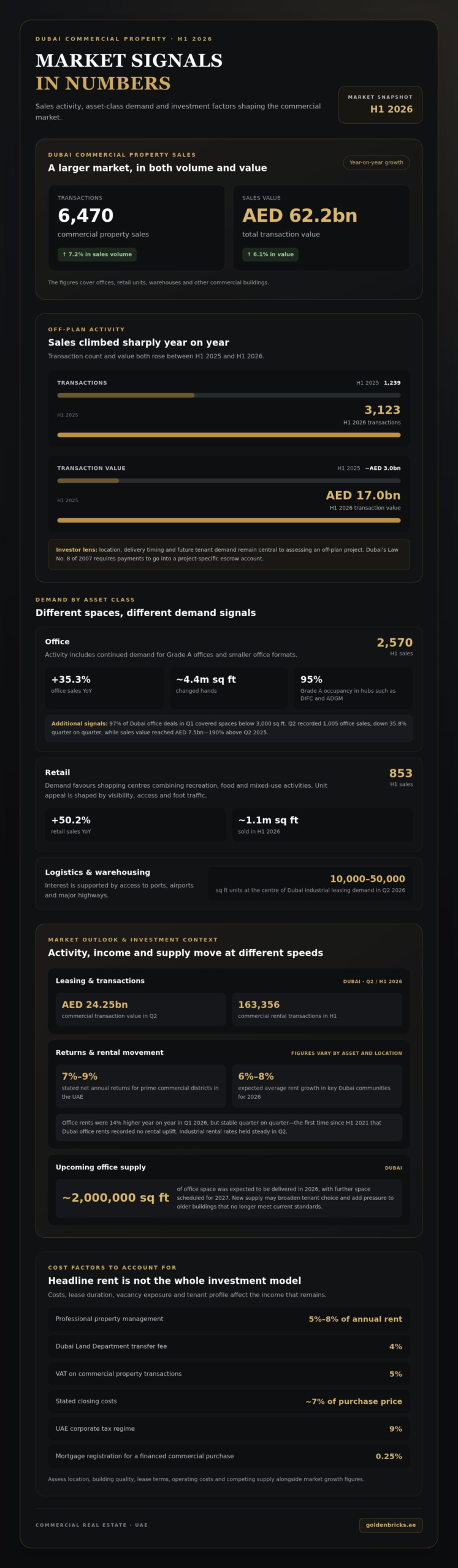
Dubai recorded 6,470 commercial property sales worth AED 62.2 billion during H1 2026. Sales volume rose 7.2% year on year, while sales value increased 6.1%. The market picture spans office space, retail units, warehouses and other commercial buildings, with distinct demand drivers across each asset class.
Market activity remained robust in that period. Rent and pricing for retail, industrial and warehouse assets, including Abu Dhabi commercial property, depend on location, building quality, unit format and lease terms.
Office sales reached 2,570 transactions in H1 2026, up 35.3% year on year. Approximately 4.4 million sq.ft. changed hands, indicating continued activity across the office market. In Q2, 1,005 offices sold, down 35.8% quarter on quarter, while sales totalled AED 7.5 billion. That value was 190% higher than Q2 2025, showing how transaction counts and values can move differently.
Demand is particularly strong for Grade A offices in Dubai and Abu Dhabi, with businesses favouring functional space, good access and flexible layouts. Grade A occupancy in hubs such as DIFC and ADGM hovers at 95%. Business Bay, DIFC, Downtown Dubai and Dubai Internet City are identified as popular office locations with high occupancy and stable rental growth. Smaller offices also remain relevant: 97% of Dubai office deals in Q1 2026 covered spaces below 3,000 sq ft.
Retail sales rose 50.2% year on year to 853 transactions in H1 2026, with approximately 1.1 million sq.ft. sold. Demand favours shopping centres combining recreation, food and mixed-use activities. For an individual retail unit, visibility, access and surrounding foot traffic shape its commercial appeal.
Logistics demand is supported by access to ports, airports and major highways. Warehousing and logistics properties near major transport routes are attracting increased interest. Dubai industrial leasing demand centred on units of 10,000-50,000 sq ft in Q2 2026, a useful reference when comparing warehouse formats and tenant requirements.
Off-plan commercial sales climbed to 3,123 transactions in H1 2026, compared with 1,239 in H1 2025; transaction value reached AED 17.0 billion from approximately AED 3.0 billion. For off-plan UAE property investments, Law No. 8 of 2007 requires payments to go into a project-specific escrow account, according to Dubai Government. Investors working with Golden Bricks Real Estate can use this legal safeguard alongside location, delivery timing and tenant-demand analysis when assessing a project.
UAE commercial real estate market outlook
Dubai’s commercial real estate market recorded AED 24.25 billion in transaction value in Q2 2026. During H1 2026, it registered 163,356 commercial rental transactions, reflecting active leasing alongside investment sales. Demand is driven by business expansion and diversification, including activity in technology, logistics, healthcare and finance. Small and medium enterprises, regional headquarters and multinational companies also contribute to space requirements. For investors researching “commercial property investment trends UAE 2026,” these activity levels provide context, not a substitute for asset-level analysis.
Returns vary by asset, tenant profile, lease terms and emirate. Prime commercial districts in the UAE are stated to deliver 7% to 9% net annual returns, while Dubai, Abu Dhabi and other emirates should be assessed against their individual locations and operating conditions. Compare net income after operating costs, then assess vacancy exposure and lease duration rather than relying on a headline yield alone.
For 2026, average rent growth in key Dubai communities is expected to be around 6-8%. Office rents were 14% higher year on year in Q1 2026, although average rents were stable quarter on quarter. The quarter also marked the first time since H1 2021 that Dubai office rents recorded no rental uplift. Industrial property rental rates held steady in Q2 2026, showing that growth differs by asset class.
Supply is moving alongside demand. Approximately 2,000,000 sq ft of office space was expected to be delivered in Dubai in 2026, with further space scheduled for 2027. This can broaden tenant choice and place greater pressure on older buildings that no longer meet current standards. In Jumeirah or another established district, assess each development against access, building quality and competing supply, not location prestige alone.
Operating costs shape the income that remains after rent collection. Professional property management in the UAE typically costs between 5% and 8% of annual rent. Commercial transactions also involve separate cost categories: the Dubai Land Department transfer fee is 4%, VAT on commercial property transactions is 5%, and stated closing costs are approximately 7% of the purchase price.
Tax treatment and financing can further affect net returns. The UAE introduced a 9% corporate tax regime in June 2023, while mortgage registration for a financed commercial purchase is stated at 0.25%. Include these items in the investment model alongside maintenance, insurance, service charges and tenant incentives. A warehouse, for example, may have different operating demands from a multi-tenant office building.
Oversupply remains a specific risk in some areas, particularly older office stock that no longer meets current standards. Commercial tenants’ turnover depends on lease arrangements and business cycles, making tenant quality and lease structure central to resilience. A second lens on “commercial property investment trends UAE 2026” is how each asset performs under changing occupancy and cost conditions. Investors can use commercial property market intelligence to compare asset types, locations and income assumptions.
Business-friendly policies and foreign ownership
UAE business policies support commercial activity through free zones and mainland licences. In Dubai, foreign investors can buy commercial property in designated freehold areas. Property ownership is separate from permission to conduct business on the premises. A company’s licensing route and a building’s permitted use determine how an investor can occupy or lease an asset.
Dubai allows 100 percent foreign ownership in many sectors. Following 2021 updates to the Commercial Companies Law, international corporations can often have 100% ownership of UAE mainland companies. These provisions can make local business structures more accessible, but company ownership and ownership of a specific property remain distinct questions. Investors comparing a free-zone entity with a mainland licence should map each structure to the intended business activity and property use.
Property ownership can also intersect with residency planning. The UAE Golden Visa property investment threshold described on the page is AED 2,000,000 for 10-year residency, according to Dubai Land Department. This threshold relates to the visa pathway, not to a general minimum purchase price for commercial real estate. Investors should distinguish residency eligibility from the separate rules governing title, permitted use and business licensing.
For an industrial asset, assess whether its location and permitted use suit the operating model. A warehouse serving logistics activity may need access to transport routes, while a customer-facing business may prioritise nearby population, visibility and accessibility. These criteria do not replace ownership rules; they help establish whether a property can support its intended commercial use.
Policy access varies by emirate, zone and business activity. Free zones and mainland licences support demand for commercial premises, but investors should compare the requirements of their enterprise with the asset’s location. A Dubai freehold purchase, for example, establishes property title, not a company’s permission to operate.
Separate the decision into clear stages: identify the asset’s ownership framework, match its intended use to the relevant business licence, and assess residency objectives independently. This helps avoid a common planning mistake: assuming a property purchase automatically resolves company setup or immigration requirements. For international investors, clarity on these distinctions matters as much as the property’s location.
Commercial property risk and economic sensitivity
Commercial property demand in the UAE is cyclical and more closely tied to economic performance than residential demand. When companies expand, they may lease offices, warehouses or retail premises; during a contraction, they may delay expansion or reduce occupied space. Assess the economic base supporting each property, including the sectors and businesses likely to occupy it.
The Q1 2026 Dubai office market report revised the UAE GDP growth forecast to 0.3%. This indicator does not determine an individual building’s performance, but it underlines why an investment case should account for changes in business activity. A technology office, a logistics warehouse and a retail unit can respond differently to the same regional conditions because their tenants serve different customers and operating needs.
Tenant turnover is another direct risk. Commercial tenants’ turnover depends on lease arrangements and business cycles. A long lease may provide a more predictable income schedule, while expiry can bring vacancy, fit-out periods or renegotiation. Review each tenant’s business activity, lease duration, renewal provisions and payment record. In a multi-tenant building, map expiry dates across the rent roll to spot the risk of clustered vacancies.
Oversupply matters most where new developments compete with older stock that no longer meets current standards. An older Dubai office may come under pressure if businesses prefer better access, flexible layouts or more functional premises. Compare the property with nearby competing supply, then assess building condition, transport links and tenant requirements. A strong address cannot make up for a mismatch with occupier needs.
Assess income alongside operating conditions. Model rent collection, vacancy periods, maintenance, service charges and tenant incentives against the lease structure. A warehouse serving logistics activity, for example, depends on tenant demand and transport access, while retail performance is influenced by visibility and customer footfall. A single market-wide assumption can hide these asset-specific risks.
Regional diversification can reduce reliance on one tenant segment, but it does not eliminate economic exposure. Compare opportunities in Dubai and Abu Dhabi by tenant mix, lease profile, building quality and local demand drivers. Test how income would change if a tenant leaves, renewal is delayed or competing developments attract occupiers. This helps distinguish durable property fundamentals from returns tied to a single business cycle.
Commercial property investment benefits
Commercial assets can combine rental income with longer lease horizons. In the UAE, corporate commercial property contracts frequently span 5 to 10 years. Longer agreements can give owners greater income visibility than short residential leases, while established tenants may support continuity. The value of that benefit depends on tenant strength, lease terms, location and the costs required to maintain the building.
Prime UAE districts are stated to deliver 7% to 9% net annual returns. Prime Dubai commercial properties are also associated with stable rental yields, long-term tenant contracts and lower vacancy risk. These characteristics can attract investors seeking income-producing assets, but the net figure must be considered alongside operating expenses, lease obligations and vacancy exposure. A well-located office with a reliable tenant may present a different profile from a retail unit dependent on foot traffic.
Commercial property can diversify an investment portfolio. Offices, logistics facilities and retail premises serve different sectors, so their income drivers vary. UAE demand is supported by activity in technology, logistics, healthcare and finance, as well as small and medium enterprises and regional headquarters. Compare tenant industries and leasing demand to see whether an asset’s income depends heavily on one business segment.
Building quality may influence leasing appeal and rental income. In the UAE, LEED Gold or Platinum certified buildings command rental premiums of 12% to 18% compared with non-certified buildings. That difference makes building performance and tenant preferences relevant to asset selection. Investors can assess energy efficiency alongside access, layout and building condition, then compare those features with the requirements of likely occupiers.
As companies establish offices, distribution operations or customer-facing premises, expansion can create leasing opportunities. Dubai’s commercial market includes demand for flexible offices and mixed-use spaces, while logistics interest favours locations near ports and major transport routes. A warehouse and a Grade A office have distinct operating profiles. Match the property type to its tenant base and assess whether local infrastructure supports ongoing business use.
Financing can preserve capital for other investments, while a cash purchase avoids borrowing costs. Non-residents seeking a UAE commercial mortgage are stated to need a down payment of at least 40% of the property value. The mortgage registration fee for a financed commercial purchase is 0.25%. Lending terms depend on the financing structure, property value and borrower’s financial position, so include repayment obligations when assessing net income.
Ownership is only one part of performance; ongoing oversight affects tenant experience and asset condition. A considered property management approach can support lease administration, maintenance planning and consistent operations. To assess how management fits your commercial investment strategy, discuss property management as part of your asset plan.
Golden Bricks Real Estate: Exclusive Off-Plan Projects
Golden Bricks Real Estate helps investors assess commercial opportunities through its Exclusive Off-Plan Projects and Exclusive Ready Properties. Its Project Curation service supports comparisons of developments, locations and potential tenant demand, particularly when weighing off-plan entry against an income-producing asset.
Investors can also use Golden Bricks Real Estate’s Property Management service for ongoing oversight. Engage during asset selection or before committing to a purchase, when location, intended use and investment priorities can guide the comparison. This connects market analysis with a practical property decision, without treating projected growth as a substitute for due diligence.
For a discussion of commercial property opportunities, contact Golden Bricks Real Estate.
Position Your Next Move with Long-Term Value in View
The commercial property investment trends in the UAE for 2026 offer a framework for making more deliberate decisions, not a substitute for a clear investment mandate. Before selecting an asset, define the income profile, holding horizon and level of operational involvement that suit your objectives. Then compare opportunities against those priorities, rather than letting market momentum set the strategy.
Golden Bricks Real Estate offers Exclusive Off-Plan Projects and Exclusive Ready Properties for investors comparing entry points. Its Property Management service supports owners who need ongoing oversight of commercial assets. Each option serves a different stage, from acquisition planning to ownership operations.
If you are ready to evaluate opportunities against your investment priorities, contact Golden Bricks Real Estate. A considered next step can help turn market insight into a property decision aligned with your longer-term plans.
Frequently Asked Questions
Is off-plan commercial property growing in Dubai?
Yes. Dubai recorded 3,123 off-plan commercial property sales in H1 2026, compared with 1,239 in H1 2025. The increase indicates expanding activity, but transaction growth alone does not establish a project’s investment quality. Compare the development’s location, intended commercial use, delivery schedule and likely tenant demand. For an off-plan purchase, also understand the payment structure and how project-specific escrow arrangements apply.
What is happening in Dubai’s office property market?
Dubai offices saw rising H1 transaction activity alongside a more mixed quarterly picture. H1 2026 office sales reached 2,570 transactions, up 35.3% year on year, while Q2 sales volume fell 35.8% quarter on quarter. This contrast makes the comparison period important. Investors can examine transaction count, value, unit size and building grade together to distinguish broad demand from activity concentrated in particular office formats.
What is Driving the Commercial Demand?
Business expansion and economic diversification support commercial demand across the UAE. Activity in technology, logistics, healthcare and finance creates varied space needs, from offices to distribution facilities. Small and medium enterprises, regional headquarters and multinational companies also contribute to demand. The practical question for investors is which businesses are likely to occupy a particular property, and whether its location and layout suit their operating needs.
What should I consider before buying commercial property?
Start by matching the asset to a defined tenant profile and intended use. Compare location, accessibility, parking, building quality, future infrastructure, market demand, tenant profile and operating costs. Then review lease terms, tenant concentration and upcoming expiries. A retail unit, for example, relies on visibility and surrounding foot traffic, while a warehouse depends more on transport access and suitability for logistics operations.
Which areas are popular for commercial property investment?
Business Bay, DIFC, Downtown Dubai and Dubai Internet City are popular commercial locations, particularly for offices, and are associated with high office occupancy and stable rental growth. Jebel Ali and Dubai South are noted for industrial activity and logistics assets. Compare locations by tenant base, access, competing supply and property type; a well-known district does not make every asset equally suitable.
What are the 2026 commercial real estate investment trends in the UAE?
Key themes include stronger off-plan commercial activity, demand for flexible office formats, mixed-use retail and logistics properties near major transport routes. Dubai off-plan commercial transaction value reached AED 17.0 billion in H1 2026, compared with approximately AED 3.0 billion in H1 2025. Investors can use these shifts to shortlist asset types, then test whether local tenant demand supports the intended holding strategy.
Which UAE cities and districts offer the strongest commercial property investment opportunities in 2026?
Business Bay, DIFC, Downtown Dubai and Dubai Internet City stand out for office activity, while Abu Dhabi also has strong demand for prime Grade A offices. Jebel Ali and Dubai South are relevant logistics locations for industrial property. The “strongest” location depends on asset type and investment priorities. Compare tenant demand, access, building quality, lease profile and competing supply before ranking districts.
What is driving demand for UAE offices, logistics, retail, and hospitality properties?
Office demand is supported by business formation, regional headquarters and companies expanding in sectors such as finance and technology. Logistics demand benefits from proximity to ports, airports and major highways. Retail activity favours destinations that combine shopping with dining, recreation and mixed-use spaces. Hospitality properties serve visitor-oriented operations, so assess operator requirements, access and surrounding activity rather than assuming demand follows other commercial sectors.