
A developer’s reputation is only one part of an off-plan purchase; the project’s registration, escrow arrangements and your own purchase record matter just as much. At Golden Bricks Real Estate, we understand that learning how to verify an off-plan developer in Dubai means checking the developer and project through Dubai Land Department services, confirming that instalments go to the project’s escrow account, and ensuring the sale is recorded through Oqood.
Look beyond a polished brochure: a developer’s track record cannot replace current checks on the specific project and transaction. A careful review helps you establish what is documented, what needs closer scrutiny and how the details fit together before you commit.
This guide provides a practical sequence for reviewing project registration, construction updates, escrow details, developer credentials and the records of the brokers or real estate companies involved. It also explains how to assess payment schedules and match transaction documents, so your decision is based on verifiable details rather than presentation alone.
Key Takeaways
- Assess a developer’s completed projects for delivery quality and consistency, not reputation alone.
- Match each instalment’s destination to the correct project account and review how the payment schedule relates to construction milestones.
- Distinguish the developer’s role from the broker’s or real estate company’s, then check each party’s relevant registration.
- Compare project records with your sale documents so the property, parties and transaction details align before you proceed.
Checking project completion through Dubai REST and Dubai Land Department
To understand how to verify an off-plan developer in Dubai, compare official project records with dated construction information and sale documents. Review each source before committing, as project details and status can change.
-
Check Construction Progress and Approvals
Compare the stated construction stage with dated site updates and available project approvals. A Project Registration Certificate records land ownership details, official RERA approvals and developer obligations. Check that the project name and developer match the documents for the unit you are considering.
Treat media coverage and industry recognition as context, not proof of delivery. An award or article about a developer, for example, does not establish the current progress of a specific project. Compare the project name and reporting date with the materials you have.
-
Confirm Project Registration and Status
Search for the project and developer through Dubai REST or Dubai Land Department digital services. Confirm that the displayed project identity matches the sale documents, then check its status again before committing. Verify that your purchase is recorded through Oqood and retain the electronically issued provisional registration certificate.
To compare a unit’s title, plot number and ownership details, match identifiers in the project records against the sale documents. The Sales and Purchase Agreement for an off-plan sale should be registered in the provisional register within 90 days of signing.
Registration and transfer charges depend on the applicable DLD fee items and transaction documents. Review the itemized breakdown before signing.
-
Review Permits and QR Codes
Check the Trakheesi permit details and scan the Madmoun QR code shown in the property advertisement. Compare the displayed project, unit and advertiser information with the sale documents, and note any differences in names or identifiers.
Use these checks when deciding how to verify an off-plan developer in Dubai before committing. Warning signs include inconsistent project details, changing status information or payment instructions that do not match the transaction documents. If a delay, cancellation or dispute occurs, preserve dated communications and contract records. Organize these documents and the SPA when preparing a complaint for DLD or RERA.
Checking project escrow account information
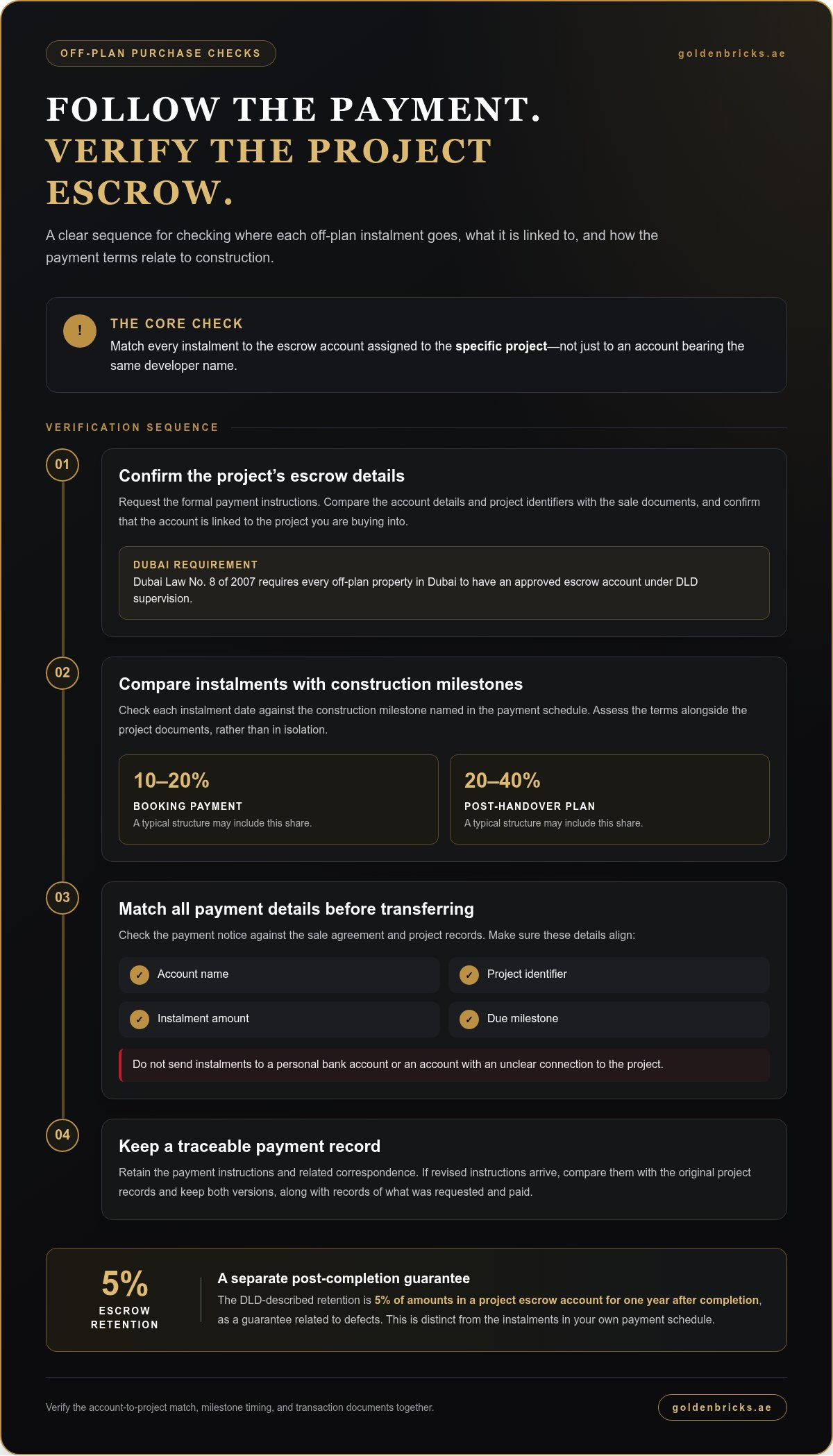
Trace each instalment to the account assigned to the specific Dubai project. Match the account details against the project documents and payment schedule before transferring funds.
-
Confirm Project Escrow Account Details
Ask for the project’s escrow account details in its formal payment instructions, then compare the account and project identifiers with your sale documents. Dubai Law No. 8 of 2007 requires every off-plan property in Dubai to have an approved escrow account under DLD supervision, according to Dubai Land Department.
Check that the account is linked to the project you are buying into, not merely to the same developer. Avoid sending instalments to a personal bank account or one with an unclear project connection. Keep the payment instructions and related correspondence with your transaction records.
-
Review Payment Plans and Escrow Withdrawals
Compare each instalment date with the construction milestone named in the payment schedule. It is sensible to check whether payment dates align with construction progress rather than accepting them without question. A typical structure may include a booking payment of 10-20% and a post-handover plan of 20-40%; assess these terms alongside the project documents, not in isolation.
For escrow withdrawals, account for the retention described by Dubai Land Department: 5% of amounts in a project escrow account are retained for one year after completion as a guarantee related to defects. This retention is distinct from the instalments in your own payment schedule.
- Before paying, match the account name, project identifier, instalment amount and due milestone across the payment notice and sale agreement. If revised instructions arrive, compare them with the original project records and preserve both versions. This creates a clear record of what was requested and paid.
Do not treat a familiar developer name as proof that a payment destination belongs to the project. The account-to-project match is central to escrow verification. For a broader assessment, compare escrow terms with the project’s registration, construction status and unit documents. Explore curated off-plan projects as part of your property review.
Reviewing a developer’s completed projects and reputation
Assess delivery evidence across completed projects rather than relying on reputation alone. In Dubai, compare the developer’s claims with completed buildings, handover records and observable upkeep.
- List completed projects under the same developer’s name. Match each project to its location, building identity and completion information. Separate projects delivered directly by the developer from those involving another development entity. A portfolio page naming a project, for example, is a starting point, not proof of the developer’s role in its delivery.
- Compare delivery statements with project-level records and dated evidence. Note the announced completion period, actual handover information and any explanations for changes. Assess each project separately: one completed development does not establish another’s delivery history.
For a completed Dubai building, inspect the entrance, shared areas and visible maintenance. Compare your observations with the quality standards presented in the current project’s materials.
- Review the handover experience using documented owner feedback and property records. Look for recurring, specific themes, such as unresolved defects, communication gaps or clear handover procedures. Distinguish a detailed account of a named development from general online praise or criticism.
Check whether feedback concerns the developer, building management or a separate contractor. These roles can affect owners’ experience of maintenance and post-handover communication.
- Assess reputation across multiple sources and projects. Compare developer statements, media coverage, industry recognition and owner accounts against identifiable developments. An award or positive article provides context, but does not establish completion quality or answer questions about a particular project.
Build a concise comparison of project name, location, delivery evidence, observed condition and reported owner issues. Use it to identify consistent strengths or recurring concerns before assessing the proposed development.
- Apply the same scrutiny to the developer’s current claims. Match named team members, development entities and project experience to the property being marketed. Treat experience associated with a different company as separate evidence unless project records connect it to the developer you are reviewing.
Use this comparison to form a balanced view of delivery history, quality and reputation, then weigh it against the project’s current approvals and transaction documents.
Verifying developers, brokers, and real estate companies
First distinguish the developer from the brokerage and individual broker. Compare each party’s stated role with the names and responsibilities in the transaction documents.
- Start with the sale agreement, reservation documents and project materials. Record the developer’s full legal name, the brokerage’s name and the broker’s name. Check that each document assigns the same role to the same entity. For example, do not mistake a marketing company for the registered developer.
Note differences in spelling, trading names or company identities. Reconcile them with formal transaction records before relying on a brand name or sales presentation.
- Check the developer’s RERA registration through the Dubai REST App, the official Dubai Land Department website or a Real Estate Services Trustee Center. Compare the registered identity with the developer named in the relevant project documents.
Dubai Land Department and RERA register developers and off-plan projects. Review the developer’s record separately from the broker’s or real estate company’s credentials: one party’s registration does not establish another’s status.
- Review the broker’s identity in the advertisement, correspondence and transaction paperwork. Confirm that the person communicating with you is consistently identified and that the brokerage they represent is clear. Compare those details with the project and developer named in the sale documents.
If a broker presents a project under one company name but the agreement names another, identify the documented relationship between the parties. A matching logo or email signature alone does not establish that relationship.
- Assess the real estate company as a separate party. Match its stated marketing or sales role with the entities named in the project documents. Keep copies of advertisements and correspondence so you can trace who made each representation.
A complete review of the parties involved in an off-plan purchase includes identifying who is responsible for each part of the transaction. Once the roles align, review Dubai off-plan opportunities against your investment criteria.
Golden Bricks Real Estate: Exclusive Off-Plan Projects
Once you have reviewed the project and transaction records, Golden Bricks Real Estate can help you explore opportunities through its Exclusive Off-Plan Projects and Project Curation services. Keep the same disciplined approach: assess each project on its own registration, escrow arrangements, delivery record and documented terms.
If your review points to a completed property, Exclusive Ready Properties offer another category to consider. Property Management may suit your needs after acquisition. These services complement due diligence; they do not replace checks of the specific project and sale documents.
For a considered discussion of your property requirements, contact Golden Bricks Real Estate or visit goldenbricks.ae.
Make Your Next Property Decision Deliberately
When deciding how to verify an off-plan developer in Dubai, treat the review as an investment decision, not a paperwork exercise. Set your criteria before making a reservation: decide which project records, delivery evidence and contract terms must align, and which discrepancies would make you pause. This helps distinguish a persuasive presentation from a proposition that fits your portfolio.
Bring your findings together in a concise decision file. Record the documents supporting each conclusion and any outstanding questions that affect your assessment. Compare the opportunity with your broader objectives, including intended use, holding period and capacity to manage construction-stage uncertainty. Proceeding, seeking clarification or declining can each be considered decisions when guided by clear criteria.
Golden Bricks Real Estate can be part of your next discussion as you assess property options against those priorities. Discuss your property requirements with Golden Bricks Real Estate and move forward with a considered view.
Frequently Asked Questions
How do I check a Dubai developer’s registration with DLD or RERA?
Search the developer’s exact legal name through the Dubai REST App, the official Dubai Land Department website or a Real Estate Services Trustee Center. Compare the registered name with the entity named in the project documents, as a brand name may differ from the legal developer. Check the project and developer separately, then keep a dated record of the information reviewed.
Where can I check a Dubai off-plan project’s status and completion percentage?
Use Dubai REST or Dubai Land Department digital services to look up the project and its current registration status. To assess construction progress, compare dated project updates with the stated stage and any available completion information. A percentage is meaningful only when it refers to the same project and a clear reporting date; figures from different dates cannot be compared reliably.
How can I review a Dubai developer’s track record and completed projects?
Build a record for each project, including its name, location, handover information and visible building condition. Check whether the same legal developer delivered it, rather than an associated brand or separate entity. For example, compare owner feedback about handover or maintenance with your observations of a completed building, and distinguish project-specific evidence from general online commentary.
How do I verify a Dubai off-plan sales permit and advertising permit?
Review the Trakheesi permit details and scan the Madmoun QR code displayed in the property advertisement. Compare the returned information with the advertised project, unit and advertiser, then retain a copy of the advertisement and permit details. If a listing names a different project or advertiser from the sale documents, treat the discrepancy as something to resolve.
What documents should I check before signing a Dubai off-plan SPA?
Read the sale and purchase agreement alongside the project registration information, payment schedule, escrow account details and advertising permit. Confirm that the project, unit, developer and payment recipient are identified consistently across the documents. Carefully review the unit description, agreed area, handover terms and milestone dates, and retain the final signed agreement with the electronically issued Oqood provisional registration certificate when received.