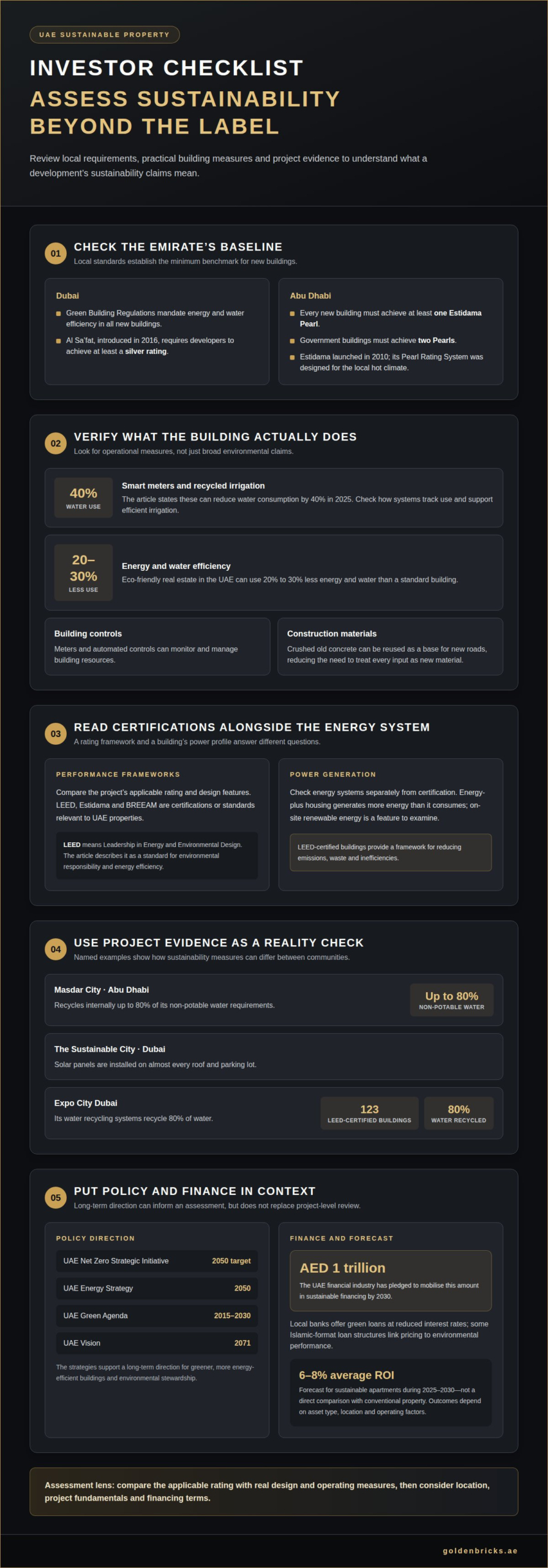
Sustainable property investment in the UAE depends on building efficiency, credible standards and alignment with local policy. Dubai’s Green Building Regulations and Specifications mandate energy and water efficiency in all new buildings, while its Al Sa’fat system requires developers to achieve at least a silver rating. In Abu Dhabi, new buildings must achieve at least a one-pearl Estidama rating, and government buildings must achieve two pearls.
For investors, sustainability is more than a certification label. Design choices, energy and water use, and emirate-specific requirements all shape a project’s profile. Careful assessment is therefore essential when investing in sustainable real estate projects in the UAE.
This article explains the features of sustainable properties, how LEED, Estidama and Al Sa’fat standards apply, and how national and emirate-level policies influence the sector. It also considers the market outlook to help you assess how sustainability may fit into a property investment strategy.
Key Takeaways
- Compare LEED, BREEAM and emirate-specific standards to understand what a sustainability label says about a property’s performance.
- Look beyond certification: cooling efficiency, water reuse and building operations are practical indicators of how a development may manage resource use.
- UAE sustainability strategies set a long-term direction for buildings, making policy alignment a useful part of assessing a project’s prospects.
- Investor interest in sustainable property is growing, but evaluate each opportunity on its own design, location and operating fundamentals.
Sustainable property features and green building certifications
In the UAE, sustainability involves resource-efficient design, building technologies and standards that assess environmental performance. For investors, these details help distinguish measurable features from broad green claims.
Estidama’s Sustainability Framework
Abu Dhabi launched Estidama in 2010 as a sustainability framework for the emirate’s built environment. Its Pearl Rating System was designed for the local hot climate, making resource use and environmental performance relevant considerations in project design. Every new building in Abu Dhabi must achieve at least a one pearl rating, while government buildings must achieve two pearls. These requirements give investors a clear local benchmark when assessing a development’s sustainability credentials.
Smart Technologies and Sustainable Materials
Green Building Regulations and Certifications
Dubai’s Green Building Regulations and Specifications mandate energy and water efficiency in all new buildings. Dubai introduced its Al Sa’fat rating system in 2016, and developers must achieve at least a silver rating. These requirements establish a local compliance baseline, while certifications can provide additional ways to assess environmental performance. LEED, Estidama and BREEAM are green building certifications or standards relevant to UAE properties. Comparing a project’s applicable rating with its design features helps investors understand how its environmental commitments are assessed.
Certifications and Energy Systems
Certifications provide a framework for assessing building performance, while energy systems determine how a property uses or generates power. According to the US Green Building Council, LEED means Leadership in Energy and Environmental Design and sets a standard for environmental responsibility and energy efficiency. LEED-certified buildings provide a framework for reducing emissions, waste and inefficiencies. Eco-friendly real estate in the UAE can use 20% to 30% less energy and water than a standard building. Energy-plus housing goes further by generating more energy than it consumes, making on-site renewable energy a feature to examine alongside a certification.
What Are Sustainable Properties?
Sustainable properties combine responsible resource use with planning intended to support durable communities. When investing in sustainable real estate projects in the UAE, consider how location, project design and sustainability relate to demand and operating performance.
Masdar City in Abu Dhabi and The Sustainable City in Dubai offer examples of distinct approaches. Expo City Dubai is another point of reference, with 123 LEED-certified buildings.
Green Development as a Competitive Advantage
Green development can strengthen a property’s competitive position by aligning resource-conscious planning with buyer and tenant priorities. This matters to investors because environmental performance can help differentiate assets within communities. The UAE’s financial industry has pledged to mobilise AED 1 trillion in sustainable financing by 2030, reflecting a wider sector focus on green initiatives. Developers can integrate sustainability throughout planning and operation rather than treating it as a final design addition.
Financing also shapes project planning. Local banks offer green loans for sustainable properties at reduced interest rates, and some loan structures use an Islamic format with pricing linked to environmental performance. Compare financing terms with the project’s sustainability objectives, resource-saving measures and management approach. This helps connect environmental commitments to the project’s financial framework.
Developers and Projects With Sustainability Credentials
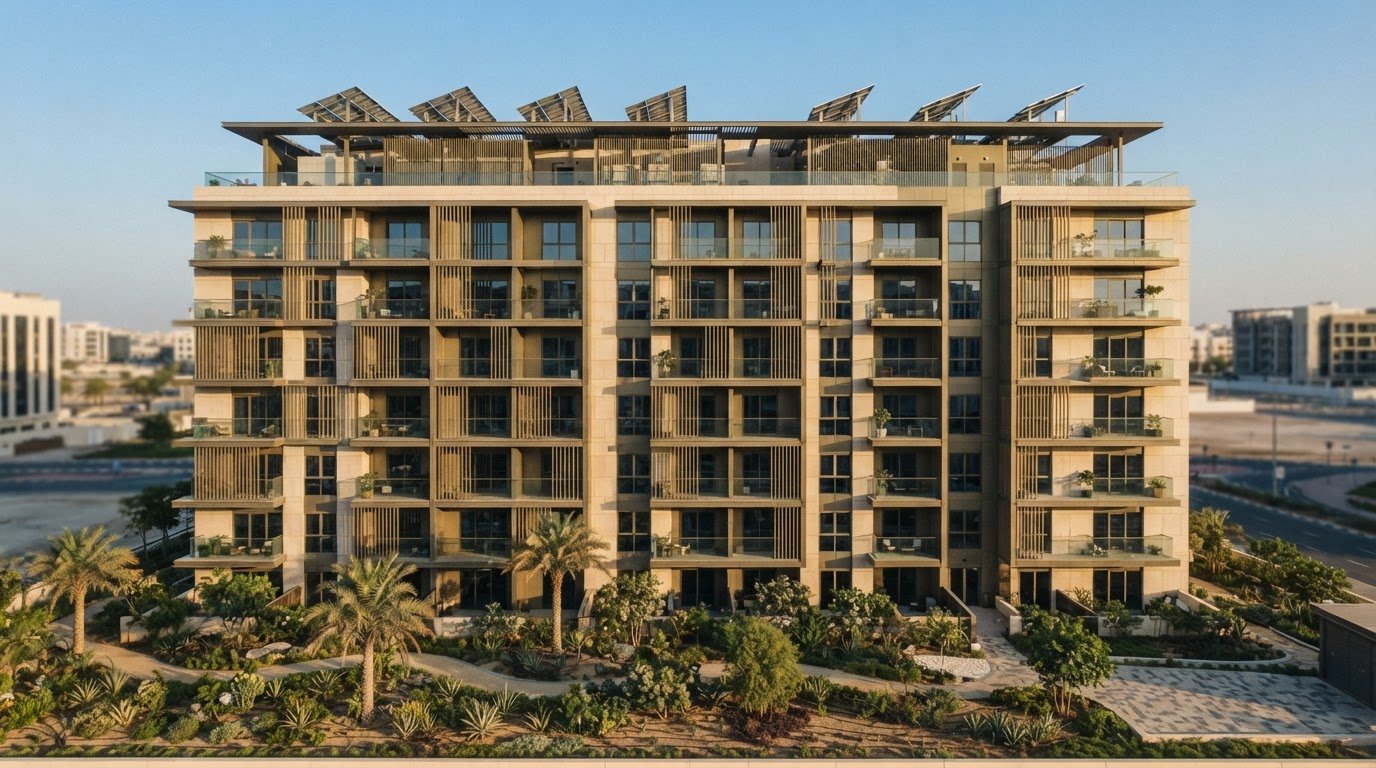
Project credentials are most useful when linked to named developments and practical environmental initiatives. Masdar City in Abu Dhabi recycles internally up to 80% of its non-potable water requirements. The Sustainable City in Dubai has solar panels on almost every roof and parking lot. Expo City Dubai has 123 LEED-certified buildings and water recycling systems that recycle 80% of water. These examples illustrate different approaches across UAE communities. Assessing each project’s measures, rather than relying on broad sustainability language, keeps the review grounded in tangible features.
For investors investing in sustainable real estate projects in the UAE, sustainable apartments have a forecast average ROI of 6-8% during 2025-2030. This is a forecast, not a direct comparison with conventional property; performance depends on asset type, location and operating factors.
Investors assessing a development’s positioning can explore project curation for UAE property opportunities as part of their market review.
UAE sustainability policies and energy strategies
UAE policy gives property owners and developers a long-term direction for sustainable development. The UAE Net Zero Strategic Initiative targets 2050, while the UAE Energy Strategy 2050 supports greener, more energy-efficient buildings. The UAE Green Agenda covers 2015-2030, and UAE Vision 2071 sets environmental stewardship alongside economic growth. For investors, these frameworks help place a residential asset within the government’s wider transition toward lower emissions and more efficient energy use.
Dubai’s Clean Energy Strategy 2050 aims to make the emirate the world’s most sustainable city by 2050. Building performance matters to that objective: buildings use about 80% of the electricity generated in the UAE, and cooling accounts for 70% of electricity used by buildings. These figures make cooling systems and their energy-management controls key considerations when assessing a property’s operating profile. Existing residential buildings may also benefit from energy-efficient retrofits that improve how systems perform.
Emirate-level plans add more specific direction. Ras Al Khaimah’s Energy Efficiency Strategy aims to reduce building energy use by 30% by 2040 and building water use by 20% by 2040. These targets give investors a way to understand how regional policy connects building upgrades with resource efficiency. For a residential property, the relevant assessment includes cooling, lighting, water systems and the controls that coordinate their use.
Renewable energy can form part of a property’s energy strategy, particularly when solar generation is integrated with building operations. Dubai Electricity and Water Authority (DEWA) enables property owners to sell excess solar energy back to the grid through net metering, linking on-site generation to the wider electricity network. Solar equipment alone is not the whole picture; assess its role in the property’s overall energy management.
Smart home technology can support energy management by monitoring and adjusting building systems. Automated cooling controls can align energy use with occupancy, while smart meters provide information about consumption. These technologies complement renewable energy and retrofit measures, rather than replacing them. Together, policy, building upgrades and daily operations contribute to sustainable development in the residential sector.
UAE sustainable real estate market outlook
The UAE real estate market combines strong transaction activity with growing attention to sustainability. For investors, the key is to distinguish broad demand signals from the fundamentals of each property.
Investment Rules and Foreign Ownership
Tax, licensing and foreign ownership considerations shape how an investor can structure a UAE property purchase. The relevant conditions depend on the emirate, property location and investor structure, affecting permitted ownership and applicable registration requirements. These factors matter because they influence the route from acquisition to ownership and ongoing investment. Compare them alongside the asset’s location and intended holding strategy when assessing opportunities across the national market.
Prices, Rental Yields, and Project Costs
Purchase prices and project costs depend on location, property type, size, design and delivery stage. Eco-certified buildings in the UAE can command rental yields up to 8-12% higher than other buildings. This is a relative comparison, not a guaranteed yield for an individual property. Assess rental prospects against local demand, operating costs and the project’s sustainability features. Sustainable apartments are forecast to see 25-30% value growth during 2025-2030, another market signal to weigh against asset-level fundamentals.
Climate, Construction, and Market Risks
Heat and cooling needs make climate resilience and building performance central to assessing UAE property. Construction risk includes delivery quality and whether installed systems perform as designed once occupied. Market risk arises when a sustainability rating or carbon ambition is valued more highly than operating evidence supports. Compare resource systems, delivery progress and buyer demand. Innovation and a sustainable city vision may strengthen a location’s appeal, but they do not replace scrutiny of the asset.
Market activity provides context: transactions across five emirates exceeded AED 239 billion, with more than 94,700 deals recorded in Q1 2025. Explore UAE property opportunities with market intelligence as part of your investment assessment.
Golden Bricks Real Estate: Exclusive Off-Plan Projects
Golden Bricks Real Estate helps investors assess UAE property opportunities through Exclusive Off-Plan Projects, Exclusive Ready Properties and Project Curation. If sustainability is part of your investment criteria, compare each opportunity’s location, design features and environmental credentials with your objectives. Project Curation supports a considered review of options, while Property Management provides ongoing oversight after acquisition.
Ready properties and off-plan opportunities involve different development and ownership stages. Decide which stage suits your priorities, then assess sustainability features alongside the property’s wider investment profile. Contact Golden Bricks Real Estate to discuss your UAE property investment objectives.
Make Sustainability Part of Your Investment Strategy
Translate your sustainability priorities into clear investment criteria. Consider how a property’s environmental performance fits your preferred asset type, ownership horizon and approach to ongoing management. This gives you a disciplined basis for comparing opportunities and weighing sustainability against broader investment objectives.
Golden Bricks Real Estate can help you explore UAE property opportunities suited to your objectives. Contact Golden Bricks Real Estate to discuss your next step and move forward with clarity.
Frequently Asked Questions
What sustainable real estate investment opportunities are available in the UAE?
What green building standards and sustainability regulations apply to UAE real estate projects?
Requirements and ratings vary by emirate and project. Dubai’s Al Sa’fat system and Abu Dhabi’s Estidama framework provide local benchmarks, while LEED and BREEAM are other certification frameworks used in the UAE. For a specific property, identify the applicable local requirements and distinguish them from any additional certification the project pursues. This clarifies what a rating represents.
What government incentives, grants, or financing options support sustainable real estate in the UAE?
Financing options include green loans from local banks, which may offer reduced interest rates for sustainable properties. Some UAE property loan structures use Islamic formats and link pricing to environmental performance. These are financing arrangements, not grants. Compare eligibility criteria, the property’s sustainability evidence and the financing terms to determine how the structure fits your acquisition plan.
What steps are involved in investing in or developing a sustainable real estate project in the UAE?
Start by defining the asset type and ownership objectives. Review the project’s sustainability commitments, certification scope, energy and water systems, and expected operating approach. Assess the acquisition structure and available financing before deciding whether the opportunity fits your portfolio. Investors evaluating a proposed development can compare its documented design and operational plans.
Which UAE emirates and areas offer the best prospects for sustainable real estate projects?
Abu Dhabi and Dubai offer notable examples, including Masdar City, The Sustainable City and Expo City Dubai. Ras Al Khaimah also has a strategy targeting lower building energy and water use, but the available information does not rank emirates by investment prospects.