

The off-plan home with the most attractive payment plan may still be the wrong investment. Common mistakes when buying off-plan property in Dubai include judging a project by its headline price, overlooking contract terms and future costs, and relying on optimistic rental or resale assumptions. Assess the developer, location, payment schedule, and likely demand together, then compare the trade-offs with a ready property.
Staged payments and the chance to buy before completion can be appealing, but those advantages matter only if the property suits your finances and investment horizon. This guide explains how to assess a project, compare payment plans, and weigh rental and resale potential against the practical certainty of a completed home. It also covers how delays, overlooked costs, and limited resale flexibility can affect your decision.
Key Takeaways
- Assess the developer’s completed projects, project registration, location and sale agreement before focusing on the purchase price.
- Map every instalment to your cash flow and understand the agreement’s consequences for late or missed payments.
- Estimate rental and resale prospects using comparable completed properties, local demand and competing supply, not projections alone.
- Weigh staged payments and potential appreciation against completion uncertainty; compare them with a ready home’s immediate usability and rental potential.
1. How to Evaluate an Off-plan Property Before You Invest?
Start with the developer’s delivery record, not the launch imagery. Review completed projects for construction quality, handover history, and consistency between promised and delivered specifications. Compare past projects with current work to see whether the developer has experience with similar locations and property types. Look for recurring concerns in customer reviews, and consider how clearly the developer communicates project progress. This helps distinguish a persuasive sales presentation from evidence of reliable delivery.
Next, verify the developer and project through Dubai Land Department channels. Confirm the project’s registration and status, and check that the developer and project are registered with RERA. Review the project’s official approvals and escrow arrangements. In Dubai, escrow funds are intended for construction and released against project milestones. A registration check should complement, not replace, a review of completed developments. Compare the stated timeline with the developer’s delivery history and the project’s current construction progress.
Read the sale agreement before committing. Identify the handover date, construction timeline, payment obligations, cancellation terms, refund provisions, and any delay-related clauses. Compare the unit’s size, layout, price per square foot, amenities, and expected completion date with similar nearby projects. Assess transport links, planned infrastructure, schools, and business districts for their relevance to future rental demand. The Dubai Land Department states that the buyer’s transfer fee is 2% of the sale value. Include this amount when assessing the full purchase commitment, rather than relying on the advertised price alone.
What are the UAE residency visa requirements for buying off-plan property in Dubai? An off-plan purchase alone does not establish visa eligibility. The relevant visa route, ownership documents, and property status all affect whether a buyer meets the applicable criteria. How can buyers verify a Dubai developer’s track record and project registration with DLD? Review completed projects and handover history, then use Dubai Land Department channels to check the project’s registration and status. Include RERA registration and project approvals in the same due-diligence process.
2. What are typical payment plans for off-plan properties?
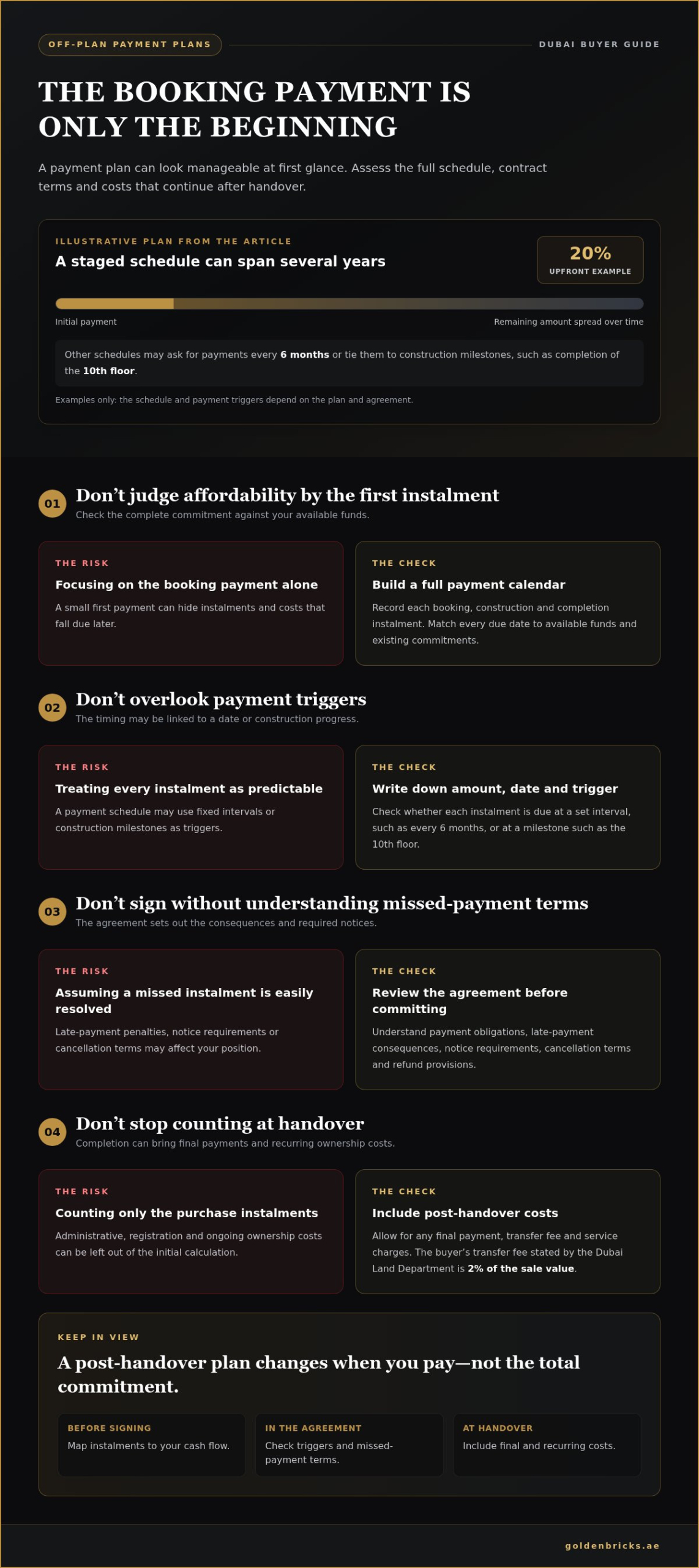
Dubai off-plan payment plans commonly combine an initial payment with instalments during construction. Some developers offer post-handover payments, shifting part of the purchase commitment beyond completion. Compare each schedule by amount, due date, and payment trigger. A common mistake when buying off-plan property in Dubai is judging affordability by the booking payment alone.
For example, a plan may require 20% upfront, with the remainder spread over several years. Other schedules may require payments every 6 months or link them to construction milestones, such as completion of the 10th floor. Map each due date against available funds and existing commitments before signing. Another common mistake when buying off-plan property in Dubai is overlooking the agreement’s late-payment penalties, notice requirements, or cancellation terms.
- Record each booking, construction, and completion instalment.
- Note the consequences and timing of missed payments.
- Include administrative, registration, and ongoing ownership costs.
After handover, final payments may fall due, ownership transfers, and service charges begin. Include these recurring charges alongside any remaining instalments. A post-handover plan changes the timing of payments, not the total commitment. Avoid common mistakes when buying off-plan property in Dubai by assessing the full schedule, not just its most flexible feature.
How do handover, snagging, and defect-liability rules work for off-plan homes in Dubai? The sale and purchase agreement sets the handover conditions and procedures for recording defects. Review its inspection process, notification requirements, and stated defect-liability terms before accepting the property.
How can buyers assess payment plans, hidden costs, and service charges? Compare the instalment calendar with your cash flow, then include administrative, registration, and recurring charges. How do Dubai off-plan escrow accounts work, and how can buyers verify payments? Project funds are held in escrow for construction use and released against milestones. Retain receipts and match transfers to the project’s payment instructions.
What should buyers check in a Dubai off-plan sale and purchase agreement? Review payment dates, missed-payment consequences, handover conditions, cancellation terms, and resale restrictions. If immediate occupancy matters more than staged payments, compare these terms with ready-property options.
3. Considering rental demand and resale potential
Estimate demand at handover, not only when you reserve. Review Dubai’s real estate activity over the previous 6 to 12 months, then compare completed nearby residential projects. Track achieved rents, days on market, and competing listings. These indicators help investors judge likely tenant demand and resale interest. A developer’s reputation and construction progress matter, but neither establishes future rent by itself.
Assess future supply alongside demand. Research employment opportunities, population growth, business districts, tourism interest, and planned infrastructure near the project. Then consider how many similar homes could reach handover around the same time. A concentration of comparable units may increase competition among landlords and limit rent growth. Compare the property’s layout, amenities, and access to schools, parks, and workplaces with nearby alternatives.
Calculate rental yield using achievable annual rent, not just a developer’s projection. Subtract service charges and other ownership expenses to estimate net income. Vacancy periods and maintenance costs also affect cash flow.
Assess capital appreciation separately from rental income. Consider the investment over a five-year horizon, and test how changing supply or slower demand could affect resale. Compare current listings with completed transactions, and account for the time between purchase and handover. A low entry price may not make up for weaker tenant demand or higher ongoing expenses.
What are the DLD and trustee fees for buying off-plan property in Dubai? The Dubai Land Department states that the buyer’s fee is 2% of the sale value. Trustee fees depend on the transaction and service provided, so include them separately when preparing your purchase budget.
4. Off-plan benefits and trade-offs versus ready property
Off-plan purchases may offer early-bird pricing, flexible payment plans, potential capital appreciation, and customization options before completion. These features may suit buyers with a longer investment horizon who can align payments with their finances. They do not remove construction or market risk. Common mistakes when buying off-plan property in Dubai include comparing a launch price with the price of a ready home without accounting for timing, usability, and income potential.
Time to completion changes the investment calculation. Smaller off-plan projects may take 1-2 years, while larger developments could take 3-5 years. Buyers are advised to prepare for delays of 6 to 12 months. During construction, the property generally cannot provide the same immediate occupancy or rental use as a completed apartment. A ready property offers a visible unit to inspect and may be used or rented sooner, subject to its condition and purchase terms.
Compare the full ownership profile, not just the initial price. Off-plan properties are often priced below completed homes, but future charges, amenities, location, and handover timing also shape value. For a ready home, assess its actual condition and current rental prospects. For an off-plan unit, weigh the payment schedule and expected completion against similar completed properties. Avoid mistakes when buying off-plan property in Dubai by assessing both options against the same intended use and investment horizon.
Use a simple decision test: if immediate occupancy or near-term rental income is central, a ready home may better suit your priorities. If staged payments and waiting for completion fit your plans, off-plan may be worth considering. Treat projected appreciation as one factor, not a substitute for evaluating demand, timing, and ownership costs.
Compare ready property options with off-plan opportunities to identify the ownership profile that best fits your objectives.
Golden Bricks Real Estate: Exclusive Off-Plan Projects
Golden Bricks Real Estate offers exclusive off-plan projects for buyers assessing Dubai opportunities against their investment plans. Its project curation helps narrow the options, while exclusive ready properties provide a completed-home alternative for buyers prioritising immediate use or rental potential. Property management can support owners with managing a property after purchase.
Turn to Golden Bricks Real Estate after weighing the payment schedule, handover horizon, rental prospects, and trade-offs against ready property. The team can help you explore options that align with those priorities. A clear view of your intended use and investment horizon will make the next discussion more focused.
Contact Golden Bricks Real Estate or visit goldenbricks.ae to discuss your property objectives.
Make Your Next Property Decision Deliberate
Treat your next step as a decision about portfolio fit, not simply a choice between property types. Common mistakes when buying off-plan property in Dubai often begin when a purchase is disconnected from the buyer’s wider objectives. Decide whether you value immediate use, future rental income, or a longer-term investment, then align your choice with your financial capacity and preferred ownership horizon.
Before proceeding, write down your priorities. Consider how much flexibility you need, when you expect the property to be usable, and what role it should play alongside your other assets. A clear investment brief makes discussions more focused and helps you assess opportunities against consistent criteria rather than shifting expectations.
Golden Bricks Real Estate offers Exclusive Off-Plan Projects and Exclusive Ready Properties, with Property Management for owners seeking support beyond acquisition. Contact Golden Bricks Real Estate to discuss a property direction aligned with your objectives and move forward with considered confidence.
Frequently Asked Questions
How to Evaluate an Off-plan Property Before You Invest?
Assess whether the specific unit suits your intended use, not just whether the development looks attractive. For example, compare the floor plan and orientation with your household or tenant needs, then match the unit description to the sale documents. Note any differences between marketing materials and contractual specifications. This gives you a practical reference for decisions about the property’s suitability and future use.
Why Due Diligence Matters Before Buying Off-plan?
Due diligence helps establish whether the project, agreement, and investment assumptions align before you commit funds. A careful review can reveal a mismatch between advertised specifications and contract wording, or show that a planned resale depends on conditions you had not considered. Keep the agreement, payment receipts, and project communications together so you can refer to consistent records throughout the purchase.
Are there risks involved in buying off-plan?
Yes. Buyers may face construction delays, changing market conditions, difficulty assessing a home before completion, or restrictions on selling before handover. These risks can affect cash flow and exit plans. Consider how you would respond if rent began later than planned or similar homes competed for tenants. Your purchase is more resilient if your finances can accommodate changes in timing.
Can I sell an off-plan property before it is completed?
Possibly, but the sale depends on the developer’s transfer policy, local regulations, and the terms of your sale agreement. Some Dubai projects require buyers to pay 50% before resale is permitted. Check the agreement for any payment threshold and transfer conditions before assuming you can exit early. Also consider whether outstanding instalments affect the timing or practicality of a resale.
How can I verify the developer’s reputation?
Look beyond promotional material and compare the developer’s completed projects with the current development. Focus on similar property types, then assess whether delivered specifications and handover timing matched what buyers were promised. Customer feedback can reveal recurring concerns, such as communication or finish quality. Compare several examples rather than relying on one highly positive or negative account.
Is my investment safe if the project is delayed or canceled?
An escrow account restricts project funds to construction purposes, with releases linked to construction milestones. This safeguard does not eliminate every investment risk. Delays do not usually result in refunds, while buyers may receive refunds if a project is canceled. Review the agreement’s delay and cancellation provisions, and retain payment records so you can track what you have paid against the project schedule.