The apparent winner in a freehold-versus-leasehold decision may not be the right fit for your investment horizon. This guide explains freehold vs leasehold property in the UAE: in designated Dubai areas, freehold ownership has no fixed term, while leasehold grants a registered interest for a defined period of up to 99 years.
Freehold vs leasehold property in the UAE explained: both structures can suit a property strategy, but they confer different rights and responsibilities. The distinction matters when assessing how long you intend to hold a property, how you may use or transfer it, and what happens when a lease ends. This comparison outlines how freehold and leasehold ownership can differ and what buyers may wish to consider. It also offers a practical guide to matching the ownership structure to your intended use and investment plans.
Key Takeaways
- Understand how a permanent ownership interest differs from a registered right with a defined term, and why the agreement’s conditions matter.
- Identify designated Dubai areas relevant to foreign buyers and the role of property registration in establishing ownership rights.
- Assess how transfer conditions, inheritance and the remaining lease term can shape financing options.
- Weigh the flexibility of freehold ownership against its ongoing obligations, then match the structure to your intended use and holding period.
Freehold vs Leasehold Dubai: Which is better for you?
In Dubai, the choice depends on whether buyers prioritise indefinite ownership or a defined property interest. Dubai Legislation Portal identifies Dubai Law No. 26 of 2007 as the law primarily referenced for leasehold arrangements, including duration, payments and renewal conditions.
For foreign buyers, compare the registered rights and agreement terms, not just the property’s marketing label. If a company or foundation will hold the property, identify the legal holder and the precise interest recorded for it.
Ownership Rights and Duration
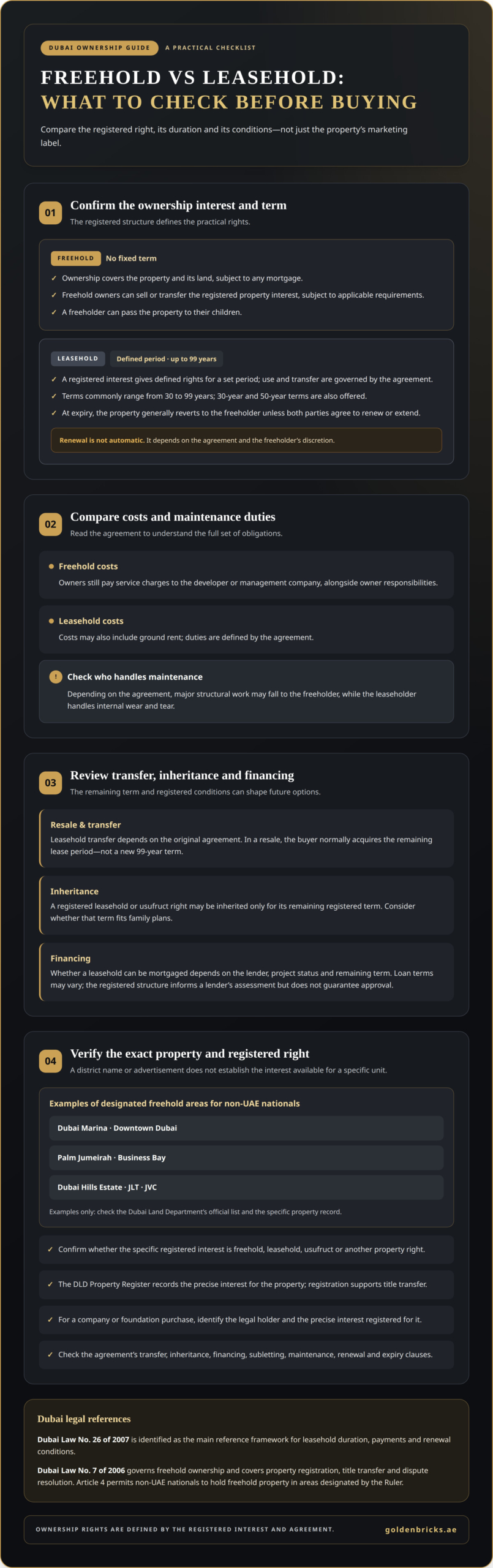
Freehold ownership has no fixed term and covers the property and its land, subject to any mortgage. Leasehold gives the holder defined rights for a set period, with use and transfer governed by the registered agreement. At expiry, the property generally reverts to the freeholder unless both parties agree to renew or extend the term.
Costs and Maintenance Responsibilities
Freehold owners still pay service charges to the developer or management company. Leasehold costs may also include ground rent. Maintenance responsibilities depend on the agreement: major structural work may fall to the freeholder, while the leaseholder handles internal wear and tear. Compare these obligations to understand the total cost of each ownership structure.
Leasehold Terms and Renewal
Dubai leasehold terms commonly range from 30 to 99 years, with 30-year and 50-year terms also offered. Renewal depends on the agreement and the freeholder’s discretion; it isn’t automatic. Before signing, buyers should examine transfer, inheritance, financing, subletting, maintenance, renewal and expiry clauses, since these terms define practical rights and end-of-term outcomes.
Dubai Law No. 26 of 2007 provides the main reference framework for leasehold duration, payments and renewal conditions. For company or foundation ownership, assess how the registered holder, property interest and lease conditions fit together; the entity structure does not replace the terms governing the property right.
| Option | Duration | Costs and obligations | Best aligned with |
|---|---|---|---|
| Freehold | No fixed term | Service charges; owner responsibilities | Long-term ownership |
| Leasehold | 30-99 years | Possible ground rent; agreement-defined duties | A defined ownership period |
Choose freehold for ownership without a fixed term. Consider leasehold when its registered terms suit your intended use and holding period.
Dubai freehold areas
Foreign buyers can acquire freehold property in Dubai’s designated areas. The Dubai Land Department (DLD) maintains the official list, so check that the property’s location and registered interest match your plans. A community name alone does not establish the ownership available for a particular unit.
Dubai Legislation Portal states that Dubai Law No. 7 of 2006 governs freehold ownership and covers property registration, title transfer and dispute resolution. Article 4 permits non-UAE nationals to hold freehold property in areas designated by the Ruler. This framework makes the specific plot or unit, rather than a general district description, central to assessing freehold ownership.
Examples of designated freehold areas for non-UAE nationals include:
- Dubai Marina and Downtown Dubai
- Palm Jumeirah and Business Bay
- Dubai Hills Estate, JLT and JVC
These examples can help narrow your search, but the precise property interest is recorded in the DLD Property Register. Distinguish the area where foreign ownership is permitted from the rights registered for the specific home.
The DLD registers Dubai property transactions, while the DLD and RERA oversee registration, developer compliance and transaction processes. Registration establishes the official property record and supports title transfer. Before buying, establish whether the registered interest is freehold, leasehold, usufruct or another property right. An advertisement’s terminology may not describe the registered structure.
Freehold and leasehold interests carry different rights in Dubai’s property market. Freehold has no fixed ownership period, while a property marketed as leasehold may involve a defined-term lease, usufruct or another registered right. The relevant agreement governs how the holder may occupy, transfer or rent the property. These distinctions can matter even when homes are in the same broad district.
For a considered next step, explore buying, selling or leasing property in Dubai with Golden Bricks Real Estate keeping the ownership structure clearly in view.
Differences in transfer, inheritance, and financing
How freehold versus leasehold ownership affects an investment depends on the registered interest and its conditions. A freeholder can sell or transfer the registered property interest, subject to applicable requirements. Leasehold transfer depends on the original agreement’s terms. In a resale, the buyer normally acquires the remaining lease period, not a new 99-year term. This distinction can shape both exit planning and the rights passed to a successor.
For families, understanding freehold vs leasehold property in the UAE means considering what can be inherited. A Dubai freeholder can pass the property to their children and sell it. A registered leasehold or usufruct right may be inherited only for its remaining registered term. Consider whether that term fits your family plans rather than assuming every property interest lasts indefinitely.
Financing also differs. Whether a leasehold can be mortgaged depends on the lender, project status and remaining term; loan terms may vary accordingly. When comparing freehold vs leasehold property in the UAE, identify the interest being financed. A designated-area freehold title differs from a fixed-term leasehold or usufruct right. The registered structure informs a lender’s assessment, but does not guarantee approval.
Remaining term can affect resale prospects. Buyers and banks may assess a leasehold more carefully as its remaining term approaches 30 or 40 years. A 99-year lease doesn’t become freehold when it expires. A resale buyer should therefore establish the years remaining, since the transfer ordinarily carries that balance, rather than restarting the original term.
For a family or investment plan, compare the registered interest, transfer conditions and term remaining at a potential resale or inheritance. These details show which rights may pass to a successor and what a future buyer would acquire. They also explain why a longer lease and freehold ownership are not interchangeable measures of long-term value.
Freehold property advantages and risks
Freehold ownership continues beyond a fixed period, with no lease expiry requiring renewal. In Dubai, the owner may live in, sell or rent the property, and may generally mortgage or transfer the registered interest, subject to applicable requirements. This flexibility can suit buyers planning long-term use or a future resale. In jointly owned developments, an apartment title generally includes an undivided interest in applicable common parts.
Ownership has limits. Owners should check applicable requirements before altering or remodeling a freehold home. Renovations affecting building systems or shared areas must also meet those requirements. During extensive renovations or transitions between properties, owners often rely on Choose and Move for self-storage and relocation services. Freehold ownership does not remove ongoing costs: owners pay service charges to the developer or management company, even after any mortgage is paid off.
Investment outcomes need separate assessment. A freehold title alone does not ensure capital appreciation, rental income or a stronger return. Location, building condition, service charges and likely demand all affect a property’s financial performance. A home bought for rental may offer ownership flexibility, but its income still depends on the asset and market conditions.
Compare this with leasehold exposure before purchase. A leasehold interest has a defined term, and renewal may rest with the freeholder. At expiry, the property generally reverts to the freeholder unless both parties agree to extend or renew. A 99-year lease does not become freehold simply because its full term has elapsed. Buyers should weigh this end-of-term position against freehold’s ongoing service charges and maintenance obligations.
A disciplined decision starts with three points: confirm the registered interest, review the building’s service-charge obligations, and match the ownership structure to your intended holding period. Freehold may suit buyers prioritising enduring control; it is not a substitute for assessing the property’s costs, condition or rental prospects. For support with ongoing ownership responsibilities, explore property management options.
Golden Bricks Real Estate: Property Management
Golden Bricks Real Estate offers Property Management for owners whose priority has shifted from choosing an ownership structure to overseeing a property. It also supports decisions to Buy, Sell or Lease, with Exclusive Ready Properties and Exclusive Off-Plan Projects for buyers assessing their next acquisition.
Consider Property Management if you own a home and want support beyond the purchase decision. For a new investment, the next step may be selecting a suitable property and deciding whether to buy, sell or lease. The right route depends on your ownership plans and the asset’s role in your portfolio.
For guidance on your next property step or ongoing ownership, contact Golden Bricks Real Estate.
Shape your next property decision
Understanding freehold vs leasehold property in the UAE can turn an ownership preference into a broader acquisition and portfolio plan. Align the property’s intended role with how you expect to use, oversee and eventually transition the asset. This keeps the decision grounded in your priorities, not ownership terminology alone.
Golden Bricks Real Estate supports the next stage through Exclusive Off-Plan Projects, Exclusive Ready Properties and Property Management. Whether you are considering an acquisition or planning ongoing oversight, focus on how the asset fits your longer-term objectives. A clear direction helps make each subsequent decision more coherent.
For a considered discussion of your property plans, contact Golden Bricks Real Estate. Take the next step with clarity and confidence.
Frequently Asked Questions
What is a Freehold Property?
A freehold property gives its registered owner an ongoing interest in the property and its land, rather than rights limited to a lease term. In a jointly owned development, an apartment title generally includes an undivided interest in applicable common parts. The title record identifies the registered owner and the interest held, helping distinguish ownership from time-limited property rights.
What is a Leasehold Property?
A leasehold property gives the holder a registered right to use a property for a defined term, subject to the agreement and applicable law. In Dubai, lease terms can extend up to 99 years. A resale buyer ordinarily takes the remaining term, not a newly issued full-length lease. The agreement sets conditions for use, transfer, maintenance and what happens at expiry.
Can foreigners buy property in Dubai?
Yes. Foreign nationals, including expatriates and buyers living abroad, can purchase freehold property in Dubai’s designated areas. They may also hold registered leasehold or usufruct rights for up to 99 years in designated areas where Article 4 of Dubai Law No. 7 of 2006 applies. The key distinction is the interest recorded for the specific property, not the buyer’s residence.
What Are Leasehold and Usufruct Rights?
Leasehold and usufruct are defined-term property interests, but their legal forms differ. Leasehold arises under a registered lease agreement, while usufruct generally gives its holder the right to use and benefit from a property for a defined period. The registered document governs each interest’s conditions, including permitted use, transfer and duration. Neither term alone describes every right attached to a property.
When Does Leasehold Make Sense?
Leasehold may suit a buyer whose plans fit a defined period, such as a professional expecting a 10-15 year career posting. The decision should account for the agreement’s use and transfer conditions, renewal provisions, and remaining term at an intended resale. A shorter ownership horizon can make the structure relevant, but its registered rights must match the buyer’s intended use.
Which Form of Property Should Be Chosen?
Choose according to your intended holding period, use and transfer plans. Freehold may suit an ownership strategy with no fixed term; leasehold may fit a defined period if its agreement provides suitable rights. For financing, lenders may consider lease length and project status. Neither structure guarantees rental income or capital appreciation, so assess the asset and ownership terms together.