
An escrow account can safeguard purchaser funds, but it does not guarantee that an off-plan project will be completed. In the UAE, the protections available depend on the emirate where the property is located, so buyers should assess the applicable local framework.
Developer and project registration, interim recording of purchases, and construction progress controls provide additional oversight. The sale and purchase agreement also sets out important contractual rights and obligations.
This article explains how these safeguards work, what buyers may face if a project is delayed or cancelled, and where protections have limits. It distinguishes controls on purchaser funds from a guarantee of completion, helping you assess an off-plan purchase with a clearer understanding of its legal framework and risks.
Key Takeaways
- Understand escrow as a safeguard for how purchaser funds are handled, not a promise that a development will be completed.
- Use project and transaction registration as important parts of assessing oversight and documenting an off-plan purchase.
- Assess whether project updates and contractual specifications align, especially when proposed changes could affect the property or handover expectations.
- Separate the remedies for delay, cancellation and buyer default; the applicable outcome depends on the project’s circumstances and contract terms.
How Are Off-Plan Buyers Protected in Dubai?
Off-plan protections in the UAE depend on the emirate where the property is located. The safeguards below describe the Dubai framework, including rules for holding purchaser payments and accessing project account records. An escrow account controls how project funds are handled, but it does not guarantee construction or completion.
Escrow Protection for Buyer Payments
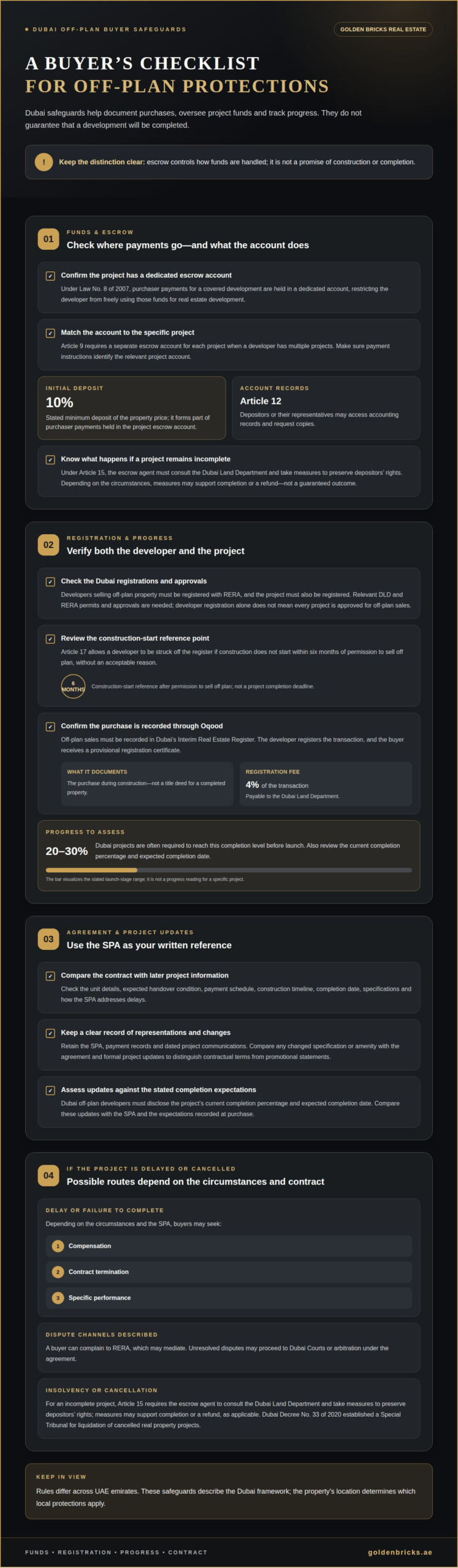
Under Law No. 8 of 2007, purchaser payments for a covered development are held in a dedicated escrow account. The law restricts developers from freely using those funds for real estate development. This separation matters because it ties buyer payments to the specific project rather than leaving them available for unrestricted use.
Article 9 requires a developer with multiple projects to open a separate escrow account for each one. Article 12 allows depositors or their representatives to access accounting records and request copies. These records can help buyers understand how funds are accounted for and preserve documentation relevant to their agreement.
Initial Deposits and Escrow Accounts
The initial deposit forms part of the purchaser payments held in the project’s escrow account. The stated minimum deposit is 10% of the property price. Buyers should ensure payment instructions identify the relevant project account, so the first transfer is directed into the designated fund rather than treated as unrestricted developer money.
Article 13 requires a loan secured by a mortgage on a project to be paid into that project’s escrow account. This connects project-backed borrowing to the same designated account used for purchaser payments. It reinforces the account’s project-specific role and supports clearer financial tracking.
If a project remains incomplete, Article 15 requires the escrow agent to consult the Dubai Land Department and take measures to preserve depositors’ rights. Depending on the circumstances, those measures may support completion or a refund. The framework establishes a process for addressing project funds, but does not promise a particular outcome or completion date.
RERA-registered developers and project progress checks
Regulatory safeguards for off-plan purchases include developer and project registration, transaction records, and progress oversight. Rules differ across UAE emirates, so the applicable framework depends on the property’s location.
Developer Registration and Obligations
In Dubai, developers selling off-plan property must be registered with RERA, and the project must also be registered. Developers need the relevant DLD and RERA permits and approvals for the development. This distinction matters because developer registration alone does not mean every project is approved for off-plan sales.
Article 17 of the off-plan property framework allows a developer to be struck off the register if construction does not start within six months of permission to sell off plan, without an acceptable reason. Registration and construction progress are therefore separate reference points when assessing the project’s regulatory status.
Oqood and Interim Property Registration
Oqood records an off-plan transaction in the Interim Real Estate Register. Under Dubai Law No. 13 of 2008 and its amendments, off-plan property sales must be recorded in the Interim Real Estate Register, according to Dubai Legislation Portal. The developer registers the transaction, and the buyer receives a provisional registration certificate confirming the recorded purchase.
The certificate documents the transaction during construction; it is not a title deed for a completed property. The registration fee is 4% of the transaction, payable to the Dubai Land Department. Formal recording links the buyer to the purchase while the unit remains under development.
Project status also matters. The current completion percentage and expected completion date help buyers assess progress against stated expectations. For a considered view of curated off-plan projects, project registration and progress can inform the wider assessment of a proposed purchase.
Material project changes and misleading marketing
For an off-plan purchase, the sale and purchase agreement (SPA) is the written reference for the unit and development. Buyers are entitled to project information, including completion dates, specifications, and changes to the development plan. Compare later updates with the SPA’s property details, payment schedule, construction timeline, and expected handover.
Before signing, examine whether the SPA describes the property’s expected condition at handover, the completion date and how it addresses delays. Dubai off-plan developers must disclose the project’s current completion percentage and expected completion date. Dubai projects are often required to reach 20-30% completion before launch, making recorded progress relevant when assessing launch-stage claims.
Keep the SPA, payment records, and dated project communications to document what was represented and when. If marketing material describes a specification or amenity that later changes, compare it with the agreement and formal project updates. This record can help clarify whether the change concerns a contractual term or a promotional statement.
If a developer delays or fails to complete the project, buyers may seek compensation, contract termination, or specific performance, depending on the circumstances and the SPA. Buyers can complain to RERA, which may mediate. Unresolved disputes may proceed to Dubai Courts or arbitration under the agreement, where guidance from dispute resolution practices such as Fervent Chambers LLC can help parties evaluate complex contract claims and enforcement avenues.
If a developer becomes insolvent before completion, the escrow agent must consult the Dubai Land Department under Article 15 of Dubai’s escrow law and take measures to preserve depositors’ rights. Those measures may support completion or a refund, as applicable. For cancelled developments, Dubai Decree No. 33 of 2020 established a Special Tribunal for liquidation of cancelled real property projects.
Dubai’s legal framework for off-plan sales
Dubai’s off-plan protections combine legislation, project oversight, and contractual remedies. Their practical value depends on how each rule applies to the development, construction progress, and sale and purchase agreement.
Dubai Law No. 8 of 2007 requires an escrow agent to retain 5% of total project funds for one year after completion as a structural-defect warranty guarantee, according to Dubai Legislation Portal. This post-completion safeguard addresses qualifying structural defects; it does not replace the SPA’s terms or guarantee every aspect of a property in Dubai.
Other rules shape what happens when a buyer defaults. After a developer complaint, the Dubai Land Department gives the buyer a 30-day notice to remedy the payment default. If the buyer does not comply, the Department confirms project completion, which affects the developer’s available next steps.
- For a project under 60% complete, the developer may retain up to 25% of the unit value.
- For a project between 60% and 80% complete, the developer may retain 40% of the property’s value.
- At 80% completion or above, the developer may enforce the agreement and demand the remaining balance.
These thresholds make construction progress relevant to both parties’ rights. The SPA should set out the purchase price, payment schedule, late-payment consequences, completion date, delay terms, and grounds for termination. Assess your contractual exposure by reading these clauses alongside the project’s recorded progress, rather than treating a general marketing timeline as the governing commitment.
Dubai’s framework also addresses project cancellation and disputes. If RERA issues a reasoned decision cancelling a project, Article 11(b) of Law No. 19 of 2017 requires the developer to refund purchaser payments. Article 14 of Executive Council Resolution No. 6 of 2010 authorises the Dubai Land Department to mediate buyer-developer disputes. For a considered review of Dubai off-plan opportunities, connect the agreement’s terms with the project’s legal and construction status.
Golden Bricks Real Estate: Exclusive Off-Plan Projects
Golden Bricks Real Estate offers Exclusive Off-Plan Projects for buyers assessing Dubai developments against their investment objectives and risk considerations. Its Project Curation helps bring focus to the selection process, while the legal framework discussed above provides context for evaluating project registration, escrow arrangements and contractual terms.
Turn to Golden Bricks Real Estate when considering an off-plan purchase and exploring curated project options. If you are weighing completed property against construction-stage opportunities, consider Exclusive Ready Properties. Property Management may be relevant after acquisition if you need ongoing oversight of your investment.
These offerings support property selection and ownership needs; they do not replace legal advice or guarantee project completion. For a considered discussion of your property objectives, contact Golden Bricks Real Estate.
Make your next property decision with clarity
Understanding what legal protections apply to off-plan buyers is a starting point, not a substitute for a decision aligned with your investment horizon, intended use, and tolerance for construction-stage uncertainty. Define what matters most: a property under development, a completed asset, or ongoing support after acquisition.
Golden Bricks Real Estate offers Exclusive Off-Plan Projects, Exclusive Ready Properties, and Property Management. These options can help shape your property search around whether you are considering an off-plan purchase, prefer a completed property, or need management support for an owned asset. The right direction depends on your objectives and the property’s intended role.
For a considered discussion of your property requirements, contact Golden Bricks Real Estate. A clear brief is a strong foundation for your next move.
Frequently Asked Questions
Does an Escrow Account Guarantee Project Completion?
No. An escrow account regulates how project funds are held and disbursed, but it cannot ensure construction will finish. Dubai Land Department disbursements are linked to technical reports documenting project progress, and RERA can freeze withdrawals in cases of serious breaches. If a project is cancelled, the available process and outcome depend on the project’s status and the applicable cancellation decision.
Does the developer have to repair issues after handover?
Developers must repair qualifying construction defects during the Defect Liability Period at no additional cost to the buyer. In Dubai, this period is typically 6 to 12 months after handover. Normal wear and tear, owner modifications and misuse are generally excluded. Record the issue, its location and when it appeared, then give formal notice through the channel set out in your sale and purchase agreement.
How Can You Verify an Escrow Account Before Paying?
Confirm that the project is registered and that the payment instructions identify its dedicated escrow account before transferring funds. Dubai’s Register Project service provides project information, including a 30% project guarantee, which may be met through construction completion, a bank guarantee or cash deposit. Compare the project identity in that record with the payment documents, and retain the instructions and transfer confirmation.
How Does an Escrow Account Protect Buyers?
An escrow account creates financial controls around money allocated to a particular development. Disbursements are linked to documented construction progress through technical reports, rather than unrestricted developer access. In cases of serious breaches, RERA can freeze withdrawals. This can help protect purchaser funds from being used outside the project framework, but it does not eliminate construction, timing, or contractual risks for investors.
What Constitutes Developer Default?
Developer default generally concerns failure to meet obligations in the sale and purchase agreement, such as an unremedied contractual breach or failure to complete under applicable terms. A delay alone does not automatically establish default: Dubai agreements commonly allow a 6-12 month grace period beyond the anticipated completion date. The SPA’s delay, notice and remedy clauses shape how a specific dispute proceeds.
What Should You Check Before Making a Payment?
Before paying, make sure the project and developer are registered for off-plan sales and that the payment instructions identify the project’s escrow account. Review the SPA for the unit description, payment schedule, completion expectations, delay provisions, and termination consequences. Confirm that the transaction will be entered in the Interim Real Estate Register, then keep your signed agreement and payment records.