

A property disposition is a wealth decision as well as a transaction. Real estate advisory for family offices brings portfolio priorities, market intelligence and sale execution into one considered process, helping decision-makers assess whether to sell, when to proceed and how to prepare an asset for the UAE market.
The decision involves more than choosing a sale date. Family offices may weigh a property’s role in the wider portfolio, ownership considerations, market conditions and the practical work of preparing the asset for prospective buyers. The right advisory model also depends on whether the office relies on an in-house team, external specialists or both.
This article explains what family office real estate advisory covers, how single-family, multi-family and outsourced models differ, and what sell-side support can contribute to a disposition. It also examines the stages of a sale, the factors that shape the advisory process and how Golden Bricks’ market intelligence and property expertise can support a broader property strategy in the United Arab Emirates.
Key Takeaways
- Structure a property sale around portfolio objectives, asset readiness and market positioning to support a more disciplined disposition process.
- Distinguish dedicated, shared and outsourced advisory models by the level of control, expertise and operational support each provides.
- Align a real estate investment strategy with the family’s priorities, governance approach and intended role for property within its wider assets.
- Weigh the control of direct ownership against the pooled structure of real estate funds, including how each approach affects oversight and ownership decisions.
Disposition and sell-side advisory
Family offices oversee property through portfolio reviews, operating updates and defined decision rights. A single-family office, for example, can combine property manager updates with financial reporting and family governance protocols. Real estate advisory for family offices connects these inputs to each asset’s role in the family’s wealth strategy. The office monitors performance and considers an exit when that role changes.
Family offices manage, monitor and exit real estate investments by setting ownership objectives, reviewing operating and financial information, and assessing whether each asset still fits the family’s priorities. Sell-side advice supports both the decision and its execution, coordinating property preparation, market positioning, buyer engagement and transaction progress.
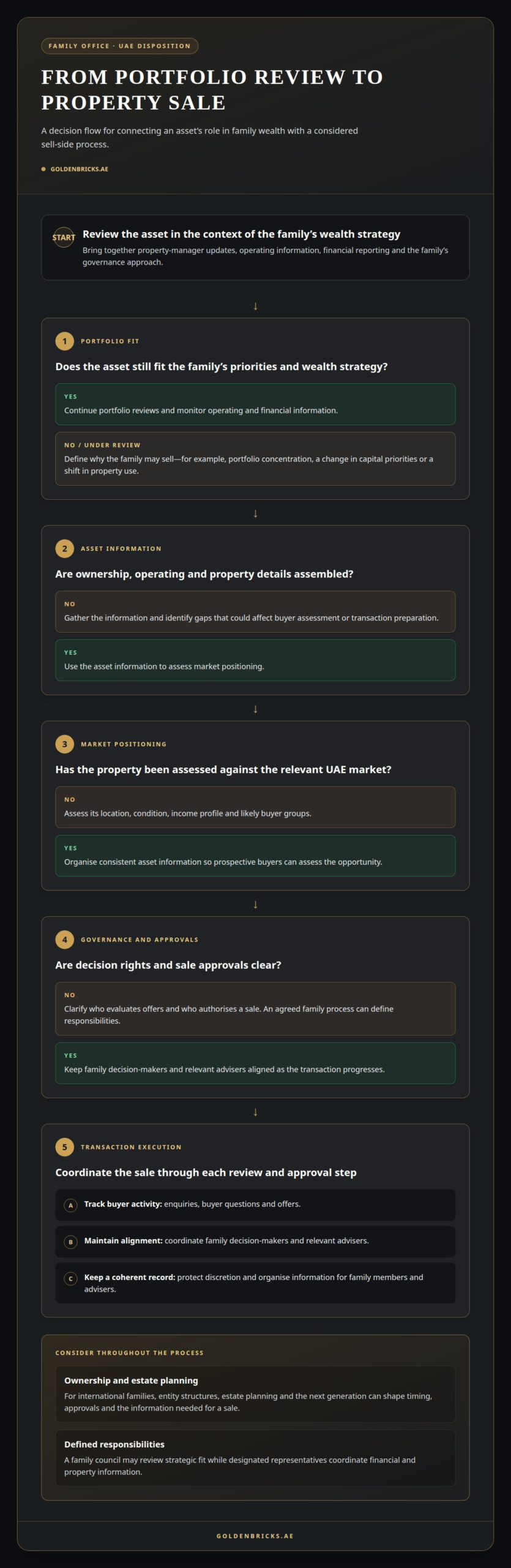
For an international family, disposition planning can also involve entity structures, estate planning and the next generation. These considerations shape timing, approvals and the information needed for a sale. A practical sell-side process can include:
- Define the objective. Record why the family may sell, such as portfolio concentration, a change in capital priorities or a shift in property use.
- Review the asset. Assemble ownership, operating and property information, then identify gaps that could affect buyer assessment or transaction preparation.
- Set market positioning. Assess the property’s location, condition, income profile and likely buyer groups in the relevant UAE market.
- Prepare buyer materials. Organise consistent asset information so prospective buyers can assess the opportunity and progress their review efficiently.
- Coordinate execution. Track enquiries, buyer questions, offers and approval steps, keeping family decision-makers and relevant advisers aligned.
Governance matters throughout. A family constitution or agreed approval process can clarify who evaluates offers and authorises a sale. For example, a family council may review strategic fit while designated representatives coordinate financial and property information. Clear responsibilities help protect discretion and maintain a coherent record for family members and advisers.
Disposition support is most useful when an asset’s purpose, ownership structure or contribution to the portfolio is under review. Real estate advisory for family offices provides a clear route from the initial decision to an informed sale process, linking property-level execution with wider wealth and succession considerations.
Family office advisory models
Family offices combine internal oversight with specialist support according to their governance framework and investment responsibilities. The suitable model depends on family members’ needs, assets and succession priorities.
Choosing Ownership and Fund Models
Direct ownership gives a family control over individual properties, operating decisions and holding structures. A real estate fund pools investment exposure, while its governance and reporting framework shapes the family’s influence. Compare control, administration, liquidity needs and fit with family wealth objectives. Ownership structures can also affect income tax during ownership and tax treatment when property passes to heirs.
A single-family office serves one family with dedicated, customised support; a multi-family office serves several families and shares costs and expertise. Either model may combine direct ownership with fund investments, depending on the family’s preferred level of control and capacity for oversight.
Developing an Investment Strategy
Begin by defining the portfolio’s purpose: income, long-term capital preservation, diversification or family use. Then align investment decisions with family governance, liquidity needs and the intended role of each asset. A succession framework can clarify how property interests relate to family members and the next generation.
Some offices retain investment responsibilities in a separate entity, while the family office coordinates administration and external specialists. Outsourcing can fill capability gaps: 62% cite limited in-house expertise as a reason to outsource, and 78% say specialist providers improve service levels. A strategy should identify what remains internal and what external support covers, such as partnering with firms like SANSAV Properties LLC when sourcing luxury residential acquisitions and high-yield off-plan developments in the UAE.
Evaluating Deals, Returns, and Risks
Assess a deal by reviewing its purchase rationale, operating assumptions, capital requirements and exit options. Compare projected income and costs with the family’s investment objectives, then test sensitivity to vacancies, maintenance needs and market changes. These checks reveal which assumptions drive expected returns and where downside exposure is concentrated.
Structure due diligence as a review of ownership and property records, physical condition and operating information, financial assumptions, and unresolved risks. Let the strategy guide market selection rather than following a trend. Compare locations and property sectors by demand drivers, use, management requirements and portfolio fit. Market intelligence can help frame these comparisons.
Assessing Tax, Legal, and Fee Considerations
Tax and legal analysis should cover the holding entity, ownership structure, income during ownership, sale proceeds and transfers to heirs. Family offices may coordinate direct and indirect tax planning, accounting, trusts and estate planning with relevant advisers. Cross-border assets can add jurisdictional and compliance considerations.
Typical advisory fees vary with scope, asset complexity and deliverables; fees are set after a quote request. A clear engagement framework identifies responsibilities, reporting and transaction support before work begins. For market context, UAE property market intelligence can inform the family’s assessment.
How do family offices develop a real estate investment strategy?
A disciplined property strategy begins with a written investment mandate. Family members define the portfolio’s purpose, acceptable exposure, liquidity needs and decision rights. For a UAE family, the mandate can distinguish income-producing assets from properties held for family use. It should also explain how real estate supports wider wealth, governance and succession priorities.
Translate the mandate into a portfolio framework through four steps:
- Map current holdings. Record each property’s ownership entity, location, use, operating status and role in the family portfolio.
- Set allocation principles. Define the property sectors and markets under consideration, alongside concentration limits and the reasons for including each category.
- Establish approval routes. Specify who develops proposals, who reviews financial and operational assumptions, and who authorises investment or divestment.
- Plan oversight. Assign responsibility for reporting, property management and periodic review against the mandate.
A family office’s operational remit can include overseeing family assets and properties, as well as coordinating with property managers responsible for administration and maintenance. The distinction matters: the investment entity may make investment decisions, while the family office coordinates information and governance. The strategy should specify how reporting moves between these roles so property-level updates inform portfolio decisions.
Family priorities can shift across generations. A strategy may identify properties intended for continued family use, assets considered for sale and holdings that support future capital needs. For example, an agreed succession framework can clarify how family members review a proposed change to a property’s use or ownership. Estate planning, trusts and tax planning should align with that framework, especially when assets or family interests cross borders.
Review the mandate when its underlying assumptions change, such as when family objectives, governance arrangements or portfolio composition shift. Record the decision, the information considered and the responsible decision-makers. This creates a practical reference for future investment proposals and helps keep property oversight aligned with family priorities.
What are the benefits of direct property ownership versus real estate funds for family offices?
For a UAE family office, direct ownership can provide greater influence over a property’s use, management and eventual sale. That control may suit a family holding a particular Dubai asset for income or family use. It also brings direct responsibility for property oversight, reporting and decisions about maintenance or repositioning.
A real estate fund provides exposure through a pooled investment structure. The family’s influence depends on the fund’s governance, reporting and investment mandate, rather than direct control of each property. This can reduce the need to oversee individual assets, while making the manager’s decisions and fund terms central to the family’s assessment.
- Control: Direct ownership allows property-specific decisions; fund investors act through the fund’s governance arrangements.
- Oversight: A directly held asset needs operating information and property management; fund reporting provides information at the fund level.
- Exposure: A single property concentrates attention on that asset, while a fund may pool interests across its portfolio.
- Flexibility: A family can decide how to use or sell a directly held property, subject to its ownership and approval arrangements.
Ownership structure also matters to cross-border families. Andersen notes that it can affect income tax during ownership, capital gains tax on sale, and gift and estate taxes when property passes to an heir. For UAE families with international holdings or beneficiaries, property decisions should therefore be considered alongside estate planning.
A practical comparison starts with the family’s desired control, oversight capacity, investment horizon and the property’s role in the portfolio. For example, a family prioritising direct oversight may prefer an individual asset, while one seeking pooled exposure may consider a fund structure. Neither route is inherently superior; each allocates decision-making and operating responsibilities differently.
For directly held assets, consistent property oversight supports informed decisions about operations and portfolio fit. Explore property management as part of a disciplined ownership approach.
Golden Bricks Real Estate
Golden Bricks Real Estate helps family offices connect property decisions with practical ownership and portfolio needs. When considering an acquisition, its Exclusive Ready Properties and Exclusive Off-Plan Projects offer property opportunities to assess against the family’s investment objectives. Project Curation supports a considered approach to selecting projects, while Property Management can provide ongoing oversight of directly held assets.
These services are most useful when a family is evaluating property opportunities, refining its holdings or arranging operational management. They complement the office’s own governance, financial analysis and legal or tax advice, rather than replacing those functions. The next step depends on whether the priority is reviewing property opportunities, curating a project or managing an existing holding.
Discuss your property priorities with Golden Bricks Real Estate.
Set the Next Property Decision in Motion
A disposition creates a new allocation choice: retain liquidity, pursue another asset or adjust the portfolio’s balance. Treat the next move as part of the family’s long-term investment framework, with clear decision rights and a defined purpose for any capital released. In the UAE, real estate advisory for family offices can connect property decisions with the family’s broader priorities.
Golden Bricks Real Estate offers Exclusive Ready Properties and Exclusive Off-Plan Projects for families assessing potential acquisitions, alongside Property Management for ongoing asset oversight. These services can support the next stage of a property strategy, whether the family is considering a new holding or managing an existing one.
Bring the relevant property objective into focus, then consider how it aligns with the family’s wider portfolio and governance approach. Contact Golden Bricks Real Estate to discuss the next property decision. A deliberate next step can help keep property choices aligned with enduring family priorities.
Frequently Asked Questions
What real estate advisory services do family offices typically need?
Family offices typically need support suited to each property’s lifecycle, from opportunity assessment to ownership oversight or sale. In the UAE, relevant services include market intelligence, property management, project curation, and assistance with buying, selling or leasing. For example, a family considering an acquisition can assess its fit with the portfolio and its operating requirements before proceeding. Legal, tax and investment decisions remain part of the family’s wider advisory framework.
How can family offices structure real estate ownership and co-investments?
Family offices can organise ownership through an entity or investment vehicle, with the structure reflecting control, reporting and succession objectives. For co-investments, document each participant’s contribution, decision rights, distribution approach, ongoing responsibilities and exit process before acquiring a property. For example, an agreement can clarify how members approve a sale or resolve differing views. The family’s legal and tax advisers can align these arrangements with relevant jurisdictions and estate plans.
What real estate markets and property sectors are family offices investing in?
Family offices compare locations and property sectors by demand drivers, use, management requirements and fit with the portfolio. When preparing a sale, they assess how the property should be positioned in the relevant UAE market.