Yes, you can rent out a UAE property after handover once it is ready for occupation and possession is complete. Handover alone does not complete the rental process: tenancy registration requirements vary by emirate. This new property owner checklist for the UAE explains the practical steps between receiving the keys and preparing to lease.
It is natural to expect that completing a purchase means you can rent the property straight away. In practice, timing depends on handover readiness, outstanding payments and the applicable tenancy registration process.
Here, you’ll learn when handover typically happens, which purchase and handover costs to plan for, and how off-plan payment schedules may be structured. The checklist also covers what to review before taking possession and how to prepare the property for a tenant, so you can make informed decisions about your responsibilities as an owner.
Key Takeaways
- Track the completion notice, reconcile the final instalment with your sale agreement and receipts, and prepare for handover charges such as service fees.
- Budget for Dubai purchase costs, including the 4% DLD transfer fee, and review whether an off-plan payment plan links instalments to construction milestones or handover.
- Arrange a snagging inspection before taking possession, then collect the keys, access tools, manuals and written records of any outstanding defects.
- Once a property is ready for occupation and possession is complete, an owner can consider letting it, subject to the applicable rental process.
When Does Property Handover Happen in Dubai?
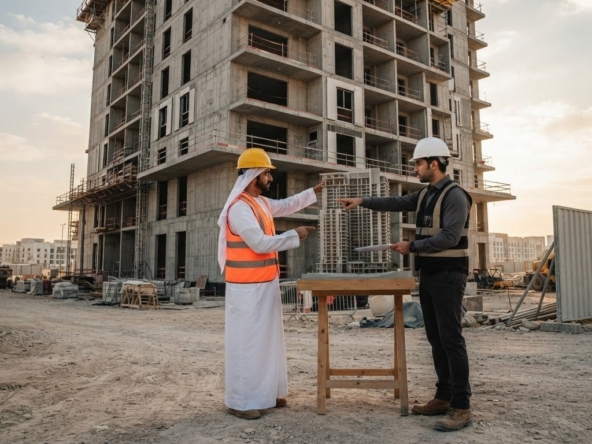
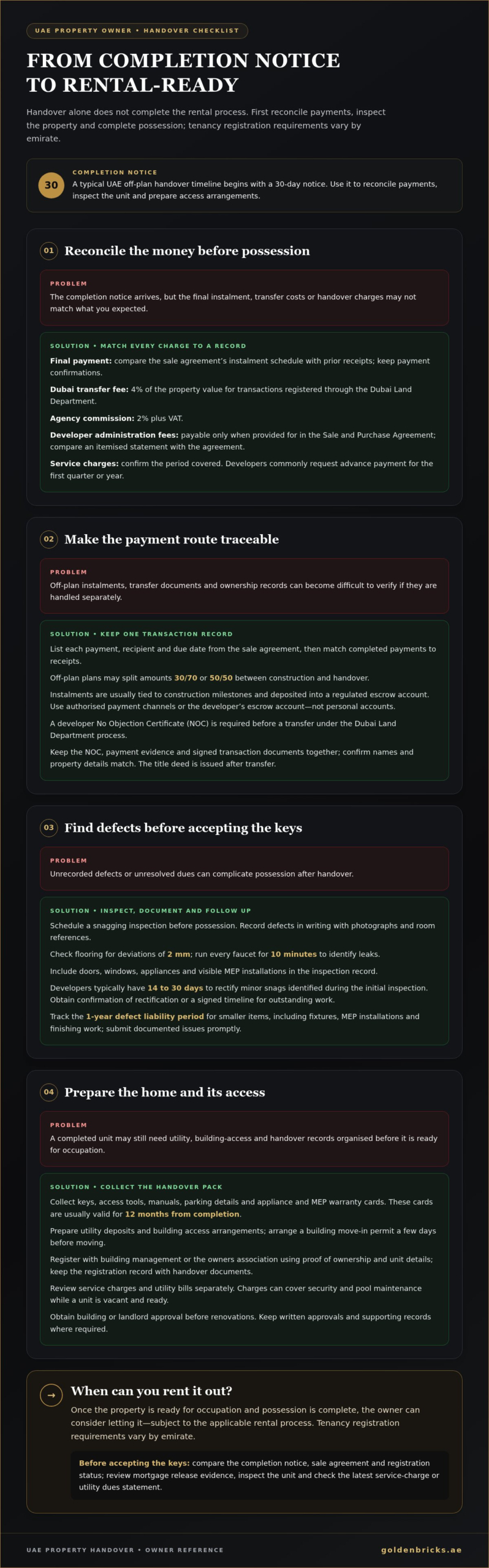
For an off-plan purchase, handover follows the developer’s completion notice and settlement of required amounts. A UAE handover timeline typically begins with a 30-day completion notice. Treat it as a prompt to reconcile payments, inspect the unit and prepare utility and building access arrangements. This new property owner checklist UAE buyers can use starts with the notice date and the sale agreement.
- Match the final payment to your records. Compare the agreement’s instalment schedule with prior receipts before paying. Keep payment confirmations for handover.
- Review registration charges.
- Check handover administration fees. Developer handover or administration fees apply only when the Sale and Purchase Agreement provides for them. Compare an itemised statement against the agreement.
- Confirm service charges and their period. Developers commonly request advance payment covering the first quarter or year at handover. Charges can cover security and pool maintenance while a unit is vacant and ready.
- Prepare utility deposits.
In Dubai, property worth AED 2 million or more can qualify its owner for a 10-year Golden Visa, according to the Federal Authority for Identity, Citizenship, Customs & Port Security.
Before starting renovations, obtain building or landlord approval. According to the Dubai Legal Affairs Department, when work requires official approval, the landlord must provide approvals if the work does not affect the structure and the tenant has official documents requesting them. Arrange a building move-in permit a few days before moving.
Consider building and contents insurance. Premiums depend on property value, location, coverage and contents. Review municipality assessments, service charges and utility bills separately. To register with building management or an owners association, submit proof of ownership and unit details, then keep the registration record with your handover documents. This new property owner checklist UAE owners can adapt also includes saving account activation and access details.
Understanding transaction costs and payment schedules
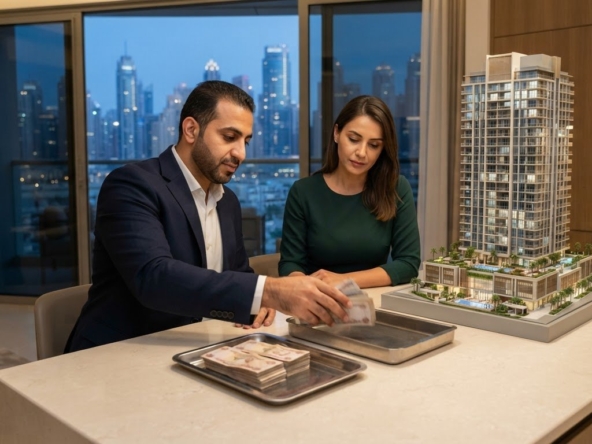
Separate the purchase price from transfer, agency, financing and document charges. For transactions registered through the Dubai Land Department, the transfer fee is 4% of the property value. Agency commission is 2% plus VAT.
- Build a transaction schedule. List each payment, recipient and due date from the sale agreement, then match completed payments to receipts. Off-plan plans may split amounts 30/70 or 50/50 between construction and handover.
- Use the authorised payment route. Off-plan instalments are usually tied to construction milestones and deposited into a regulated escrow account. Use authorised payment channels or the developer’s escrow account, not personal accounts.
- Obtain the developer NOC. A developer No Objection Certificate is required before a transfer under the Dubai Land Department process.
- Prepare for title deed transfer. The Dubai Land Department issues the title deed after transfer. Keep the NOC, payment evidence and signed transaction documents together, and confirm names and property details match.
Registration procedures vary across the UAE. Submit sale documents and any required identity or ownership records to the relevant emirate’s property registration authority, complete the transfer process, and obtain the ownership certificate or title deed.
If a representative will act on your behalf, tailor the Power of Attorney to the property and transaction. Specify the powers granted, such as signing transfer documents or obtaining an NOC. Requirements vary by emirate and institution. Arabic is central to UAE legal documentation, and authorities commonly rely on the Arabic text of bilingual documents. Use certified legal translation where required.
After transfer, property management can support owners with ongoing property oversight.
Property handover timing and completion notices
For a ready property in Dubai, registration is completed at a Real Estate Services Trustee Center, and the buyer receives the title deed upon completion. An off-plan handover follows the developer’s completion notice and the agreement’s payment conditions. Compare the notice, sale agreement and registration status before arranging possession.
New owners should assess three risks: an outstanding mortgage, defects, and unpaid service charges or utilities. Compare the title deed and transfer documents with mortgage release evidence, inspect the unit, and review the latest dues statement before accepting the keys.
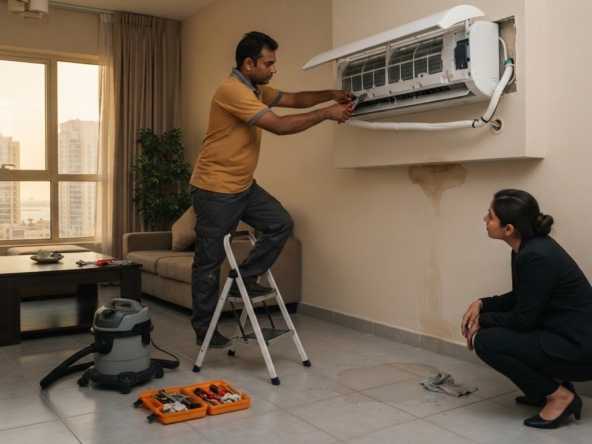
- Schedule a snagging inspection before possession. Record defects in writing, with photographs and room references, then obtain confirmation of rectification or a signed timeline for outstanding work.
- Test fixtures and finishes systematically. Check flooring for deviations of 2 mm and run every faucet for 10 minutes to identify leaks. Include doors, windows, appliances and visible MEP installations in the inspection record.
- Track the defect liability period. UAE homeowners have a 1-year defect liability period for smaller items, including fixtures, MEP installations and finishing work. Submit documented issues promptly within the applicable period.
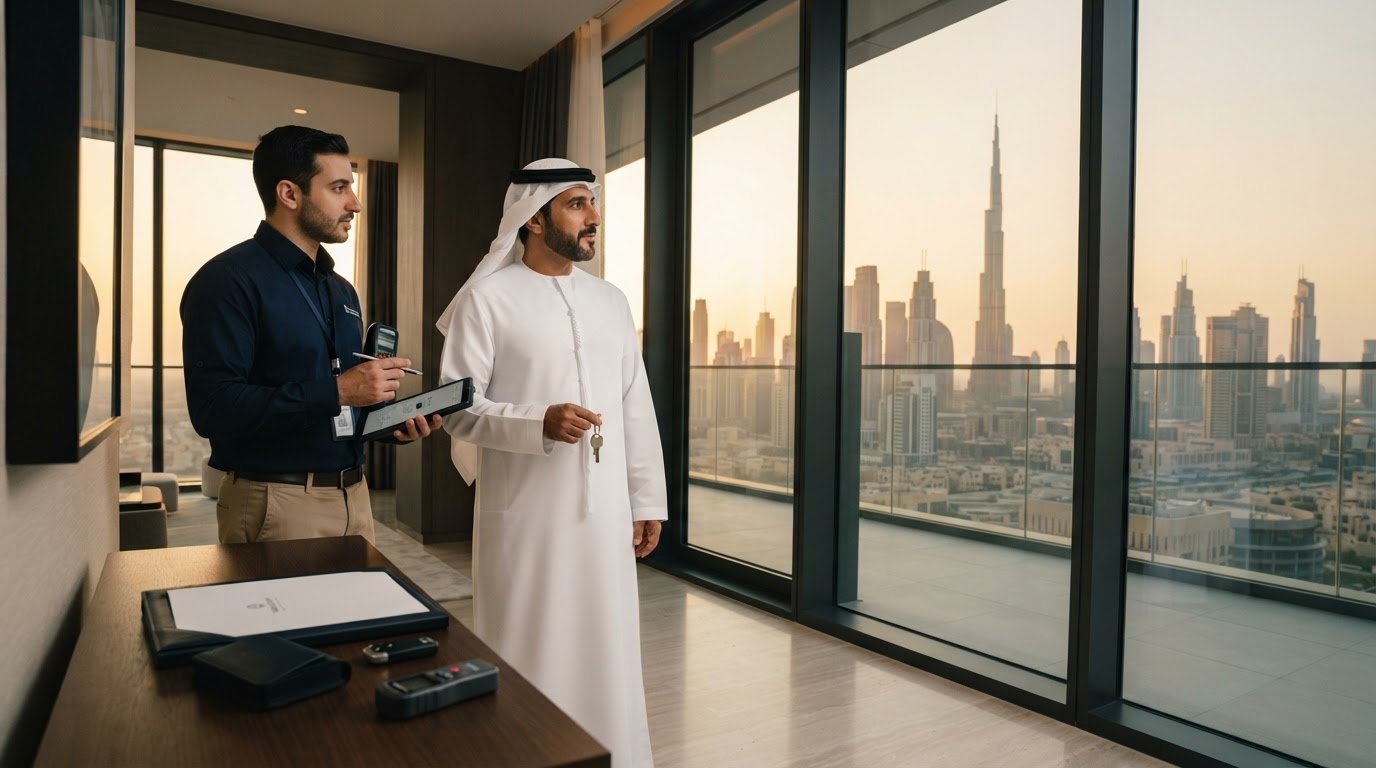
- Collect the complete handover pack. Obtain keys, access tools, manuals, parking details and appliance and MEP warranty cards. Those cards are usually valid for 12 months from the date of completion.
Developers typically have 14 to 30 days to rectify minor snags identified during the initial inspection. Keep the inspection report, submission date and every response together, so outstanding work remains traceable after possession.
For an off-plan purchase, retain the Oqood certificate as interim ownership proof during construction. For a completed ready property, file the title deed issued through registration. If the property is mortgaged, keep bank discharge records with the ownership documents and confirm the transfer paperwork reflects the loan status.
Before signing the handover record, compare meter readings and service-charge statements with the unit and period shown. Record any unpaid balance or disputed item in writing, and keep the completion notice, agreement and final inspection report with your title deed.
Can You Rent Property Immediately After Handover?
You can rent out a Dubai apartment once handover is complete, possession is available, and the unit is ready for occupation. Every Dubai tenancy agreement must be registered on Ejari.
- Distinguish a purchase booking deposit from rental income. An off-plan booking deposit is typically 5 to 10% of the purchase price. It forms part of the purchase process, not permission to lease before completion.
- Review the developer’s payment plan. Off-plan plans may use 30/70 or 50/50 splits between construction and handover. Map each instalment to its due date and the handover conditions in your sale agreement.
- Verify the property and project. Use Dubai REST or Dubai Land Department records to check an off-plan project’s registration and escrow account. For a resale, compare seller ownership details with the title deed and transfer documents.
- Record broker and developer details. Keep the broker’s identifying and registration details with the transaction file, and retain developer notices and payment receipts. Review service-charge statements when planning the apartment’s rental costs.
Developers may have a standard 12-month grace period beyond the handover date in the Sale and Purchase Agreement before a buyer can seek compensation for delay. Keep the agreed date, completion notices and payment records together, and account for delays before committing to a tenant’s move-in date.
Short-term letting follows a separate route: Dubai property owners must obtain a Holiday Home Permit from DTCM before listing on Airbnb or similar platforms. For a long-term tenancy, complete Ejari registration and maintain records of the signed agreement and handover condition. Plan your next property ownership steps with the rental timeline and documentation in view.
Golden Bricks Real Estate: Exclusive Off-Plan Projects
Golden Bricks Real Estate can help buyers assess Exclusive Off-Plan Projects when planning a purchase around construction milestones, handover timing and future use. Project Curation supports a considered comparison of project options, while Exclusive Ready Properties suit buyers seeking completed homes. For owners preparing to lease or oversee a completed asset, Property Management is a relevant next step.
The right route depends on your ownership stage: selecting an off-plan purchase, comparing ready property, or managing an asset after handover. Align the choice with your intended holding period, occupancy plans and approach to ongoing oversight. Contact Golden Bricks Real Estate to discuss your property requirements, or visit goldenbricks.ae.
Shape Your Next Property Decision
Ownership is not a single transaction; it is an ongoing investment decision. Use a new property owner checklist in the UAE to guide your next move, whether you are refining an acquisition strategy, preparing an asset for long-term use or considering a future purchase. Priorities may change as your circumstances and investment objectives evolve, so keep your property records and plans aligned.
Golden Bricks Real Estate offers Exclusive Off-Plan Projects and Exclusive Ready Properties for buyers weighing different ownership pathways. Its Property Management service supports owners seeking ongoing oversight. Consider which approach best fits your objectives, then take your next step deliberately.
Contact Golden Bricks Real Estate to discuss your property plans. A considered decision today can provide a stronger foundation for the ownership journey ahead.
Frequently Asked Questions
Do property owners need Ejari in Dubai?
For a rented home in Dubai, every tenancy agreement must be registered on Ejari. Ejari records the rental relationship, not ownership itself, so an owner living in their own property does not need Ejari to connect DEWA. If you lease the home, make sure the registered tenancy details match the signed agreement, including the unit and named parties.
The Handover Pack: What Should Be Inside?
A useful handover pack should let you trace the property’s condition, ownership and outstanding obligations. Keep the completion notice, signed possession record, snagging report, written repair commitments, payment receipts and service-charge statement together. Add the title deed for a completed property or the Oqood certificate for an off-plan unit. Check that names and unit details match across the records, then keep accessible digital copies.
What Happens If Documents Are Incomplete?
Incomplete documents can delay the preparation or notarisation of a property Power of Attorney. A blurred scan, cropped passport page, expired identification or ownership document without relevant property details can hold up the process. Before signing, compare names and identification details with passports and Emirates IDs, complete every field, and do not sign blank sections. Material changes after execution may require a new Power of Attorney.
What documents should a new property owner in the UAE receive from the seller or developer?
For a completed property, retain the title deed, signed sale documents, payment receipts, developer NOC and any available service-charge statement. Request records about the unit’s condition, including snagging findings and written repair commitments. For an off-plan purchase, keep the Oqood certificate and payment confirmations. These documents help distinguish interim ownership evidence from the title deed issued after registration.
What are the UAE property title deed and registration fees for new owners?
The DLD transfer fee is separate, at 4% of the property value. These figures describe Dubai charges, not a single UAE-wide schedule.
How do new UAE property owners set up electricity, water, cooling, and gas accounts?
Apply to the utility providers serving the property and provide the unit and ownership details they require. In Dubai, an owner occupying the home can connect DEWA without Ejari. Cooling and gas arrangements depend on the building’s supply setup, so identify the designated providers through building management. Keep account activation records and meter details with your ownership documents for future billing checks.