
Handover doesn’t always mean the final instalment is due. A post-handover plan lets buyers pay part of a Dubai property’s purchase price after completion, with schedules commonly structured around splits such as 50/50 or 60/40. When comparing off-plan property payment plans in Dubai, the key distinction is how much is due before handover and how much remains payable afterwards.
It’s understandable to focus on the headline split, but the timing matters just as much. Construction-linked instalments, fixed payment dates and post-handover terms determine when funds are needed and how the purchase fits your broader plans.
This guide explains how Dubai off-plan payment schedules work, what post-handover payments mean, and how financing, potential rental income and service charges affect the full ownership picture. You’ll learn what to assess before choosing a plan, so you can compare payment milestones and the commitments that continue after handover.
Key Takeaways
- Compare the share due before handover with any balance scheduled afterwards, and assess whether the timing suits your available capital.
- Distinguish construction-linked instalments from fixed-date payments so you can understand what triggers each payment.
- Assess delivery timelines alongside the developer’s track record, since the handover date shapes your payment and ownership planning.
- Model financing, service charges and furnishing costs separately from the developer’s schedule; potential rent should not be treated as guaranteed payment cover.
- Review the specific project’s current schedule and late-payment terms before committing, as plans can differ between project releases.
What is a Post-Handover Payment Plan in Dubai?
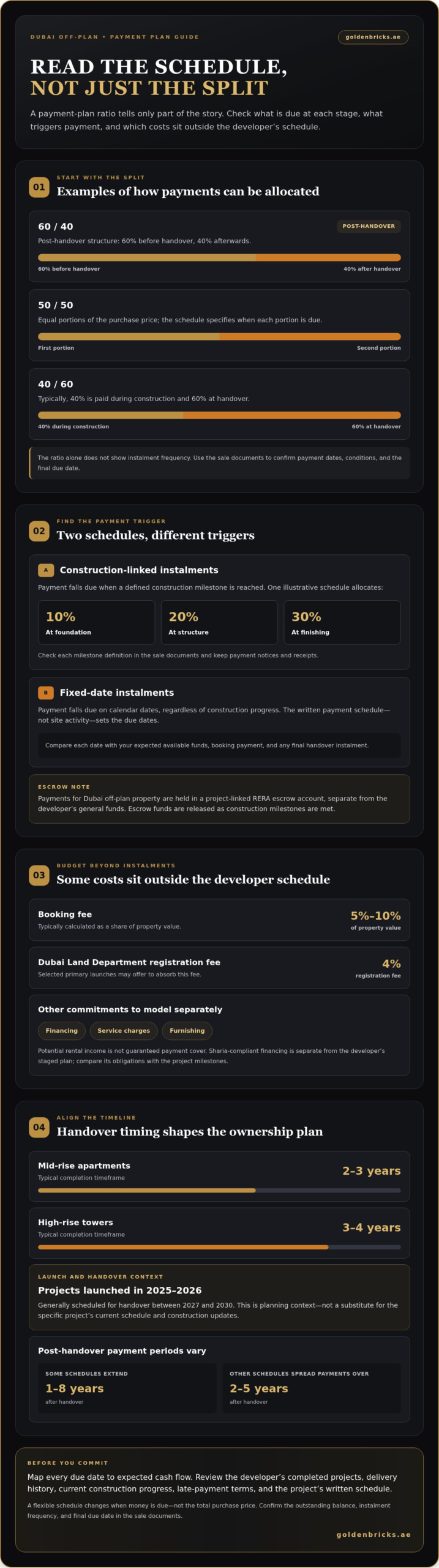
A post-handover payment plan lets a buyer pay part of a Dubai property’s purchase price after completion. The buyer takes possession at handover while agreed instalments continue under the developer’s schedule. For example, a 60/40 structure may allocate 60% before handover and 40% afterwards. The sale documents specify the payment dates and conditions. Buyers comparing off-plan property payment plans in Dubai should assess those details alongside the headline split.
Common structures divide payments between booking, construction, handover and, in some cases, the period after completion. A 40/60 plan typically means 40% is paid during construction and 60% at handover. A 50/50 plan divides the purchase price into equal portions, with the schedule setting when each is due. In a post-handover 60/40 plan, 60% is paid before handover and 40% afterwards. The ratio alone doesn’t show instalment frequency.
Some post-handover schedules extend for 1 to 8 years after handover; others spread instalments over 2 to 5 years. A useful way to evaluate off-plan property payment plans in Dubai is to map each payment date against expected cash flow. Record the outstanding balance, the instalment frequency and the final due date. A flexible schedule changes when money is due, not the total purchase price.
For off-plan purchases, booking fees are typically 5% to 10% of the property value, and the Dubai Land Department registration fee is 4%. Selected primary launches may offer to absorb the registration fee. These charges sit outside the developer’s instalment schedule, so include them when calculating funds required at booking and during the purchase process.
Missing an instalment can have consequences set out in the sale agreement, including penalties or effects on the purchase. Review the late-payment terms and the process for handling a missed due date before signing. Add every due date to a cash-flow calendar and match it to the funds you expect to have available.
Sharia-compliant financing is separate from a developer’s staged payment plan. Its contractual and payment arrangements depend on the financing structure and the parties’ agreement. Compare its obligations with the project’s booking, construction and handover milestones to understand how financing commitments interact with the purchase schedule.
Construction-linked and fixed-schedule payment plans
Dubai off-plan payment plans may link instalments to construction milestones or fixed calendar dates. The difference determines whether payments follow project progress or a predetermined schedule.
Construction-Linked Instalments
With construction-linked instalments, payment becomes due as the building reaches defined milestones. A schedule may allocate 10% at foundation, 20% at structure and 30% at finishing. Buyers should compare each trigger with the project’s stated construction stages and the sale documents. This connects payment timing to progress, while requiring funds to be ready when each milestone is reached.
Fixed-Date Instalments
Fixed-date instalments fall due on calendar dates, regardless of construction progress. You may need to pay on schedule even if a milestone has not yet been reached. Check the dates against expected cash availability, the booking payment and any final handover instalment. The written schedule, not construction activity, sets each due date.
Payments for Dubai off-plan property are held in a project-linked RERA escrow account, separate from the developer’s general funds. Escrow funds are released as construction milestones are met, so milestone definitions and payment notices matter. Compare each payment trigger with the corresponding project stage, and keep due dates and receipts with your sale documents.
A developer’s delivery record and the project’s stated timeline also inform payment planning. Dubai mid-rise apartments typically take 2 to 3 years to complete, while high-rise towers typically take 3 to 4 years. Delays can affect when buyers expect handover and any post-handover arrangements. Review the developer’s completed projects, delivery history and the current project schedule together, rather than relying on the launch date alone.
Before booking, map the schedule against your expected cash flow. Identify whether each instalment follows a construction milestone or a date, and note the evidence that marks a milestone as reached. Then assess how a revised construction timeline could affect your planned funds. A launch may advertise 1% monthly instalments, but the contract’s payment calendar governs the actual obligations.
Use a project comparison to assess how Dubai off-plan project options align with milestone timing, delivery expectations and your available funds.
Developer reputation and delivery timelines
A developer’s delivery record can help you judge whether a payment schedule fits the project’s progress. Compare completed projects, construction updates and stated handover dates. Then consider how a delay could affect financing, cash flow and expected rental income. A payment plan alone cannot tell you when a property will be ready. Assess delivery history and current progress separately, and record both before deciding.
Dubai mid-rise apartments typically take 2 to 3 years to complete, while high-rise towers typically take 3 to 4 years. Projects launched in 2025-2026 are generally scheduled for handover between 2027 and 2030. These timelines offer planning context, not a substitute for reviewing the schedule of a specific project. Buyers should compare the stated completion date with construction updates and the developer’s record of completed work.
Payment terms also vary between developments. One listed tower schedule assigns 32% of the purchase price after handover, with delivery stated for Q3 2027. Another residence schedule uses a 10/80/10 structure and states a Q2 2031 handover. These examples illustrate why buyers should consider the payment plan and delivery date together. A larger post-handover share may affect cash flow after possession, while a later handover can extend the period before rental income begins.
Compare developers and projects using the same details: stated handover date, latest construction progress, instalment milestones and amount due at possession. Review completed developments to understand the developer’s delivery history, then compare it with the current project’s schedule. Terms can change between releases, so use the written schedule for the specific release and unit you are considering.
- Delivery record: Review completed projects and compare their handovers with stated timelines.
- Construction progress: Match current updates to the milestones that trigger payments.
- Cash-flow impact: Assess the balance due at handover and any later instalments.
Don’t count rental income as available funding before possession. After handover, you may be able to rent out a completed property while continuing post-handover instalments, but don’t assume rent will cover every payment. Assess the expected start of rental income alongside the handover date, remaining balance and ownership costs. This puts the developer’s schedule in the context of your broader plan for paying for and operating the property.
Financing, rental income and service charges
Map the developer’s instalments against financing, ownership costs and expected rent. These follow different timelines: purchase payments can begin before handover, while rental income starts only after possession. List each due date, expected funding source and recurring expense. This clarifies how much capital you may need before the property begins generating income.
Include mortgage costs alongside the developer’s schedule. Financing approval and disbursement timing affect how much capital you need to hold for each due date. A post-handover balance remains payable after possession, even if the property is rented. List instalments and financing commitments separately, then compare them with available funds without assuming future rent will arrive in time.
A rental example illustrates the distinction between projected yield and cash available. The Arjan example estimates an 8% rental yield on completion, equal to about AED 48K per year for a AED 600K property. This gives investors an annual revenue illustration, not a monthly payment calendar. Compare the rent schedule with each instalment date, and allow for periods when the residence is not producing rental income.
Service charges also affect the net return from a property. They are separate from purchase instalments and reduce the income available after rent is received. Include service charges, furnishing and mortgage costs in your ownership model. Assess these expenses alongside expected rental income rather than treating gross rent as spendable capital.
Before handover, you may need to meet instalments without rental income. After possession, you can generally rent out the property while continuing post-handover payments. That overlap may support cash flow, but don’t assume rent will cover every outstanding instalment. Compare payment dates with expected rent receipts, financing obligations and service charges, and plan for any gap.
For an investment appraisal, separate the figures into three stages: pre-handover capital, post-handover obligations and operating income. The Arjan illustration’s AED 48K annual rent should be compared with the full year’s costs, not one instalment alone. This approach helps buyers assess whether a payment plan suits their investment horizon, expected handover date and capacity to fund the property before rental income begins.
- Before handover: Plan for instalments, financing and purchase costs before rent begins.
- After possession: Compare rental receipts with remaining instalments and service charges.
- For returns: Assess net income after ongoing property and financing costs.
Dubai off-plan project payment schedules
A project schedule shows when portions of the purchase price become payable. Focus on the sequence, not just the advertised split. Record the booking payment, construction instalments, handover balance and any amount due afterwards. Then compare the schedule with the capital available at each stage. This shows where the biggest funding demands fall and whether they fit your plans.
For example, a 10/70/20 plan allocates 10% at booking, 70% during construction and 20% at handover. A 40/60 plan places 40% during construction and 60% at handover, while a 60/40 plan allocates 60% during construction and 40% at handover. An 80/20 structure assigns 80% before handover and 20% afterwards. Other plans spread payments at 1% of the property value per month.
Project schedules can be compared using named examples without assuming every release follows the same terms. Terra Gardens has a 10/70/20 plan and a Q4 2029 handover. Lyvia by Palace also has a 10/70/20 plan, with a Q3 2029 handover. The shared split does not establish identical instalment dates or triggers. Buyers should assess each project’s written schedule, handover timing and payment conditions independently.
For apartments, townhouses and other properties, create a stage-by-stage comparison. Note what is due at booking, how construction payments are spread, and how much remains at handover. Include any post-handover instalments in the same table. A lower initial payment can still mean substantial obligations during construction, while a smaller handover balance may mean payments continue after possession.
- Booking: Record the initial share and the due date.
- Construction: Identify whether instalments follow milestones or fixed dates.
- Handover: Note the amount due at possession and any later instalments.
- Contract terms: Review late-payment consequences and other applicable charges.
Terms may change between project releases. Compare the current written schedule for the specific unit, including payment dates and consequences for missed instalments. A payment plan changes when the purchase price is due, not the total price itself. To compare Dubai off-plan opportunities against your payment priorities, explore curated off-plan opportunities and consider how each schedule fits your investment strategy.
Golden Bricks Real Estate: Exclusive Off-Plan Projects
Golden Bricks Real Estate helps buyers assess Dubai opportunities through Exclusive Off-Plan Projects and Project Curation. When comparing payment schedules, consider how instalments, construction milestones and handover timing fit your investment priorities. This gives you a clearer basis for weighing a staged purchase against other property options.
Exclusive Ready Properties offer a point of comparison when deciding between a property under construction and a completed one. After handover, Property Management can support owners with the property’s ongoing operation. These services address different stages, from project selection to post-completion management.
Contact Golden Bricks Real Estate to discuss off-plan opportunities and project schedules that align with your buying priorities.
Make Your Next Property Decision With Clarity
Turn the payment schedule into a practical ownership plan. Consider how the purchase fits your investment horizon, how much capital you want to retain, and the role you expect the property to play after handover. Clear priorities make it easier to compare off-plan property payment plans in Dubai with ready properties and decide which route supports your objectives.
Golden Bricks Real Estate can help you consider Exclusive Off-Plan Projects alongside Exclusive Ready Properties. Property Management can support you during the ownership phase. Together, these services connect asset selection with planning for its ongoing operation, rather than treating the instalment schedule in isolation.
For a considered discussion of your Dubai property priorities, contact Golden Bricks Real Estate. Define your preferred asset, investment purpose and payment priorities before taking the next step. With a disciplined approach, you can move forward with greater confidence and a clearer view of how the property fits your plans.
Frequently Asked Questions
How do Off Plan payment plans work?
They divide the purchase price into payments due at agreed stages. A buyer might pay an initial amount at booking, followed by instalments during construction and a balance at handover. For example, a 10/70/20 schedule allocates those shares to booking, construction and handover. The signed sale documents set the applicable dates and conditions, so use them to map payments against your available funds.
What should investors check before choosing a payment plan?
Compare the full payment calendar, not just the advertised split. Identify each due date, the event that triggers an instalment, the handover balance and any later payments. Review late-payment consequences and the project’s delivery schedule, then assess financing, registration costs and ongoing service charges separately. Put these commitments beside your expected income and available capital, so a lighter initial payment doesn’t obscure later obligations.
What is the typical down payment for a Dubai off-plan property?
Down payments for the Dubai off-plan projects covered typically start at 10% to 20% of the property value. A booking fee is a separate initial payment, typically 5% to 10%. The sale schedule determines how the booking amount relates to the total down payment, so compare both figures before budgeting. For post-handover plans, the upfront amount may be 10% to 30%, depending on the project’s structure.
How are construction-linked installment plans structured in Dubai?
These plans make instalments due as construction reaches specified stages. A schedule may assign 10% at foundation, 20% at structure and 30% at finishing. The exact milestone descriptions and payment triggers appear in the project documents. Compare those definitions with the construction schedule, and keep the milestone notices alongside payment records. This helps distinguish a progress-triggered instalment from one due simply because a calendar date has arrived.
What are post-handover payment plans and how do they work?
They allow buyers to pay part of the purchase price after the property is completed and handed over. For example, a 60/40 post-handover structure allocates 60% before handover and 40% afterwards. Some Dubai plans spread post-handover instalments over 2 to 5 years. Buyers should plan for those continuing payments alongside ownership costs, rather than treating possession as the end of their financial commitments.
Can foreign buyers use mortgages to pay for off-plan property in Dubai?
Foreign buyers may consider mortgage financing for an off-plan purchase, but a developer’s instalment schedule and a bank’s financing terms are separate commitments. Available funding depends on the lender’s assessment, the buyer’s finances and the property’s status. Allow for the possibility that instalments fall due before financing is disbursed, and include mortgage costs in your overall cash-flow assessment.
How do developer payment plans compare with bank financing in Dubai?
A developer’s plan sets when purchase instalments are due, often around booking, construction or handover. Bank financing is a separate borrowing arrangement, with repayment obligations defined by the lender. Compare payment dates, funding sources, ongoing repayments and the total cash required at each stage. A developer schedule changes the timing of purchase payments, not the property’s price.
What legal protections apply to off-plan buyers in Dubai, including escrow requirements?
Payments for off-plan property go into a project-linked RERA escrow account, separate from the developer’s general funds. The account holds payments and releases them to the developer against construction progress. This project-specific mechanism governs funds during construction. Keep payment receipts and sale documents, and understand how stated milestones relate to instalment requests. These details clarify how payments are administered for the project.