

Foreign buyers can own property in Dubai, but freehold ownership is limited to designated areas. Dubai Government Regulation No. 3 of 2006 designates the areas where non-UAE and non-GCC nationals may acquire freehold ownership, making location the first essential check in due diligence when buying property in Dubai.
Eligibility is only the starting point. Ready homes and off-plan units carry different risks. For a ready property, verify registered ownership, outstanding charges and transfer details. For an off-plan purchase, scrutinise the project, payment arrangements and completion terms. The right checks depend on the property and transaction, so complete them before committing.
This guide explains how to verify ownership, review service charges and account for purchase fees. It compares key risks for ready and off-plan property and outlines the documents and records to examine, helping you approach a Dubai property decision with a clearer view of the obligations involved.
Key Takeaways
- Foreign buyers can acquire freehold property in designated areas; confirm that the specific location permits the ownership structure you intend.
- Before a resale transfer, establish whether the developer’s No Objection Certificate can be obtained and review service-charge records for outstanding amounts.
- Include the Dubai Land Department transfer fee of 4% of the purchase price in your cost model, alongside other transaction costs.
- Compare the title deed with the property and transaction records, and establish how any mortgage or legal restriction will be resolved before transfer.
- For off-plan property, assess the project, payment terms and completion obligations; Dubai Government says Dubai Law No. 8 of 2007 requires developers to place payments in separate project escrow accounts.
1. Can Foreigners Buy Property in Dubai?
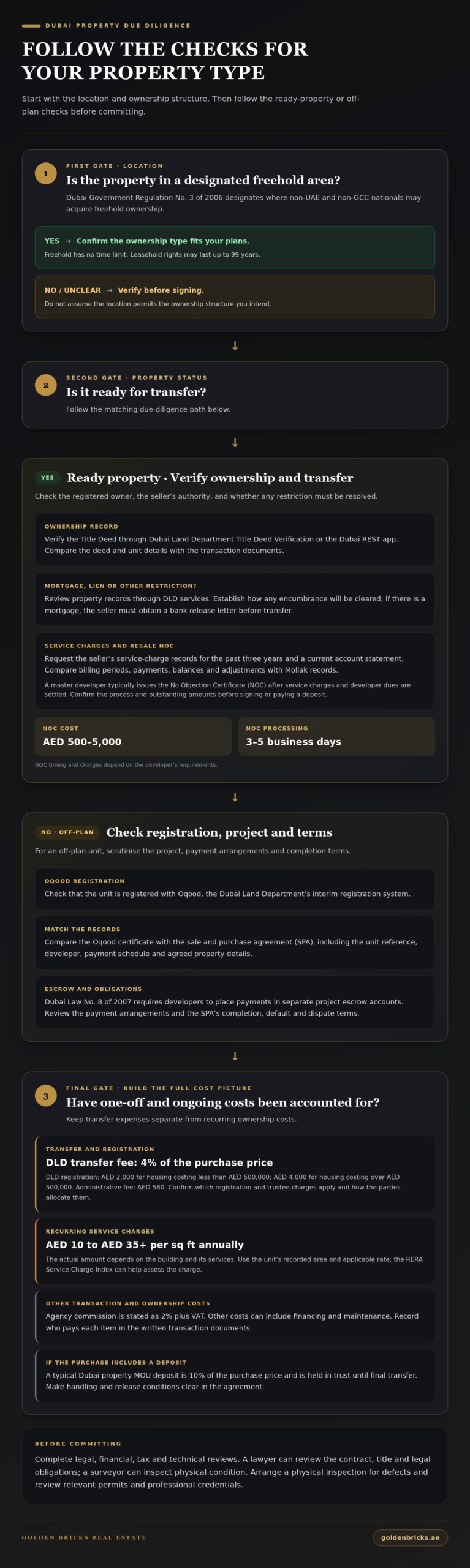
Yes. Non-UAE and non-GCC nationals may acquire freehold ownership in designated areas. Dubai Government Regulation No. 3 of 2006 designates the areas where they may acquire freehold ownership. Confirm the specific location and ownership type before signing. Dubai freehold ownership has no time limit, while leasehold rights may last up to 99 years. The distinction affects the rights attached to the real estate and should match your investment plans.
Property worth at least AED 2,000,000 may qualify a property investor for 10-year UAE Golden Residency, subject to the stated ownership conditions, according to UAE Government. Treat residency eligibility as a separate consideration from title verification. For an off-plan unit, check that it is registered with Oqood, the Dubai Land Department’s interim registration system. Compare the Oqood certificate with the sale and purchase agreement, including the unit reference, developer, payment schedule and agreed property details.
For a ready property, confirm who owns it and whether the seller has authority to transfer it. Use Dubai Land Department Title Deed Verification or the Dubai REST app to check the deed, then compare the unit details with the transaction documents. Establish whether a mortgage, lien or other restriction affects the property and how it will be cleared. If there is a mortgage, the seller must obtain a bank release letter before transfer. Match the seller’s identity and authority to the registered ownership record.
To check for mortgages, liens, service-charge arrears or other encumbrances, review the property records through DLD services. Obtain current mortgage or release details, and compare service-charge records with Mollak and the RERA Service Charge Index. Request utility account statements and clearance evidence. Before proceeding, investigate any disclosed ownership, tenancy, construction, payment or boundary disputes.
Compare the Mollak history with the seller’s service-charge statements to identify unpaid balances or unusual changes. For an existing property, request records covering the past three years. A discrepancy can affect the transfer and your ongoing ownership budget. Confirm whether developer dues remain unpaid, as settling them may be necessary to obtain a resale No Objection Certificate.
A lawyer can review the contract, title and legal obligations; a surveyor can inspect the property’s physical condition. The right professional depends on what you need to assess. The cost of due diligence varies with the scope of the legal review and inspection.
Complete legal, financial, tax and technical reviews before committing. Examine the sale and purchase agreement (SPA) for payment, completion, default and dispute terms; assess ongoing costs and tax implications; and arrange a physical inspection for defects. Where relevant, check permits and the credentials of professionals involved in the work or documentation. These steps make due diligence when buying property in Dubai specific to the unit, transaction structure and intended use.
2. No Objection Certificate and service charges
For a Dubai resale, the developer’s No Objection Certificate (NOC) is a key transfer document. The master developer typically issues it after confirming that service charges and developer dues have been settled. Confirm the NOC process and any outstanding amounts before signing or paying a deposit. A Dubai NOC commonly costs د.إ 500 to د.إ 5,000 and is processed in 3-5 business days. Timing and charges depend on the developer’s requirements.
Review the seller’s service-charge records for the past three years and compare them with the current account statement. Check the billing period, payment dates, outstanding balances and adjustments. Request a clear account position from the building’s management, then reconcile it against Mollak records. This helps separate recurring charges from arrears that could affect the NOC or transfer.
Service charges in Dubai range from د.إ 10 to د.إ 35+ per square foot annually. The actual amount depends on the building and its services, so calculate the annual cost using the unit’s recorded area and the applicable rate. For example, compare the charge per square foot across similar units, then account for the property’s facilities and maintenance needs. The RERA Service Charge Index can help buyers assess the applicable charge.
Include transfer and registration charges in the purchase budget, not just the agreed price. The Dubai Land Department transfer fee is 4% of the purchase price. DLD registration fees are د.إ 2,000 for housing costing less than د.إ 500,000 and د.إ 4,000 for housing costing over د.إ 500,000; the administrative fee is د.إ 580. Confirm which registration and trustee charges apply to the transaction, and establish how the parties will allocate them.
Other costs can include agency commission, financing, maintenance and ongoing service charges. The stated agency commission is 2% plus VAT. Keep one schedule for one-off transfer expenses and another for recurring ownership costs. That separation makes the property’s total cash requirement and annual carrying cost easier to assess before signing. Record who pays each item in the written transaction documents rather than relying on verbal agreements.
If the purchase includes a deposit, make its handling and release conditions clear in the agreement. A typical Dubai property MOU deposit is 10% of the purchase price and is held in trust until final transfer. Align the deposit timetable with NOC issuance and settlement of dues, so the transfer sequence is explicit. For ongoing cost planning, Dubai property management can be considered alongside the service-charge budget.
3. Purchase fees and complete cost modelling
Build the cost model around the agreed price, transaction type and ownership plan. Dubai buyers should budget total closing costs of 7% to 10% above the purchase price. Separate one-time charges from recurring obligations before comparing properties. List transfer, registration, agency commission, legal review, financing, maintenance and service charges individually. This shows the cash required at completion and the property’s continuing cost.
The Dubai Land Department transfer fee is 4% of the purchase price. Record it separately from registration and trustee charges, then state in writing how buyer and seller will allocate applicable fees. Housing registration fees are د.إ 2,000 for properties costing less than د.إ 500,000 and د.إ 4,000 for properties costing over د.إ 500,000. The DLD administrative fee is د.إ 580. An agency commission is stated as 2% plus VAT, so include VAT in the model.
Off-plan purchases have a different registration line: the Oqood registration fee is د.إ 1,020. Add the project’s payment schedule and any specified charges to the same cash-flow plan. For a mortgage, account separately for financing costs and the mortgage registration fee, which is 0.25% of the loan amount plus د.إ 290. This distinguishes the purchase price from the funds required at each payment stage.
Review the Sale and Purchase Agreement (SPA) before signing. A UAE property lawyer’s SPA review is estimated at د.إ 5,000 to د.إ 15,000, and typically takes one to three days. Check that the written terms cover price, payment dates, completion, transfer, default, cancellation, responsibilities, fees and dispute resolution. Include every negotiated commitment in the agreement; verbal assurances alone do not define the documented rights and obligations.
The SPA must be registered with the Dubai Land Department within 90 days of signing. Track that deadline alongside payment milestones and completion conditions. A foreign buyer should also model property-specific costs, including service charges and maintenance, rather than treating the purchase price as the full investment. Construction status and intended use can change which checks and costs deserve priority.
For commercial property sales and leases in the UAE, VAT is 5%. Do not apply that rate indiscriminately to every residential transaction; distinguish the property’s use and transaction type in the cost worksheet. Buyers can then compare the initial outlay, recurring expenses and financing obligations on a consistent basis. A complete model makes the financial commitment visible before signing, rather than after transfer.
4. Verifying title deeds and registered ownership
For a ready property, use Dubai Land Department Title Deed Verification or Dubai REST to verify the title deed. Compare the property and ownership details with the sale agreement and the seller’s identification. Confirm that the unit being transferred is the one described in the documents. Resolve differences in the property description or registered ownership before signing transfer documents. Even a small mismatch can mean the transaction records do not accurately describe the property.
Ownership checks should establish that the seller has legal authority to sell. Match the seller’s details to the registered ownership record and confirm that the title reflects the arrangement described in the agreement. If a representative is signing, verify that the documents establish their authority to act for the owner. If the property has an existing mortgage, establish how it will be cleared. The seller must obtain a bank release letter before transfer.
Identify any mortgage, lien or other legal restriction affecting the property, and establish how it will be dealt with before completion. Request the relevant account or release information and compare it with the transaction documents. Do not assume an encumbrance will disappear automatically. Record the agreed steps and responsibilities in writing, including who must provide the required documents and when.
For an off-plan purchase, verify the developer’s corporate registration and the project code on the Dubai REST platform. Compare the project and unit information with the sale and purchase agreement and Oqood registration details. To verify a developer and project’s RERA registration, search for both on Dubai REST and match the displayed identifiers to the transaction documents. This distinguishes project registration from the developer’s corporate identity.
Budget for title transfer registration as a separate transaction cost. The stated property registration fee range for a Dubai title transfer is د.إ 2,100 to د.إ 4,200. Confirm the applicable charge against the transaction’s registration requirements and include it in the completion funds. If a verification issue remains after reviewing DLD’s app or website, the Dubai Land Department can be contacted at 800-4488. Keep records of the verification and final transfer documents together, so the ownership evidence can be reconciled with the completed agreement.
5. Ready-property and off-plan risks
Ready property and off-plan property expose buyers to different risks. A completed home can be inspected, but its actual condition may differ from its presentation. Off-plan property is bought before construction is complete, so buyers rely more heavily on project records, contractual terms and delivery information. Foreign buyers should assess which risks matter most to their intended use, payment plan and ownership horizon.
For a ready property, inspect the unit and building, then compare what you see with the seller’s statements and transaction records. Look for visible defects, incomplete repairs, changes to fixtures and signs of water damage. Match the unit details to the title deed and sale agreement, and review service-charge and maintenance records. These checks help establish the property’s actual condition rather than relying on photographs or a viewing alone.
Off-plan diligence starts with the developer and the specific project. Dubai Government says Dubai Law No. 8 of 2007 requires developers to place off-plan property payments in separate project escrow accounts. Verify the developer’s corporate registration and project code on Dubai REST. Match those details with the sale agreement, project information and payment instructions. A project’s registration and its developer’s identity are separate records, so check both.
For an off-plan property, examine the contract’s unit description, payment arrangements, expected completion and the parties’ obligations. Request the complete fee schedule in writing before signing, and understand the consequences of late payment, changes or cancellation. Compare the promised specifications with the plans and written project documents. Review the developer’s reputation and available project records, rather than treating marketing descriptions as a substitute for contractual terms.
Financing can also differ by property stage. Central Bank rules cap an expatriate’s loan for a home that is not yet built at 50% of the home’s value. Model the required cash payments against the contract schedule before committing. For a completed property, account for any mortgage affecting the seller’s title and the steps needed for release before transfer. The sequence of payment and document release should be clear in writing.
Dubai developers must guarantee major structural defects for 10 years from completion. That protection does not replace a careful review of the unit’s specifications, handover condition or contract. For ready homes, an inspection focuses on existing defects; for off-plan purchases, scrutinise plans, construction commitments and completion terms. To compare ready and off-plan property options against these due-diligence priorities, review the available property pathways before choosing.
Golden Bricks Real Estate: Exclusive Off-Plan Projects
Golden Bricks Real Estate helps buyers turn due-diligence priorities into a considered property search. Its Exclusive Off-Plan Projects and Exclusive Ready Properties give buyers options at different stages of completion, while Project Curation supports a focused comparison of opportunities. For owners planning beyond acquisition, Property Management can help with the ongoing responsibilities of ownership.
When you are ready to explore property options that fit your investment objectives and preferred ownership approach, Golden Bricks Real Estate can help you shape your search. The checks in this guide remain essential: review project or title records, written payment obligations, fees and property condition before committing. A clear brief covering your preferred location, property type and intended use helps focus the search.
To discuss your Dubai property requirements, contact Golden Bricks Real Estate.
Make Your Next Property Decision With Clarity
Turn your findings into a decision framework. Define the property’s intended use, ownership horizon and investment priorities, then identify which unresolved points must be settled before proceeding. This helps you distinguish a suitable opportunity from one that needs revised terms or a different property type.
Due diligence when buying property in Dubai is most useful when it informs both your choice and the transaction. Golden Bricks Real Estate offers Exclusive Ready Properties and Exclusive Off-Plan Projects for buyers comparing these options, as well as Property Management for owners considering the responsibilities that continue after acquisition. The right path depends on your objectives and ownership plans.
Share your priorities and explore the next step with Golden Bricks Real Estate. A considered decision begins with a clear brief, and you can move forward with greater purpose.
Frequently Asked Questions
Can Foreigners Buy Property in Dubai?
Yes. Foreign nationals may acquire freehold ownership in designated areas, as set out under Dubai Government Regulation No. 3 of 2006. Before selecting a property, establish whether its location and ownership structure suit your plans. A buyer seeking residency eligibility should assess that separately: property worth at least AED 2,000,000 may qualify an investor for 10-year UAE Golden Residency, subject to the ownership conditions stated by the UAE Government.
What Is Legal Due Diligence in Dubai Real Estate?
Legal due diligence is a structured review of the documents and obligations involved in a property transaction. It examines whether the seller can transfer the property, what rights the contract grants, and whether mortgages, disputes or payment obligations could affect completion. For example, a buyer should understand how an existing mortgage will be released and confirm that the written contract matches the agreed transaction before accepting its obligations.
Why Is Property Due Diligence Important?
Due diligence helps buyers make an informed decision before committing funds and accepting contractual responsibilities. A careful review may reveal that registered details, physical condition or payment obligations differ from initial expectations. The purpose of due diligence when buying property in Dubai is not just to collect documents, but to identify material issues early enough to assess their effect on the purchase, ownership costs and intended use.
How is it carried out?
Begin by defining the property type, intended use and ownership structure, then gather the relevant transaction and property records. Compare each document against the others rather than reviewing it in isolation. For example, reconcile the unit description in the agreement with the registration record, and compare stated charges with account statements. Record unresolved discrepancies, identify who must address each one, and settle material points in writing before proceeding.
What is being checked?
The review covers the property’s legal, financial and physical aspects. Legal checks consider ownership, seller authority, contract obligations and restrictions. Financial checks cover outstanding payments, service charges and financing arrangements. A technical inspection assesses the unit’s condition and defects. For off-plan property, focus on project registration, developer details, payment terms and completion obligations. The scope depends on the property type and transaction.
What documents should buyers check before purchasing property in Dubai?
For a ready property, review the title deed, seller identification, sale agreement, mortgage release information where applicable, service-charge statements and developer NOC records. For an off-plan purchase, examine the sale and purchase agreement, Oqood certificate, project details, payment schedule and written fee schedule. Inspection findings and relevant account statements add context. Compare names, unit identifiers, payment obligations and dates across documents to find inconsistencies.
How can buyers verify a Dubai property’s title deed and ownership with the Dubai Land Department?
Use Dubai Land Department Title Deed Verification or the Dubai REST app to compare the deed details with the property and transaction documents. Confirm that the registered owner matches the seller and that the unit information matches the agreement. If someone is representing the seller, establish that they have authority to act. Resolve any mismatches before relying on the deed for transfer.
What due diligence is needed when buying off-plan property in Dubai?
Verify the developer’s corporate registration and the specific project code on Dubai REST, then compare them with the contract and Oqood details. Review the payment schedule, expected completion, unit specifications and written fee schedule. Dubai Government says Dubai Law No. 8 of 2007 requires developers to place off-plan property payments in separate project escrow accounts. Assess how contractual terms address payment obligations and completion responsibilities.