Indian nationals can own 100% freehold property in Dubai’s designated freehold areas. For anyone learning how to invest in UAE property for beginners, the first decision is how to balance rental income, potential price growth and the risks of the chosen property. Off-plan purchases can offer a route into the market, but a payment plan alone doesn’t make an investment sound.
It’s sensible to weigh a property’s income potential against its prospects for long-term appreciation. Both depend on the asset, location, ownership strategy and costs, so don’t judge an investment by its asking price or projected returns alone.
This guide explains the main UAE property investment options, how owner-occupier and landlord strategies differ, and what to assess when comparing ready and off-plan properties. You’ll also learn how rental yield works, what risks can affect an off-plan purchase, and how to make the decision using a clear investment framework.
Key Takeaways
- Compare gross rental yield with net yield by accounting for ownership costs, service charges and periods without a tenant.
- Factor Dubai Land Department registration and transfer costs into your purchase budget, not just the property price.
- Choose an ownership strategy that reflects whether you plan to live in the property, earn rent or combine both goals.
- Assess off-plan payment schedules alongside completion, delivery and resale risks before committing.
- Explore Golden Bricks Real Estate’s Exclusive Off-Plan Projects and Project Curation when assessing suitable investment opportunities.
What do you get beyond rental income?
Rental income is only one measure of a UAE property investment. Compare expected cash flow with potential capital appreciation, ownership costs and the legal steps involved in renting out the property.
-
Calculate Gross and Net Rental Yields
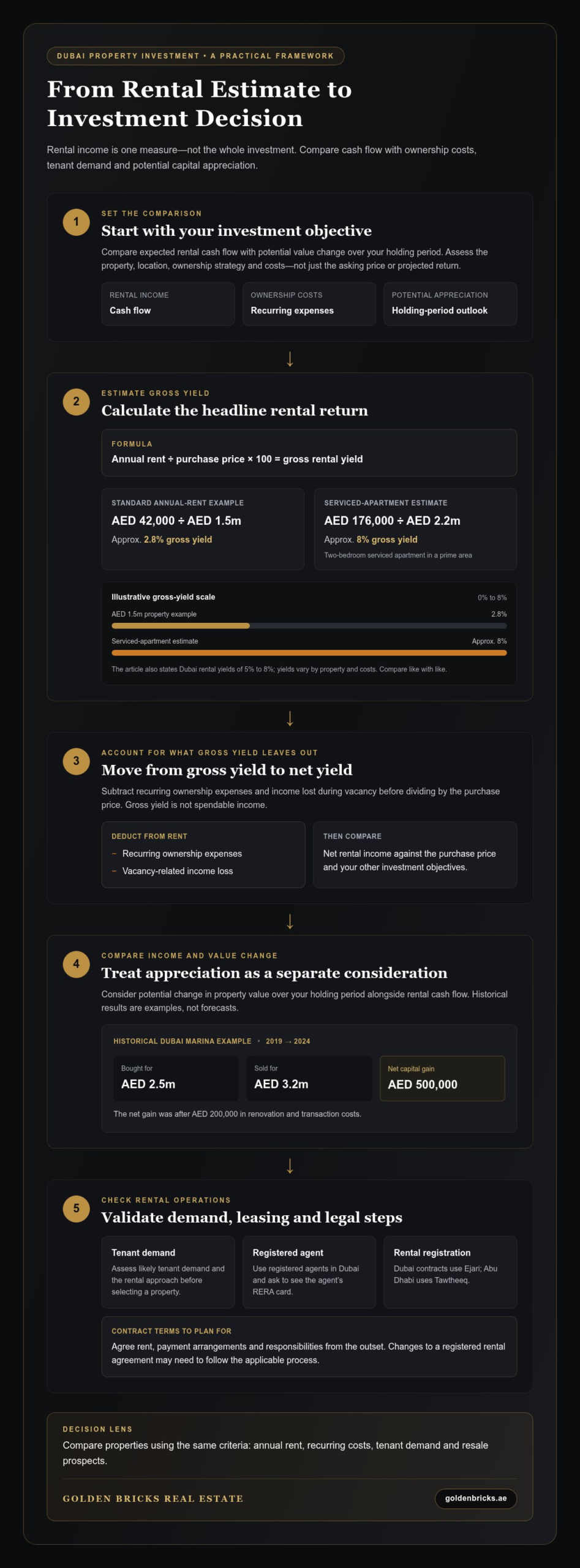
Calculate gross yield by dividing annual rent by the purchase price, then multiplying by 100. A property costing AED 1.5 million and earning AED 42,000 annually has an approximate gross yield of 2.8%. For net yield, subtract recurring ownership expenses and vacancy-related income loss from rent before dividing by the purchase price. Don’t treat gross yield as spendable income.
-
Compare Rental Income and Property Appreciation
Compare rental cash flow with the potential change in the property’s value over your holding period. Dubai rental yields are stated at 5% to 8%, but yields vary by property and costs. One historical example: a Dubai Marina apartment bought for AED 2.5 million in 2019 and sold for AED 3.2 million in 2024 produced a net capital gain of AED 500,000 after AED 200,000 in renovation and transaction costs. Treat this as an example, not a forecast.
- Assess the likely tenant demand and rental approach before selecting a property. A two-bedroom serviced apartment in a prime area priced at AED 2.2 million is estimated to generate AED 176,000 in annual rental income, or approximately 8% gross yield. Compare that estimate with a standard annual rental scenario: AED 42,000 rent on a AED 1.5 million property yields approximately 2.8% gross. The difference shows why property type, location, and leasing model matter alongside headline price. Luxury positioning alone does not establish stronger income; compare expected rent with the property’s total carrying costs.
Use registered agents in Dubai, and ask to see the agent’s RERA card to confirm the agent is acting legally. Before renting out a home, account for the tenancy registration process: contracts in Dubai must be registered through Ejari, while Abu Dhabi uses Tawtheeq. Build agreed terms into the contract from the outset, as changes to a registered rental agreement may need to follow the applicable process. Build the agreed terms into the contract from the outset, including rent, payment arrangements and responsibilities. This helps you assess the rental strategy as an operating commitment, rather than relying only on projected income.
If you’re balancing income with potential capital growth, compare properties using the same criteria: annual rent, recurring costs, tenant demand and resale prospects. Property management can help with the practical work of operating a rental asset. The investment decision still depends on whether its income and appreciation potential suit your objectives.
What are your options for investing in Dubai property?
Choose between residential, commercial, ready and off-plan property by matching the asset to your income and capital objectives. If you’re wondering how to invest in UAE property for beginners, start by comparing location, transaction costs and rental strategy before selecting a property.
-
Compare Investment Areas and Property Prices
Compare asking prices by location and property type before assessing a purchase. A sound approach to how to invest in UAE property for beginners starts with like-for-like comparisons. Don’t treat average prices for an area as valuations for individual units.
-
Review Market Activity and Rental Yields
Use market activity alongside yield and property prices when comparing locations. Dubai recorded nearly 60,000 residential property sales in Q3 2025, and residential prices increased 15.8% in 2025. Average Dubai rental yields are stated at 5% to 8%. Across Dubai, Abu Dhabi and Sharjah, compare expected rent and purchase price by property type, location and ownership costs; yields and prices vary with those factors.
Dubai tenancy contracts must be registered through Ejari, while Abu Dhabi uses Tawtheeq. Include the applicable registration system in your rental operating plan when comparing properties across the emirates.
-
Weigh Off-Plan Against Ready Property
Compare each option with your investment timeline. A ready property lets you assess its current condition and rental potential; an off-plan purchase means paying for a property before completion. If you prioritise immediate rental income, a completed property may be a closer fit. Off-plan can suit buyers planning around staged payments and future delivery. Neither option is automatically the better investment.
- Budget transaction costs before committing. The Dubai Land Department charges a registration fee of 4% of the purchase price at the time of the transaction. For Indian nationals, designated Dubai freehold areas permit 100% ownership.
Dubai property investments of AED 2 million can make an investor and family eligible for a 10-year Golden Visa. Eligible investors with assets exceeding AED 1 million can apply for a 2-year residency visa. To compare options against location, price and rental objectives, use Dubai property market intelligence as part of your assessment.
Owner-occupier, owner-investor, and landlord strategies
Set your ownership strategy before choosing a property. How you intend to use it affects the property type, cash-flow assumptions and annual expenses to assess.
- Decide whether you’ll live in the property, rent it out or combine both uses over time. An owner-occupier prioritises suitability for personal use, while an owner-investor weighs that benefit against potential rental income and resale prospects. A landlord focuses on tenant demand, rental operations and recurring costs. These goals can point to different properties, even within the same area. Write down your primary objective first, then assess each candidate against it.
- Establish which ownership interest applies to your chosen location. Foreigners can buy property in Dubai only in designated freehold areas. Check the title and transaction documents for the property’s tenure type, and understand the rights attached to that interest before proceeding. Do not assume every area or apartment provides the same ownership arrangement. For Indian nationals considering Dubai, designated freehold areas permit 100% ownership, making location and title central to the decision.
- Include annual expenses in your ownership plan instead of comparing properties by rent alone. A larger apartment or a building with extensive facilities may have different recurring costs. Add relevant charges to your operating budget, then assess their effect on net income and achievable yields. Property management can help landlords handle the ongoing work of operating a rental asset.
- Consider whether direct ownership or pooled real estate exposure better suits your available capital and desired level of involvement. These routes can offer exposure without requiring you to purchase an entire apartment, but they differ from holding title to a specific property. Before choosing, review how each structure allocates income, ownership rights and decision-making.
- Match your transaction plan to your ownership strategy. Resale property buyers in the UAE usually pay a 10% deposit, so include this initial commitment alongside later transaction and ownership costs. An owner-occupier may prioritise a manageable purchase and suitable home, while a landlord needs a plan for leasing and recurring expenses. An owner-investor should assess both uses, rather than assuming personal occupancy will automatically support rental income or capital growth.
Off-plan property risks and payment plans
Verify the developer and agent with the relevant regulatory agency, and compare the title deed details with the property and transaction documents. In Dubai, ask agents to show their RERA cards and review the project’s escrow arrangements.
- Map each payment to a project milestone before committing. The remaining payment schedule determines how much capital stays available for other assets. Read the contract for payment dates, handover conditions and the consequences of late payment. A low initial deposit doesn’t mean the full schedule will suit your finances.
- Understand the purpose and protection provided by project escrow. Dubai Land Department’s Escrow Account Service is intended to help safeguard buyers and developers during transactions. Confirm that the project’s payment arrangements align with its stated escrow structure, and retain the relevant contract and payment records. Escrow doesn’t remove delivery, market or resale risks. Treat it as one part of due diligence, not a substitute for reviewing the project terms.
- Review completion and delay provisions before accepting a payment plan. Off-plan buyers may need to make regular payments to developers until completion, so compare each due date with your available capital. Some developers in Dubai offer instalments for two to five years after handover. This structure can support cash-flow planning, but the contract’s obligations remain central. Check what happens if completion is delayed and how payment duties apply during that period.
- Separate the project’s investment case from its marketing. A premium location or projected 8% yield doesn’t establish future appreciation or rental income. Compare the planned property with ready assets by considering location, likely tenant demand, delivery timing and resale prospects. Off-plan opportunities can suit buyers with a longer investment horizon and staged payments. A ready property offers a different route for those prioritising an existing home and current rental assessment.
- Use a documented verification process to reduce fraud risk. Confirm that the developer or real estate agent is approved by the relevant regulatory agency, and compare names and property identifiers across the transaction documents. In Dubai, ask the agent to show their RERA card. Seek independent legal and financial advice throughout the purchase, especially before signing or transferring funds. If you’re buying internationally, keep copies of agreements and payment records at every transaction stage.
Off-plan property prices and potential appreciation
Off-plan pricing can create an opportunity to buy before completion, but potential appreciation depends on more than the launch price. Assess the property’s future appeal, delivery terms and resale prospects before including projected growth in your investment case.
- Compare the launch price with completed properties that appeal to similar buyers. In Dubai, examine the neighbourhood, unit size, building quality and access to employment or transport. A lower off-plan price may reflect an earlier purchase stage, but it may also involve a different location or delivery timeline. Compare like with like, and don’t treat a developer’s projected future price as proof of achieved market value.
- Model appreciation through distinct scenarios rather than one expected outcome. For a AED 2 million property, record the purchase price, payment dates and anticipated completion, then assess how your decision changes if resale demand is stronger or weaker. Keep rental yields separate from resale growth: rental income depends on leasing performance, while capital appreciation depends on what a future buyer will pay. This distinction makes the investment case more transparent.
- Assess what could support demand after handover. Consider whether the location serves residents, businesses or visitors, and whether the property’s layout suits those groups. A compact apartment aimed at tenants may have different resale appeal from a larger family home. Dubai’s global profile can inform your assessment, but broad market appeal doesn’t replace evidence about the specific project and competing supply.
- Account for the time and capital required before completion. An off-plan property may require scheduled payments while generating no rental income. Compare those obligations with your available capital and other commitments. Also consider how a delayed handover would affect your letting or resale plan. The payment schedule should remain manageable without relying on appreciation to fund every instalment.
- Build a consistent comparison before deciding. List the agreed price, payment milestones, completion terms, likely ownership costs and features that could influence resale demand. Then compare the off-plan opportunity with a ready property using the same assumptions. If your strategy depends mainly on immediate rental cash flow, an unfinished property may not meet that objective. If you’re investing through completion and planning for a future resale, consider whether the location and design support that plan.
Explore Dubai off-plan property opportunities as part of your investment assessment.
Golden Bricks Real Estate: Exclusive Off-Plan Projects
Golden Bricks Real Estate offers Exclusive Off-Plan Projects for investors assessing opportunities before completion. Project Curation helps structure comparisons between project options, while Exclusive Ready Properties offer an alternative for buyers considering completed assets. Property Management supports owners focused on the ongoing operation of rental property.
Turn to Golden Bricks Real Estate when weighing off-plan against ready property or considering how a purchase fits your rental strategy. The next step is to discuss your investment priorities and explore relevant property options.
Visit goldenbricks.ae to contact Golden Bricks Real Estate.
Make Your Next Property Decision Deliberately
Turn your investment priorities into a clear acquisition brief. Define the role property should play in your wider portfolio, the level of involvement you want and the conditions that would make you reconsider a purchase. If you’re learning how to invest in UAE property for beginners, this discipline helps ground your decision in personal objectives rather than market momentum.
Golden Bricks Real Estate offers Exclusive Off-Plan Projects and Exclusive Ready Properties for investors comparing purchase routes. Its Property Management service is relevant when your focus shifts from acquisition to operating a rental asset. Identify which stage of the investment journey needs attention now, then approach the decision with clear priorities.
Contact Golden Bricks Real Estate to discuss your property investment direction and take your next step with confidence.
Frequently Asked Questions
Can Indians in the UAE invest in Dubai real estate?
Yes. Indian nationals can own 100% freehold property in Dubai’s designated freehold areas. The key is selecting a property within an eligible area and understanding the ownership interest recorded for that property. Before proceeding, compare the title and transaction documents with your intended use, whether that is personal occupancy, rental income or long-term investment. Foreign ownership rights depend on the designated area, not nationality alone.
How Much Money is Required to Buy a Property in Dubai?
There isn’t one purchase amount that applies to every Dubai property; your budget must cover the price, deposit and transaction costs. As an example, a AED 1 million purchase requires an expatriate buyer to provide AED 200,000 as a down payment under the guide’s example. The Dubai Land Department charges a 4% registration fee at the time of the transaction. Include applicable agent and financing costs in your cash plan.
How do you actually sign up and invest?
Start by setting your investment purpose, budget and preferred property type, then compare ready and off-plan options against those criteria. Once you select a property, review the sale documents, payment schedule, ownership details and applicable transaction charges before signing. Arrange payment as agreed and retain the contracts and receipts. For a rental property, plan for tenancy registration and ongoing leasing arrangements after purchase.
How much are the property prices?
Prices vary by location and property type. These figures offer a starting point for comparing locations, not a complete purchase budget. Unit size, condition, building facilities and transaction costs also affect the amount you’ll need.
What are the steps for a beginner to buy investment property in the UAE?
First decide whether you prioritise rental income, potential appreciation or personal use. Then compare property type, location and total ownership costs, and assess the payment structure and rental demand. Review the purchase documents and verify the transaction parties with the relevant regulatory agency. Before signing, account for registration, deposit and financing obligations. After purchase, arrange the applicable tenancy registration if you plan to lease the property.
Which UAE areas offer the best rental yields for property investors?
Dubai rental yields are stated at 5% to 8% on average, while The Valley townhouses are described as reaching yields of 7.5%. Use these as reference points, not a ranking that applies to every property. Compare expected annual rent with purchase price, service charges, vacancy exposure and property type. A location with a higher headline yield may produce a different net result after operating costs.
How much do apartments and villas cost in Dubai, Abu Dhabi, and Sharjah?
Prices differ by emirate, location, property type and unit specifications. Compare apartment and villa prices using equivalent sizes, condition and facilities. Then include ownership and transaction costs, since the advertised price alone doesn’t show the full capital required.
What are the minimum down payment and mortgage requirements for UAE property buyers?
The stated minimum down payment is 20% for first-time expatriate buyers and 15% for UAE national buyers. Financing may reach 80% for UAE residents purchasing their first property, while overseas investors may access financing of 60%-65% loan-to-value. Mortgage eligibility and the required cash contribution depend on buyer status and the property purchase. Include mortgage registration costs in your upfront budget.