

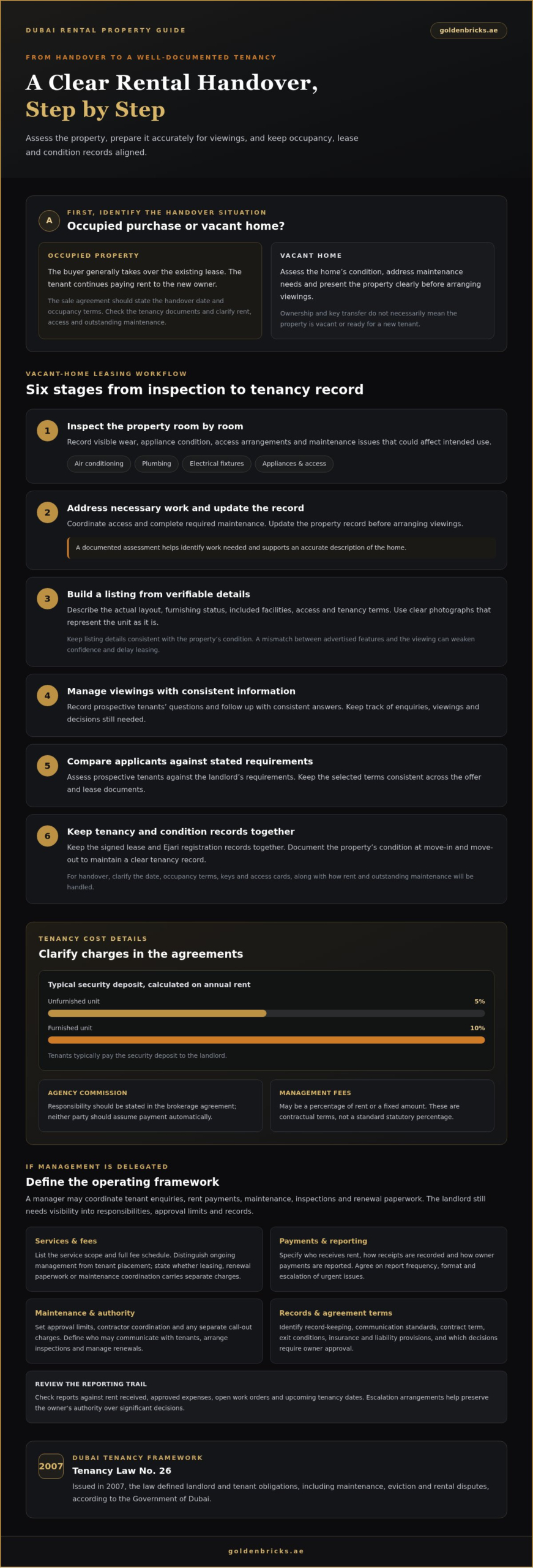
Buying a tenanted property does not end the existing tenancy. During a property handover and tenant placement, the buyer generally takes over the lease, and the tenant continues paying rent to the new owner. The sale agreement should specify the handover date and occupancy terms.
That distinction matters: transferring ownership and keys does not necessarily mean the property is vacant or ready for a new tenant. Reviewing the lease, property condition and agreed occupancy terms helps you plan the next steps with confidence.
This guide explains how an occupied-property handover works, what to consider when preparing a vacant home for rent, and how tenant screening, lease documents, registration and inspections fit into the process. Whether you are taking over a tenanted investment or arranging a new tenancy, Golden Bricks Real Estate helps you use this overview to plan a well-managed transition.
Key Takeaways
- For an occupied purchase, clarify the existing lease, occupancy terms, handover date, keys and access cards before planning the property’s next tenancy.
- Dubai’s Tenancy Law No. 26 was issued in 2007 and defined landlord and tenant obligations, including maintenance, eviction and rental disputes, according to the Government of Dubai.
- Prepare a vacant home for the rental market by assessing its condition, addressing maintenance needs and presenting it clearly to prospective tenants.
- Tenant placement can bring together property advertising, viewings, screening and lease negotiation; a consistent process helps owners assess prospective tenants.
- Keep the signed lease and Ejari registration records together, and document the property’s condition at move-in and move-out to support a clear tenancy record.
Professional management for overseas and time-poor landlords
For overseas investors, delegated property management can connect rental decisions with local follow-through. A manager may coordinate tenant enquiries, rent payments, maintenance, inspections and renewal paperwork. The landlord still needs a clear view of responsibilities, approval limits and records. Dubai’s Tenancy Law No. 26 was issued in 2007 and defined landlord and tenant obligations, including maintenance, eviction, and rental disputes, according to the Government of Dubai. For a fuller overview of how to define responsibilities and assess management scope, see this guide to property management services in Dubai.
Who pays the Dubai rental agency commission and security deposit? Commission responsibility should be set out in the brokerage agreement, so neither party should assume payment automatically. Tenants typically pay the security deposit to the landlord; deposits are typically 5% of annual rent for unfurnished units and 10% for furnished units.
Long-term residential property management fees may be calculated as a percentage of rent or a fixed amount. These are contractual terms, not a standard statutory percentage. The fee structure should distinguish ongoing management from tenant placement and state whether leasing, renewal paperwork, maintenance coordination or other work carries separate charges. Compare the full scope and payment terms rather than judging by a headline rate alone.
Before signing, read the management agreement as an operating framework. It should identify the property and services, full fee schedule, handling of funds, maintenance rules, communication standards, record-keeping, contract term and exit conditions, as well as insurance and liability provisions. It should also state which decisions need the owner’s approval. For example, routine maintenance may follow agreed limits, while a larger repair or change to lease terms may require written consent.
- Payments: specify who receives rent, how receipts are recorded, and how owner payments are reported.
- Maintenance: set approval limits and clarify whether contractor coordination or call-out charges are separate.
- Authority: define who may communicate with tenants, arrange inspections and manage renewals.
Residential and commercial property management share core tasks, including rent administration, maintenance oversight and documented owner approvals, but their day-to-day needs differ. A residential landlord may prioritize tenant communication, renewal timing and move-in condition records. A commercial owner may focus on business occupancy, access, service responsibilities and lease-specific operating terms. The agreement should reflect the property’s use, not rely on a generic scope.
For an owner abroad, reporting is part of control, not an administrative extra. Agree on how often reports will arrive, their format and how urgent maintenance or payment issues will be escalated. Review each report against rent received, approved expenses, open work orders and upcoming tenancy dates. This gives investors a concise view of property performance while preserving the owner’s authority over significant decisions.
Preparing a property for the Dubai rental market
Tenant Finding and Leasing
Finding a tenant and completing a lease involves assessing the property, marketing it, arranging viewings and negotiating terms. Clear presentation and consistent information help prospective tenants make informed decisions.
Start with a room-by-room inspection. Record visible wear, appliance condition, access arrangements and maintenance issues that could affect the property’s intended use. Note, for example, whether the air conditioning, plumbing and electrical fixtures need attention before advertising. If work is required, coordinate access and completion, then update the property record before arranging viewings.
Build marketing around verifiable property details: layout, furnishing status, included facilities, access and tenancy terms. Use clear photographs that represent the actual unit, and ensure listing descriptions match its condition. A mismatch between advertised features and what a viewer sees can weaken confidence and delay leasing. Market intelligence can help owners assess how a property’s features fit its intended tenant audience. Dubai property market intelligence can inform positioning without overstating the property’s attributes.
During viewings, record questions and follow up with consistent answers. Compare applicants with the landlord’s stated requirements, then keep the selected terms consistent across the offer and lease documents. This creates a clear record from property assessment through tenant selection and leasing. It also helps a property manager report accurately on enquiries, viewings and decisions still needed.
Handover Risks and Common Disputes
Handover risks and disputes can arise when occupancy, property condition or agreed responsibilities do not match the parties’ expectations. A clear record helps distinguish pre-existing issues from concerns raised after possession.
When buying an occupied property, the buyer generally takes over the existing lease, and the tenant continues paying rent to the new owner. The sale agreement should specify the handover date and occupancy terms. Before completion, compare those terms with the tenancy documents and confirm how rent payments, access and outstanding maintenance will be handled.
Common sources of disagreement include key or access-card delivery, incomplete property records, unresolved maintenance requests and different accounts of the unit’s condition. Keep a written inventory, dated photographs and a record of known issues. At handover, compare the items delivered with the agreed arrangements, then document any exceptions and who will follow up.
For a vacant home, disputes may arise if a listing promises an unavailable feature or repair work is unfinished during a viewing. Make sure photographs and descriptions reflect the property, and track each maintenance task through completion. Owner approvals, viewing feedback and written tenant terms provide a practical reference if expectations later differ. These records also support leasing decisions and timely follow-up.
Tenant advertising, placement and screening
Tenant placement connects property marketing with applicant assessment and lease negotiation. For owners arranging property handover and tenant placement in Dubai, each stage should be based on accurate information and clearly documented decisions.
Tenant Advertising and Sourcing
Advertising and tenant sourcing involve listings, enquiry handling and viewings. Accurate marketing matters because applicants compare the advertised details with the home they visit.
Describe the layout, furnishing, facilities and tenancy terms consistently. Use current photographs and descriptions that reflect the property. For example, a furnished apartment listing should show the furnishings included in the proposed tenancy.
Track enquiries, viewing requests and follow-ups in one record. This shows owners which channels attract relevant interest and where prospects disengage. If scheduled viewings are repeatedly missed, review the timing and access arrangements before changing the listing or its terms.
Record questions raised during viewings and provide consistent answers. Details such as included facilities, occupancy dates and furnishings can influence an applicant’s decision. Resolve discrepancies before progressing an application so the eventual offer reflects the property shown.
Tenant Screening and Placement
Tenant screening assesses applicants before the landlord selects a tenant and proceeds to lease negotiation. Applying the same criteria to each applicant helps owners make a fair comparison.
Collect each applicant’s information and conduct background checks as part of placement. Keep screening records organized and assess applicants against the landlord’s stated criteria. For example, compare proposed tenancy dates and payment arrangements with the owner’s approved terms.
After selecting a tenant, confirm the agreed terms, prepare the lease documents and coordinate signing. When included in the agreed scope, a property management company can bring advertising, applicant communication and leasing into one workflow. Document the selection and approved terms so the lease reflects the parties’ decision.
Keep applicant information and decisions organized for the owner’s records. A concise file can show which applications were reviewed, the criteria used in selection and the terms accepted. This creates a traceable path from initial enquiry to signed tenancy.
Tenant Placement Timeline
Tenant placement in Dubai takes the time needed for preparation, marketing, viewings, screening and lease negotiation. Delays at any stage can postpone the tenancy start.
A ready unit with accurate marketing can move to viewings, while unfinished repairs or access issues can disrupt scheduling. Applicant response times and completion of background checks also affect progress. Lease terms that need further discussion add another step before signing.
Owners can track progress through listing preparation, enquiries, viewings, screening, selection and lease signing. Record the status and next action at each stage. This gives investors a practical view of leasing activity without relying on an assumed completion date.
Clear records connect property handover and tenant placement in Dubai, especially when an incoming tenant’s start date depends on the property being ready. Align the proposed occupancy date with completed maintenance, access arrangements and signed lease terms. This helps owners make decisions based on the actual status of the tenancy process.
Lease documentation and Ejari registration
A complete tenancy file links the signed contract, Ejari registration and handover records. In Dubai, tenancy contracts must be registered through Ejari under the registration regulation introduced in 2010. RERA-governed lease agreements set out the terms that guide the landlord and tenant during the rental period.
What documents are required for property handover in Dubai? For a tenanted property, keep the signed lease, Ejari registration certificate, rent receipts and any power-of-attorney or management authority documents. The sale agreement should also record the handover date and occupancy terms. At handover, the buyer should receive the keys and access cards.
Before signing, compare the contract with the agreed offer and the property’s actual condition. Confirm the unit details, landlord and tenant information, rental period, payment schedule and agreed responsibilities. Check that included furnishings or facilities match the inventory. Keep a written record of amendments to prevent different contract versions from circulating after signing.
Ejari registration formalizes the tenancy record. Information submitted should match the signed lease and supporting documents, including the property and parties’ details. If a licensed property management company handles registration or renewal, it must be authorized and eligible to do so. The landlord should retain the signed lease, Ejari certificate, receipts and relevant authority documents.
- Signed lease: retain the complete, final contract and any agreed amendments.
- Ejari record: keep the registration certificate with the corresponding lease.
- Payment evidence: file rent receipts to track rental income and payments.
- Authority records: retain power-of-attorney or management authority documents when applicable.
For an occupied purchase, align the tenancy file with the sale and handover records. The buyer generally takes over the existing lease, while the tenant continues paying rent to the new owner. Record the effective handover date, payment arrangements and documents transferred. This supports rent collection and gives both parties a reference if questions arise about the tenancy.
Keep administrative records separate from evidence of the property’s condition. File inspection reports, photographs and repair correspondence with the tenancy documents, labeled by date and purpose. For example, a move-in report records the unit’s condition, while an Ejari certificate records the registered tenancy. Keeping them distinct helps owners find the right information when reviewing rental income, maintenance or tenant screening.
Before filing the documents, confirm that names, dates and property details match across the lease, Ejari certificate and receipts. Record who holds original documents and who can access copies. If a manager handles registration, keep the written authorization in the file. These straightforward controls make renewals, payment reviews and handover discussions easier to track.
Move-in and move-out inspections
A property handover in Dubai for landlords involves recording the unit’s condition, transferring keys and access cards, coordinating utilities and documenting outstanding work. Linking inspections with tenant placement helps ensure the property is ready for the agreed occupancy date.
At move-in, compare the unit with the tenancy agreement and prepare a condition report. Record each room, appliance, fixture and visible mark, then add dated photographs. Note meter readings and the condition of supplied items, such as a refrigerator or wardrobe. The tenant and landlord can keep copies as a shared reference for later inspections and any deposit assessment.
DEWA arrangements also need attention at move-in. Coordinate the utility account transfer with the incoming tenant, and record relevant meter readings and confirmation. Align the timing with the agreed occupancy date so responsibility for consumption is clear from the start. Include utility access and account status in the handover record.
During the tenancy, keep maintenance requests, repair records and inspection notes with the original condition report. For example, a leaking tap reported after move-in should have a dated request and a record of the completed repair. This evidence helps distinguish routine wear from an unresolved issue and informs decisions during renewal or a dispute.
At move-out, inspect the same areas and items documented at move-in. Compare dated photographs, inventory notes and repair records before assessing proposed deposit deductions. Record returned keys and access cards, meter readings, visible damage and items requiring follow-up. Share the findings with the tenant and keep the written record with the tenancy agreement.
- Condition: use consistent room-by-room notes and photographs at both inspections.
- Access: list keys, access cards and other items delivered or returned.
- Utilities: record meter readings and DEWA account arrangements at handover.
- Follow-up: document repairs, responsibilities and agreed next actions.
For landlords managing a portfolio, consistent inspection templates make records easier to compare across units. Property management can include coordinating inspections, maintenance records and move-in or move-out handovers within the agreed scope. Clear approval procedures help owners distinguish routine follow-up from decisions that require their direction.
Organized inspections connect property handover and tenant placement in Dubai by giving owners a documented view of readiness and occupancy. For support coordinating property inspections and tenancy handovers, arrange property management support.
Golden Bricks Real Estate: Exclusive Off-Plan Projects
Golden Bricks Real Estate can help owners assess how a property fits their investment plans after handover. Its Property Management service supports owners overseeing rental property operations, while Exclusive Ready Properties may suit buyers seeking completed assets. Investors considering future acquisitions can explore Exclusive Off-Plan Projects and Project Curation as part of a broader property strategy.
The right next step depends on your immediate decision: managing a tenanted asset, considering a ready property or evaluating an off-plan opportunity. Clarifying your priorities helps focus the discussion, whether you need property oversight now or are planning your portfolio’s next move.
Contact Golden Bricks Real Estate to discuss your property priorities and the right next step.
Shape Your Property’s Next Chapter
A disciplined approach to property handover and tenant placement in Dubai supports a more considered ownership strategy. Once immediate tenancy matters are settled, decide how the asset should contribute to your wider objectives. You might strengthen oversight of a current holding, consider a completed residence or evaluate a future acquisition.
Golden Bricks Real Estate offers Property Management, Exclusive Ready Properties and Exclusive Off-Plan Projects. Each supports a different stage of an investor’s property journey, from managing an existing asset to exploring new opportunities. The right focus depends on your priorities, the property and the role you want it to play in your portfolio.
Use your next conversation to clarify those priorities and identify a practical direction for your property plans. Contact Golden Bricks Real Estate to discuss the next step. A considered decision today can help you move forward with greater purpose and confidence.
Frequently Asked Questions
After buying a property, what is the process for handover in case a tenant is occupying it?
The buyer generally takes over the existing lease, and the tenant continues paying rent to the new owner. Review the lease and sale agreement together, then reconcile the handover date, occupancy terms, payment arrangements and outstanding maintenance. Request the tenancy records and document the transfer of keys and access cards. If the tenant’s lease continues, do not treat the property as vacant for a new letting.
How much do Dubai property management and tenant placement services cost?
Fees depend on the agreed service scope and contract terms, not a statutory standard percentage. Property management and tenant placement may be charged separately, so compare the full fee schedule, including any separate leasing, renewal or maintenance-related charges. The fee depends on the property, services required and division of responsibilities, and is provided after a quote request.
What are the steps to find and screen tenants in Dubai?
Prepare accurate listing details and arrange viewings, then assess applicants against the landlord’s stated requirements. Tenant placement commonly includes advertising, enquiries, viewings, background checks and lease negotiation. Apply screening criteria consistently, document the basis for selection and make sure the lease reflects the agreed terms. For example, check that proposed tenancy dates and payment arrangements match the owner’s approved terms.
What are the Dubai rules for tenancy contracts and Ejari registration?
Dubai tenancy agreements are RERA-governed, and tenancy contracts must be registered through Ejari under the registration regulation introduced in 2010. Keep the signed contract consistent with the registered tenancy details, including the property and parties. Retain the Ejari certificate, lease and payment receipts together. If a manager handles registration or renewal, preserve the written authority allowing that person to act for the landlord.
What should landlords inspect and document during property handover?
Record the unit’s condition, included items, meter readings, keys and access cards. Use dated photographs and a room-by-room inventory, noting existing marks or faults before occupancy. For example, document an appliance’s visible condition and whether it is included in the tenancy. At move-out, compare the record with the original evidence before discussing repairs or deposit deductions, and keep relevant maintenance correspondence with the inspection file.
How do DEWA, chiller, and access-card arrangements work when handing over a Dubai rental property?
Coordinate utility account responsibilities and transfer timing with the incoming occupant, and record meter readings at handover. Confirm whether chilled water is billed through a separate account or building arrangement, then document responsibility under the tenancy agreement. List every key and access card delivered, and record their return at move-out. Clear written records distinguish utility responsibilities from rent and property-access arrangements.
How do Dubai property management companies compare on tenant placement services?
When comparing tenant placement services, review whether listings, viewings, background checks, tenant screening and lease negotiation are included. Check whether placement is charged separately from ongoing management and whether key handover is coordinated.