

The first step in optimizing my real estate portfolio for retirement is to assess how well its properties are diversified by location and property type. This review shows where income may be concentrated and whether the mix supports dependable cash flow as well as long-term capital appreciation. It also gives you a clearer basis for deciding what to retain, reposition or sell.
Property can play a meaningful role in retirement planning, but owning real estate alone does not ensure that your assets will meet future income needs. Align each holding with your time horizon, liquidity requirements and willingness to manage it. This article explains how to assess portfolio performance, plan around lease expirations, prepare for capital needs and maintain appropriate liquidity. It also considers how rental income and growth-oriented assets can work together to support your retirement plans in the United Arab Emirates.
Key Takeaways
- Review each property’s income, growth potential and exposure across locations and property types to identify concentration risks.
- Map lease expirations against renewal, vacancy and sale decisions so income changes do not catch your retirement plan off guard.
- Set aside accessible funds for withdrawals and planned capital expenditure, especially when much of your wealth is tied up in property.
- Balance income-producing holdings with assets suited to long-term appreciation, using your cash-flow needs and investment horizon to guide the mix.
1. What is the first step in optimizing a real estate portfolio?
Start with a portfolio audit. Record each property’s location, type, occupancy, lease status and contribution to retirement income. Compare net operating income, vacancy, cash-on-cash returns, yield on cost, capital expenditure against budget and time to lease. These measures help identify reliable income sources and properties that need attention. Then check whether your holdings are concentrated in one location or property type in the UAE. A mix of residential and commercial assets, or properties in different locations, can reduce reliance on a single market or tenant segment. Diversification does not remove risk, but it can reveal where risks overlap.
How does real estate compare with stocks and bonds for retirement income? Property can generate rental income and may appreciate, but it requires active oversight and is generally less liquid than publicly traded investments. Stocks can provide dividends and growth, while bonds can contribute interest income. Each asset class has different market and income risks.
Set your objectives before changing the portfolio. Separate the income needed for regular spending from the capital intended for long-term appreciation. Review each property’s rent, operating costs, lease terms and planned maintenance, then compare its net income with its potential for future value growth. A property with rising expenses may still support an appreciation objective, while a steady income-producing asset may be more useful for near-term withdrawals. The right balance depends on your cash-flow needs, investment horizon and willingness to manage the properties.
Consider how your retirement investments work together. Diversify across real estate, stocks and bonds rather than relying on property alone. Within your real estate allocation, assess exposure by location and property type. Include tax treatment when comparing net returns, since ownership structure, location, income and a sale can affect the amount ultimately available to you. For properties held outside the UAE, account for the rules in the relevant jurisdictions, as tax treatment can differ. Compare the initial investment and ongoing costs with expected income and potential appreciation. This makes the review practical: measure performance, identify concentrations and align each holding with a defined retirement objective.
2. What role does lease expiration management play in portfolio optimization?
Create a lease calendar for every property, recording expiry dates, renewal options, rent reviews, notice periods and expected vacancy. Compare each lease’s end date with tenant demand, the property’s condition and your retirement cash-flow needs. Staggering expirations can reduce the chance of several units becoming vacant at once. Before renewing, compare current rent with market evidence and estimate the cost of incentives, repairs or downtime. An annual review can flag leases that need early attention, particularly when inflation affects operating costs or tenant affordability.
Operational data can make these decisions more precise. Track occupancy, arrears, maintenance requests, time to lease and net operating income in one asset record. A simple dashboard can highlight properties where recurring repairs or slow leasing are reducing returns. Technology supports oversight, but decisions still depend on the asset’s condition, lease terms and local demand.
In the UAE, rental and ownership obligations depend on the emirate, property location, ownership structure and lease terms. Tax treatment can also differ between UAE and overseas holdings. Assess each asset under the rules that apply to its location, and include relevant obligations and taxes when estimating net cash flow.
When a lease expires, compare renewal, re-leasing and sale in light of the property’s income, maintenance needs and role in your retirement plan. Consider timing and tax consequences before selling. Sale proceeds may improve liquidity, while retaining the property may preserve rental income and potential appreciation. Record how each option affects your wealth and future cash flow rather than deciding on the sale price alone.
Discuss responsibilities with family by their early 60s, including whether relatives want to manage properties or inherit ownership interests. If daily coordination becomes burdensome, a property manager can oversee leasing and operations, while an asset manager can focus on performance and portfolio decisions. Property management may suit owners seeking support with ongoing property oversight, while direct involvement may better fit those who prefer to manage tenants and operations themselves.
Liquidity needs and non-liquid alternative investments
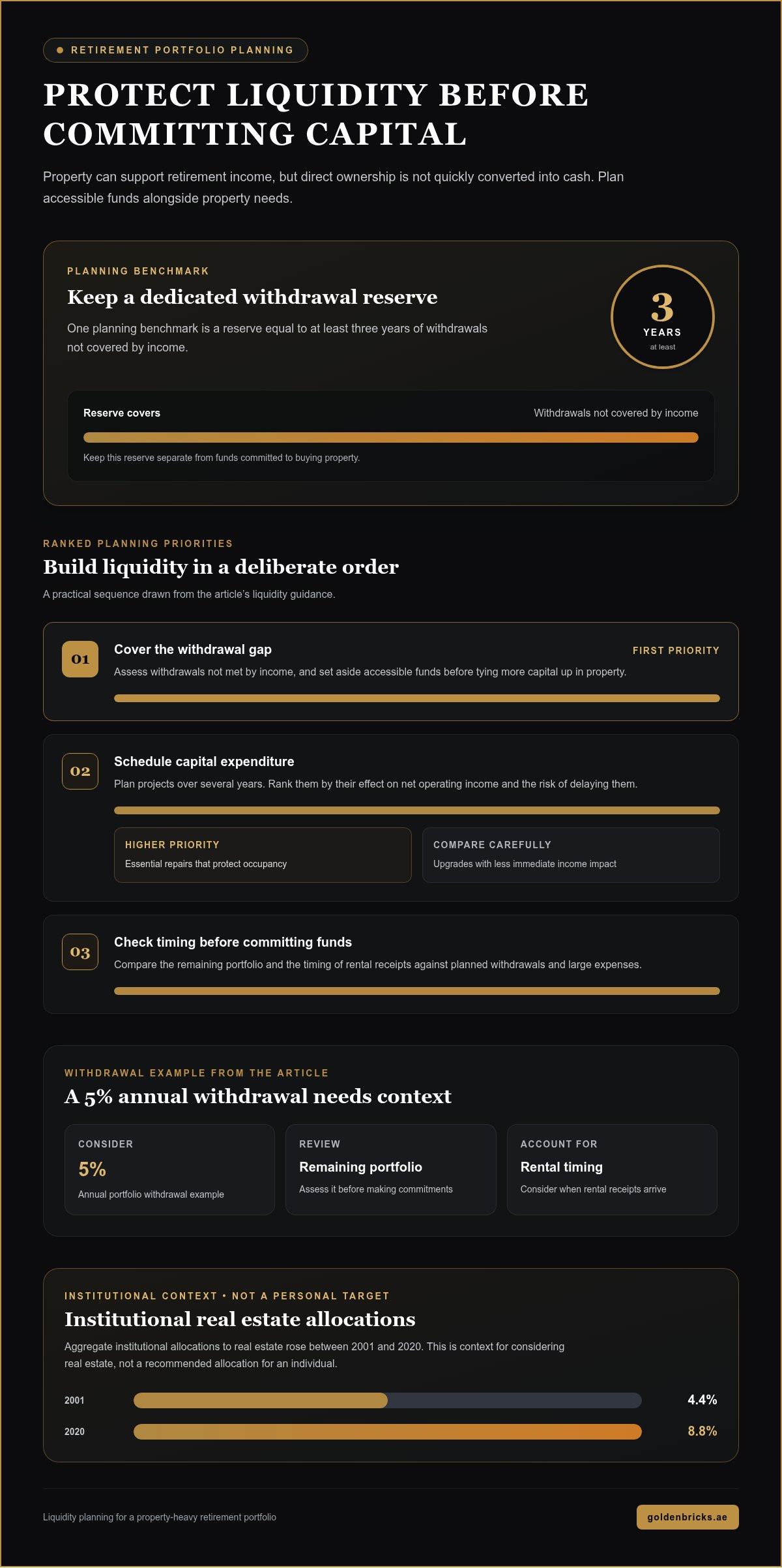
Property can support retirement income, but direct ownership is not quickly converted into cash. Keep a reserve for withdrawals and unplanned expenses, separate from funds committed to buying property. One planning benchmark is a reserve equal to at least three years of withdrawals not covered by income. For example, someone considering a 5% annual portfolio withdrawal should assess the remaining portfolio and the timing of rental receipts before making commitments.
Plan capital expenditure over several years. Rank each project by its effect on net operating income and the risk of delaying it. Essential repairs that protect occupancy may take priority over upgrades with less immediate income impact. A schedule helps you avoid being forced to sell during an unfavorable market to cover a large expense, and clarifies how much liquidity remains available for retirement spending.
Institutional allocations show real estate’s growing role, but they are context, not a personal target. Aggregate institutional allocations to real estate rose from 4.4% to 8.8% between 2001 and 2020. Institutional allocations can offer context for considering real estate exposure, but they do not establish a personal target. A Tiger 21 survey found real estate averaged 27% of members’ portfolios, while private equity and real estate together averaged 53%. These examples reflect different objectives, liquidity needs and risk capacity.
Moving bond investments into property may increase exposure to rental income and appreciation, but it also reduces access to liquid capital. Compare bond interest with expected property income, maintenance needs, lease commitments and flexibility to sell. A staged change can preserve liquidity while you assess whether direct real estate investment fits your objectives.
In the UAE, estate planning for property should account for title, ownership structure and applicable succession arrangements, which shape how assets pass to heirs. Documenting these matters as part of retirement planning connects property decisions with your family’s wealth intentions.
4. Real estate allocation for retirement income and capital appreciation
Start with retirement cash flow, not a target property percentage. List annual expenses, then subtract pension payouts, annuities, investment income and rental income to identify the remaining need. For each property, calculate net cash flow by subtracting operating expenses, planned capital expenditure and debt payments from collected rent. This gives you a more useful income estimate than gross rent alone. Compare the result with your withdrawal needs and the property’s role in your investment portfolio.
Separate income from investment performance. Rental distributions provide spendable cash, while a change in property value affects capital appreciation but does not itself fund expenses. A property’s estimated value can rise while its cash flow remains weak, or it can produce steady income without strong appreciation. Review both measures alongside occupancy, maintenance requirements and economic conditions before deciding whether to retain, improve or sell an asset.
Rebalancing should respond to changing income needs and risk. If property exposure has increased because of appreciation, consider whether selling or redirecting new capital would restore a diversified mix. The University of Florida model portfolio recommends 50% real estate, 30% stocks and 20% bonds; treat that allocation as one model, not a universal prescription. There is no single formula for optimal real estate exposure. Your time horizon, liquidity needs, other investments and tolerance for management demands all matter.
Review the allocation annually, or after a material change in expenses, income or property performance. A careful comparison of rental cash flow, pension income and investment distributions can show whether holdings support retirement needs or mainly pursue growth. An advisor can help assess the interaction between asset values, income and risk. For properties requiring operational oversight, explore property management as part of maintaining income-producing assets.
Golden Bricks Real Estate: Exclusive Off-Plan Projects
Golden Bricks Real Estate helps investors connect portfolio objectives with property opportunities through its Exclusive Off-Plan Projects and Exclusive Ready Properties. Consider these options when assessing whether an additional holding could complement existing income-producing assets or support long-term appreciation. Project Curation can help align property selection with your investment priorities, while Property Management provides ongoing oversight when that forms part of your portfolio plan.
The right next step depends on your intended holding period, liquidity needs, income objectives and capacity to manage property. An off-plan purchase and a ready property may serve different purposes, so assess each against your retirement plan rather than treating them as interchangeable investments.
Contact Golden Bricks Real Estate to discuss property options in relation to your portfolio objectives.
Set a Clear Direction for Your Next Decision
A written decision framework can turn optimizing my real estate portfolio for retirement from a broad ambition into deliberate choices. Define what would lead you to retain, reposition or sell an asset, and record how each decision should support your preferred retirement lifestyle. This links your long-term intentions with the choices you make as circumstances change.
Revisit the framework when your priorities shift, such as when family responsibilities, desired spending or your willingness to oversee property changes. The goal is not constant activity. It is to make each adjustment for a clear reason, while considering its effect on your wider financial plan and the future role of property.
When you’re ready to consider the next property decision, discuss your portfolio objectives with Golden Bricks Real Estate. A considered next step can help you move forward with greater clarity and confidence.
Frequently Asked Questions
What is the first step in optimizing a real estate portfolio?
Start by assembling an up-to-date record for every holding, including ownership shares, lease documents, outstanding obligations and recent operating statements. When optimizing my real estate portfolio for retirement, compare those records with your intended retirement start date and your family’s income priorities. For example, a co-owned property may require a different decision process from an asset you own outright. Accurate records provide a sound basis for later choices.
How do you decide which properties to sell in a portfolio optimization?
Consider selling a property when its role no longer supports your financial objectives or its demands outweigh the value it contributes. Compare its net income, upcoming maintenance, lease position, contribution to liquidity and concentration risk with those of your other holdings. For example, a property requiring substantial attention may be a poor fit for a retirement plan that prioritizes simplicity. Include transaction timing and applicable tax consequences in your decision rather than relying on estimated value alone.
How does geographic diversification factor into portfolio optimization strategy?
What are the primary benefits of effective portfolio optimization?
Effective optimization can align property holdings more closely with retirement income needs, growth objectives and available liquidity. It can also highlight underperforming assets, show where capital expenditure may improve operations and reduce excessive concentration. For example, a portfolio review may reveal that one property generates income while another absorbs a disproportionate amount of management time. The aim is a more deliberate allocation of resources, not simply more assets or a higher estimated portfolio value.
What role does lease expiration management play in portfolio optimization?
Managing lease expirations gives owners time to plan for renewal, re-leasing, repairs or sale before a tenancy ends. Track notice requirements, renewal provisions and expected vacancy for each agreement. For example, if a property needs work before a new tenant moves in, scheduling it around the lease end can help coordinate costs and marketing. A forward-looking lease calendar also helps anticipate changes in rental cash flow across the portfolio.
How much retirement income can my real estate portfolio generate?
Property income depends on collected rent after operating expenses, maintenance, vacancy and debt payments. Calculate net cash flow for each property, then combine it with pensions, annuities and distributions from other investments. For example, two properties with similar rents can contribute different amounts if one has higher upkeep or more vacant periods. Compare the total with planned retirement expenses, and review the figures as leases and operating costs change.