
A strong UAE property market doesn’t make every purchase a safe investment. Whether buying property in the UAE is a safe investment depends on the ownership structure, the asset and its costs, as well as your investment horizon. Foreign buyers can own property in designated freehold areas, while leasehold ownership grants property rights for 30 to 99 years without ownership of the land.
It’s reasonable to look for both security and long-term value, but neither follows from a location’s reputation or a rising market alone. In 2026, a considered decision means weighing potential returns against price movements, supply, project risks and the costs that continue after purchase.
This article explains the ownership rules, price outlook, purchase fees and ongoing expenses involved in buying property in the UAE, along with common mistakes that can undermine an investment. Use it as a framework for assessing risks before committing capital.
Key Takeaways
- Distinguish freehold ownership from leasehold rights, and establish whether the specific area permits the ownership structure you intend.
- Assess Dubai’s price outlook against shifting supply, demand and market conditions rather than relying on past growth alone.
- Build purchase fees and continuing property costs into your investment assessment, not just the purchase price.
- For an off-plan purchase, understand how project escrow protections work and consider the risks of delays or changes to development plans.
- Reduce avoidable mistakes by reviewing ownership documents, legal details and the full investment assumptions before committing.
Can foreigners own property in Dubai and Abu Dhabi?
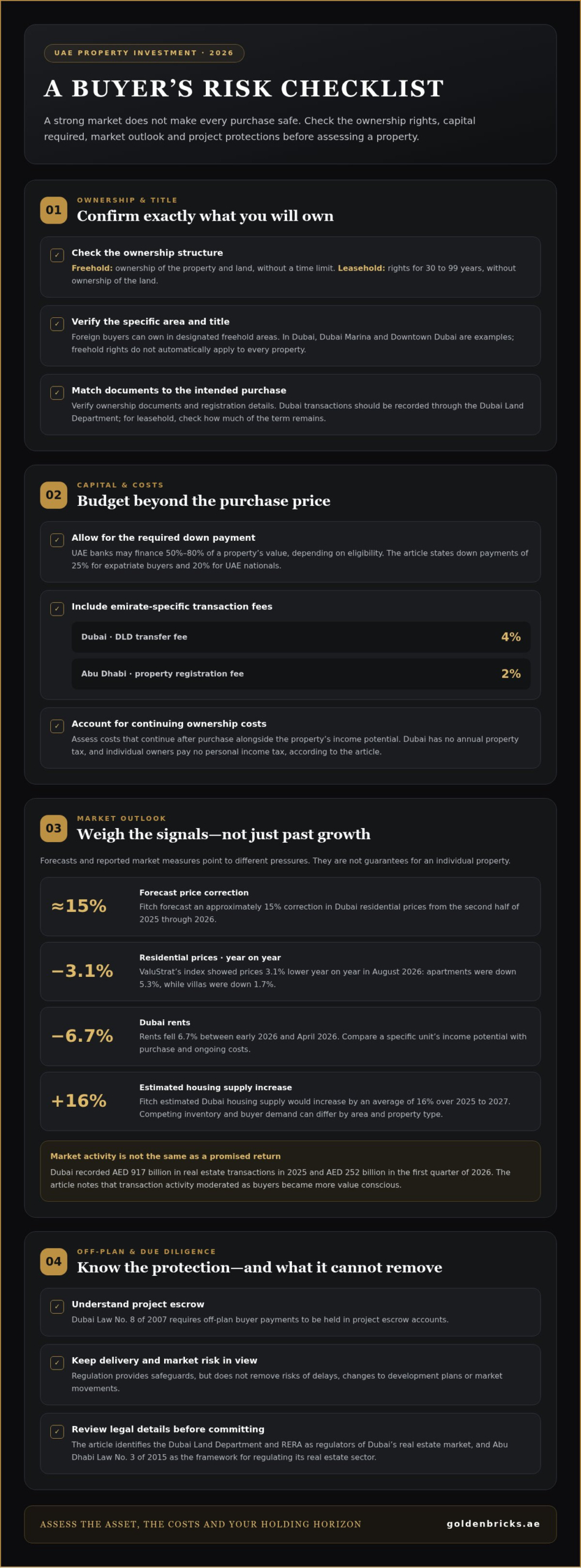
Yes, foreign buyers can own property in designated UAE freehold areas, while leasehold offers a different set of rights. The relevant rules depend on the emirate, location and ownership structure, so legal due diligence begins with identifying exactly what the title will grant.
Mortgage terms affect the capital required to complete a purchase. UAE banks may finance 50% to 80% of a property’s value, depending on eligibility; expatriate buyers need a 25% down payment, while UAE nationals need 20%.
Foreign Buyer Ownership Options
Freehold gives a buyer full ownership of both the property and land, without a time limit or lease period. Leasehold grants rights to occupy or lease a property for 30 to 99 years, but the buyer doesn’t own the land. This distinction matters because the title determines the duration and scope of the buyer’s legal interest.
When comparing properties, match the ownership structure to your intended use and holding period. Freehold title and leasehold rights differ, even for properties in the same emirate.
Dubai Ownership Rules and Freehold Areas
Dubai allows foreign buyers to purchase, sell and rent homes in designated freehold areas without special permission. Dubai Marina and Downtown Dubai are examples of these areas. Dubai introduced laws in 2002 allowing foreign buyers to buy, sell and rent property in certain freehold areas. Confirming the area’s status is therefore central to understanding the ownership available.
Freehold rights do not automatically apply to every property in Dubai. Assess the area and title together, rather than relying on a development’s location or marketing description.
Registration establishes the formal record of ownership. In Dubai, property transactions should be officially recorded through the Dubai Land Department (DLD), and buyers should verify ownership documents before proceeding. Legal due diligence also means examining whether the documents identify the property and ownership interest being purchased, and whether the transaction details align with the intended purchase.
Reduce legal uncertainty by working with a RERA-registered agent and reviewing ownership documents as part of due diligence. This can reveal discrepancies between a property’s stated status and the rights recorded in its registration. A legal review is especially relevant for leasehold purchases, as the remaining term determines how long the buyer’s rights last.
Abu Dhabi buyers receive official registration and documentation supporting the purchase and legal ownership. The registration record forms a key part of the transaction’s documentary trail. For either emirate, retain the completed ownership documents and confirm that the registered property and buyer details match the agreed transaction.
Transaction costs also differ by emirate: Dubai charges a 4% DLD transfer fee, while Abu Dhabi charges a 2% property registration fee. These costs sit alongside the legal ownership question, so include them when assessing the purchase. For a property intended to generate rental income, Property Management can support the ownership stage after registration.
Will Dubai property prices fall further?
Further declines remain possible: Dubai’s 2026 market has moderated, while forecasts point to price correction and additional supply. Whether buying property in the UAE is a safe investment depends partly on the asset, location and holding period.
Dubai’s Investment Appeal and Economic Stability
Dubai’s appeal combines active property trading, population growth and a currency peg, but none removes market risk. The emirate recorded AED 917 billion in real estate transactions in 2025 and AED 252 billion in the first quarter of 2026. Fitch forecast population growth of around 5% over 2025 to 2027. The UAE dirham has been pegged to the US dollar since 1997.
Unlike bank deposits and bonds, property investment may generate rental income and changes in asset value, but it also brings ownership costs and limited liquidity. When comparing UAE property with investments in other countries, consider how local ownership rules, taxes and currency exposure affect its suitability for you.
Property Price and Rent Forecasts
Forecasts suggest prices could correct further rather than follow a uniform path. Fitch Ratings forecast an approximately 15% correction in Dubai residential property prices from the second half of 2025 through 2026. ValuStrat’s index showed residential prices 3.1% lower year on year in August 2026, with apartments down 5.3% and villas down 1.7%.
Rents have also softened: Dubai rents fell 6.7% between early 2026 and April 2026. These figures describe different periods and market measures, not a guaranteed outcome for every property type. Investors should compare the specific unit’s income potential with purchase and ongoing costs.
Supply adds pressure to the outlook. Fitch estimated Dubai housing supply would increase by an average of 16% over 2025 to 2027. Additional supply entered the market in 2026 as buyers became more value conscious, and transaction activity moderated. An area’s competing inventory, property type and buyer demand can influence performance differently across Dubai.
Regulation provides safeguards, especially for off-plan purchases, but does not remove delivery or market risk. According to Dubai Legislation Portal, Dubai Law No. 8 of 2007 requires off-plan buyer payments to be held in project escrow accounts. Dubai’s real estate market is regulated by the Dubai Land Department and RERA. Abu Dhabi regulates its real estate sector under Law No. 3 of 2015.
Tax treatment also matters when comparing investments. Dubai has no annual property tax, and individual owners pay no personal income tax on rent or capital gains tax. Dubai Marina and Downtown Dubai are examples of designated freehold areas, but location alone does not determine investment quality. Golden Bricks Real Estate’s Project Curation can help assess an off-plan opportunity in the context of its location, property type and market.
What are the real risks of investing in Dubai property in 2026?
Dubai’s property market carries price, supply and resale risks, while Abu Dhabi follows a steadier pattern. Your exposure depends on the location, property type and investment horizon.
Price Fluctuations and Market Corrections
Price fluctuations reflect changing demand, supply and buyer confidence, so past growth alone cannot indicate future performance. Dubai prices rose markedly between 2012 and 2014, then declined gradually until 2020. They climbed from 2020 onward, reached record highs during 2024 and 2025, and moderated in 2026.
That cycle matters to investors who may need to sell during a weaker phase. In August 2026, Dubai residential prices were 3.1% lower year on year on the ValuStrat index. Apartments fell 5.3%, while villas fell 1.7%, showing how property type can affect exposure.
Market Volatility and Downturn Risk
Market volatility is the risk that asset values and demand shift faster than an investor’s plans. Dubai prices fell sharply during the 2008 crisis as residents and investors exited. The historical decline from 2014 to 2020 also shows that rising prices can reverse over an extended period.
Current risks include additional supply and more selective buyers. Fitch estimated housing supply would increase by an average of 16% over 2025 to 2027. Abu Dhabi’s market is described as balanced, with steady price growth rather than a focus on rapid gains. Yas Island, Saadiyat Island and Al Reem Island continue to attract buyer attention.
Prices and Rental Yields
Current prices vary by community, property condition, size and demand, so a citywide figure can obscure meaningful differences. Dubai residential rental returns typically range from 6% to 10%. In Abu Dhabi, the market is characterized by steadier price growth; yields and purchase values depend on the location and asset.
Over the past five to ten years, UAE residential markets have not followed one continuous upward path. Dubai’s trajectory includes the 2012-2014 rise, gradual decline through 2020, subsequent growth and 2026 moderation. That history makes entry price and holding period central to assessing risk.
Resale Liquidity and Timing
Liquidity is how readily you can find a buyer and resell at a suitable price. Dubai has active property transaction activity, but that does not guarantee a set resale timeline for any individual home.
Resale timing depends on asking price, local demand, competing listings, property condition and complete ownership documents. A unit priced in line with comparable properties may attract a different response from an overpriced one, while selling in a less active location can take longer. Golden Bricks Real Estate’s Market Intelligence can help investors compare these factors across cities before choosing a property.
Property purchase fees and ongoing costs
Budget for both transaction charges and recurring ownership expenses. The purchase process includes completing the transfer, paying applicable fees and registering ownership. Dubai’s transfer fee is 4%, while Abu Dhabi’s property registration fee is 2%.
Purchase and Transfer Fees
Purchase and transfer fees are charges connected with completing and registering a property transaction. They matter because the purchase price alone does not represent the full initial outlay. UAE property transfer fees range from 1% to 4% of property value, with the emirate and transaction affecting the applicable charge.
In Dubai, the Dubai Land Department transfer fee is 4% of the transaction. In Abu Dhabi, the property registration fee is 2%. Buyers should include the relevant emirate’s fee when planning their capital requirement, rather than applying one rate across both cities.
Agency commission is another potential transaction cost. Across the UAE, real estate agency commission is typically 2%-5% of the property price; for Dubai purchases, brokerage commission is usually between 2% and 3%. The agreed transaction and applicable commission should be reflected in the buyer’s cost plan.
A mortgage adds a separate registration charge: the UAE mortgage registration fee is 0.25% of the loan amount. This is calculated against the financing, not the property’s full value. Buyers using a mortgage should account for it alongside the transfer charge and agency commission.
The purchase process involves agreeing transaction terms, arranging applicable payments, completing the transfer and recording ownership. Transfer or registration fees depend on the emirate. For a financed purchase, include mortgage registration costs; for a Dubai purchase, account for the stated brokerage range.
Maintenance and Service Charges
Ongoing costs continue after registration and affect the investment’s net income. Dubai property buyers should account for service charges in addition to transfer fees. These expenses form part of ownership costs, so rental yields should be assessed after recurring charges, not against rent alone.
Service charges vary by property and its building or community. Property type, shared facilities and maintenance requirements all affect the expense. An apartment and a villa may have different upkeep needs, and apartment owners may also pay for common areas.
Maintenance costs depend on the unit’s condition and the work needed during ownership. Consider its current condition alongside recurring service charges to distinguish routine ownership costs from property-specific repairs.
For an income-producing property, keep purchase charges separate from ongoing costs in the investment calculation. A 4% Dubai transfer fee is paid at transaction, while service charges continue during ownership. Property Management can support ongoing oversight, while the owner’s net income still depends on rent and property expenses.
Common property-buying mistakes
A common mistake is treating a UAE property purchase as a single transaction. A sound ownership decision connects the property, its documents, costs and intended use. Assess these elements together instead of relying only on a prominent address or projected yield.
One mistake is choosing an off-plan property based only on its launch presentation. In Dubai, off-plan purchases may involve completion delays, changes to development plans or project cancellation. Before committing, compare the promised project details with the purchase agreement and consider how changes could affect your intended use, holding period and expected income.
Another is treating an escrow account as a guarantee against every project risk. Dubai Law No. 8 of 2007 requires off-plan buyer payments to be held in project escrow accounts, but buyers still need to assess the project and developer carefully. Review the escrow details and understand the payment terms, milestones and consequences described in the sale documents.
Document review is easy to underestimate. Check that the ownership records, purchase agreement and property details refer to the same unit and buyer. For a completed property in Dubai, compare the ownership documents with the agreed transaction and confirm official registration through the Dubai Land Department. In Abu Dhabi, retain the official registration and ownership documents supporting the purchase.
Another mistake is focusing too heavily on a property’s headline yield. Rental income is only one part of the investment picture. Consider service charges, maintenance, vacancy periods and the property’s condition alongside expected rent. A unit requiring substantial upkeep, for example, may deliver a different net return from what its advertised rental figure suggests.
Skipping location analysis can also lead to a poor fit. Even a sought-after community may have competing properties, and additional supply can affect buyer choice and rental demand. Compare similar units in the same area, then assess their condition, facilities and asking prices. A Dubai Marina apartment and a villa in another community are not like-for-like comparisons.
Give representation and paperwork equal attention. In Dubai, check that the real estate agent holds valid RERA certification and that transaction documents are completed accurately. Missing or inconsistent details can complicate registration and delay a sale. Keep the signed agreement, payment records and ownership documents together throughout the transaction.
Finally, avoid buying without a clear exit plan. A buyer who may need to resell quickly should consider local demand, competing listings and the property’s appeal to likely purchasers. Property Management can support ongoing ownership responsibilities; explore property management when you need structured oversight after purchase.
Golden Bricks Real Estate: Exclusive Off-Plan Projects
Golden Bricks Real Estate offers Exclusive Off-Plan Projects for buyers assessing new developments, ownership terms, project protections and market exposure. Its Project Curation can help investors compare opportunities with their objectives. Exclusive Ready Properties offer an alternative for buyers considering completed homes, while Property Management supports owners who need ongoing operational oversight after acquisition.
When you’re ready to assess off-plan or ready-property opportunities against your investment priorities, speak with Golden Bricks Real Estate. Clarifying your intended use, time horizon and ongoing ownership needs can help focus the discussion.
To discuss your property objectives, contact Golden Bricks Real Estate.
Make Your Next Property Decision With Clarity
Whether buying property in the UAE is a safe investment depends on how well the asset fits your objectives, time horizon and capacity to manage ownership. Turn your research into an investment brief: clarify the intended use, preferred property type and role of rental income, then compare opportunities against those priorities.
Golden Bricks Real Estate offers Exclusive Off-Plan Projects and Exclusive Ready Properties, as well as Property Management for owners planning beyond acquisition. These services can support different investment stages, from assessing a purchase to managing the property after completion. Discuss your plans with Golden Bricks Real Estate to identify the direction that fits your priorities.
For a considered conversation about your next UAE property decision, contact Golden Bricks Real Estate. A disciplined next step can bring greater definition to your investment strategy.
Frequently Asked Questions
Does buying property in Dubai give residency?
Some qualifying property investments can make an owner eligible for UAE residency, but the applicable route depends on the investment. Property worth AED 2 million or more qualifies its owner for a renewable 10-year UAE Golden Visa, according to the Federal Authority for Identity, Citizenship, Customs & Port Security. Foreign buyers investing AED 750,000 in property may be eligible for a two-year UAE residency visa. Property ownership and visa eligibility are related, but distinct matters.
How does the law protect property buyers in Dubai?
Dubai’s framework combines transaction registration, regulated oversight and project-specific protections. Dubai Law No. 8 of 2007 requires off-plan buyer payments to be held in project escrow accounts, according to the Dubai Legislation Portal. The Dubai Land Department and RERA regulate the real estate market, and transactions should be officially recorded. For a buyer, these safeguards make it important to match payment records, contract terms and registration details to the same property.
Are off plan properties in Dubai risky?
Yes, off-plan purchases carry delivery and project risks alongside potential investment benefits. A development may face completion delays, changes to its plans or cancellation, so assess the developer, payment schedule and project documents. Escrow requirements provide a protective structure for buyer payments, but do not remove every risk related to timing, changing plans or market conditions. The purchase agreement’s milestones and terms are central to understanding the commitment.
How can I avoid real estate scams in Dubai?
Reduce exposure by confirming the agent’s valid RERA certification, reviewing ownership documents and ensuring the transaction is officially recorded through the Dubai Land Department. Compare the property details in the agreement with the ownership documents, including the unit and buyer information. For an off-plan purchase, examine the project’s escrow account details and payment terms. Keep signed agreements and payment records together to maintain a consistent documentary trail.
Why do investors still consider the UAE a secure place to hold property?
Investors may value the UAE’s established transaction frameworks, international market activity and currency stability. The dirham has been pegged to the US dollar since 1997, and Dubai recorded AED 917 billion in real estate transactions in 2025. The UAE was removed from the Financial Action Task Force grey list in February 2024. These factors can inform an investment assessment, but they do not eliminate market, asset or resale risks.
Which UAE areas allow foreign nationals to buy freehold property?
Foreign buyers can purchase freehold property in designated areas, not throughout every emirate. In Dubai, examples include Dubai Marina and Downtown Dubai; foreign buyers can purchase, sell and rent homes in certain freehold areas without special permission. Abu Dhabi offers foreign buyers ownership options with official registration and documentation. As rights depend on the specific location and ownership structure, assess the property’s title and area together.
What taxes, registration fees, and ongoing costs apply to UAE property owners?
Costs depend on the emirate and property, but Dubai charges a 4% transfer fee, while Abu Dhabi charges a 2% property registration fee. Dubai has no annual property tax, and individual owners pay no personal income tax on rent or capital gains. Owners should also budget for service charges and maintenance. A mortgage adds a registration fee of 0.25% of the loan amount, making financing another cost to include.
What protections do UAE property buyers have when buying off-plan?
In Dubai, off-plan buyer payments must be held in project escrow accounts under Dubai Law No. 8 of 2007, according to the Dubai Legislation Portal. This provides a formal structure for project payments. Buyers can also reduce exposure by reviewing escrow account details, examining the developer and understanding the payment schedule and contractual milestones. These protections address payment handling, while completion timing and changes to development plans remain relevant investment considerations.