
Property can broaden a portfolio, but it does not eliminate investment risk. For investors diversifying investments away from stocks into property, the goal is to spread exposure across assets that may respond differently to market conditions, rather than relying on equities alone.
It is understandable to look beyond stocks when seeking a more balanced mix of assets. Diversification can include owning property directly or investing in real estate investment trusts (REITs), which provide property exposure through traded shares. Neither approach guarantees profit or protects against loss. Direct property can also take months to sell, unlike stocks traded during market hours.
This guide explains how diversification works, where property and REITs may fit alongside stocks, and how rebalancing can help keep your asset mix aligned with your objectives. It also compares direct ownership with a more liquid, market-traded route, so you can assess which may suit your investment horizon and liquidity needs in the UAE.
Key Takeaways
- Set an asset mix around your goals, time horizon and liquidity needs, then review it regularly to spot meaningful drift.
- Understand how direct property ownership and REITs differ in access, liquidity and the way they provide real estate exposure.
- Look beyond asset classes: spreading investments across sectors and regions can help reduce concentration in a narrow part of the market.
- Consider whether property management or a curated property opportunity fits your intended role for real estate in a broader portfolio.
Portfolio rebalancing
Rebalancing restores a portfolio’s intended asset weights after market movements change its allocation. For investors diversifying capital beyond stocks, regular reviews can keep exposure aligned with their objectives and tolerance for losses.
Asset Allocation and Portfolio Weighting
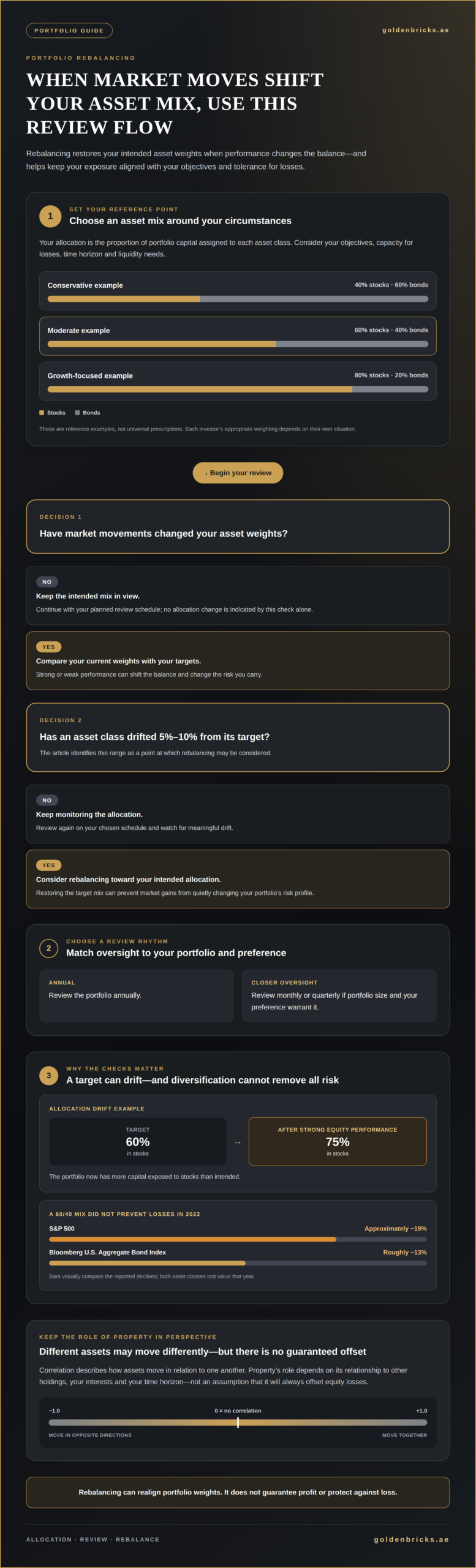
Asset allocation is the proportion of portfolio capital assigned to each asset class, such as stocks, bonds and property. Those weights matter because a strong or weak performance can shift the balance and alter the risk an investor carries. A portfolio targeting 60% in stocks, for example, could reach 75% after strong equity performance, leaving more capital exposed to stocks than intended.
Real Estate’s Role in a Stock-Heavy Portfolio
Adding real estate can broaden a stock-heavy portfolio with an asset class that may respond differently to market conditions. Correlation describes how assets move in relation to one another, ranging from -1.0 to +1.0; 0 represents no correlation. Property’s role depends on its relationship to the other holdings, the investor’s interests and the time horizon, rather than an assumption that it will always offset equity losses.
Common allocation examples provide reference points, not universal prescriptions. A conservative portfolio may hold 40% stocks and 60% bonds; a moderate mix may use 60% stocks and 40% bonds; a growth-focused allocation may hold 80% stocks and 20% bonds. Each investor’s appropriate weighting depends on their objectives, capacity for losses and liquidity needs.
The 60/40 mix also illustrates why rebalancing matters. In 2022, the S&P 500 declined approximately 19%, while the Bloomberg U.S. Aggregate Bond Index fell roughly 13%. Both asset classes lost value that year, so a stock-and-bond allocation alone did not prevent losses.
Review the portfolio annually, or monthly or quarterly if its size and the investor’s preference warrant closer oversight. Rebalancing may be considered when an asset class drifts 5%-10% from its target. Restoring the intended allocation can prevent market gains from quietly changing the portfolio’s risk profile.
What does it mean to diversify across asset classes?
Diversification spreads investments across assets with different sources of return and risk. A strategy for diversifying investments away from stocks into property can add another type of exposure, but it should support your broader objectives and account for your liquidity needs.
Stocks, Bonds, and Real Estate
Asset-class diversification combines stocks, bonds, and real estate, held directly or through investment structures. This means your performance does not depend entirely on one market or source of income. For investors diversifying investments away from stocks into property, real estate is an alternative asset, not a guaranteed counterweight to equity movements. Diversification cannot ensure a profit or prevent losses.
Real estate crowdlending differs from buying traded shares: investors lend capital to projects, so repayment depends on the borrower’s ability to meet its obligations. That creates credit risk. Loan terms can also restrict access to capital before maturity; example project maturities include 12, 18, or 24 months. Consider those terms against your investment horizon and cash requirements.
Spreading Investments Across Property Projects
Spreading property exposure across projects, locations, or property types can reduce reliance on one development. For example, an investor might hold properties in different regions instead of concentrating on a single location. This can reduce project-specific concentration, but it does not remove broader property-market or borrower risks.
Assess each crowdlending project individually, including its repayment basis, maturity, and economic drivers. Several loans may still be concentrated if they depend on the same borrower or market. Consider any property allocation alongside stocks, bonds, liquidity needs, and your overall risk profile.
UAE Property Returns and Sale Liquidity
UAE rental yields and capital growth vary by location, property type, demand, and holding period. Compare property and stock returns over the same timeframe, separating rental income from changes in property value. A direct property sale can take months, unlike trading shares during market hours, so factor your liquidity needs into the allocation.
Property project curation can help investors assess opportunities in the context of their portfolio strategy. For a UAE allocation, project curation offers a way to consider property exposure alongside other holdings.
Diversification across asset classes, sectors and regions
A resilient strategy looks beyond asset classes to consider sectors, regions, company sizes, and investment platforms. These layers can reveal concentrations that broad labels conceal, such as holdings exposed to similar economic drivers.
Sector exposure can dominate an equity portfolio even when it contains several companies. An investor with 15 technology stocks among 20 equities has 75% of those holdings in one sector. Adding companies from other industries can reduce that concentration, while mixing company sizes may broaden exposure to different business profiles. The objective is not to pursue every market segment, but to understand what drives potential returns and losses.
Mutual funds and ETFs can provide access to hundreds or thousands of securities. Holding stocks across several sectors can reduce company-specific risk, but not broader market risk. Check fund holdings for overlap: two ETFs with different names may own many of the same companies. Distinct underlying exposures matter more than the number of funds.
Stocks, bonds, and real estate have different sources of return and different liquidity. A UAE property investment adds exposure to a physical asset and its local market, while equities represent ownership in businesses. Regional allocation matters too: property markets can face different economic conditions, and international securities can broaden exposure beyond one country. Each choice should suit your risk profile and access needs.
Platform diversification concerns where and how investments are held, not necessarily what they own. Using two platforms may do little to diversify your exposure if both offer access to the same funds or projects. Compare the holdings, investment structure, liquidity terms, and available information for each route. Consider whether another platform genuinely broadens your portfolio or simply adds complexity.
Direct property investment and REITs
Direct ownership and REITs offer different ways to gain property exposure alongside equities. Their liquidity, income profile, and risks vary, so the investment structure matters as much as the asset class.
Buying Investment Property in the UAE
UAE residents can buy investment property with cash or financing. A mortgage lets a buyer use borrowed capital, with lenders assessing factors such as income, existing obligations, property value, and repayment capacity. The down payment depends on the financing terms and the buyer’s circumstances, so include it in your capital plan before committing.
Direct ownership gives you control over a specific asset, but it also concentrates capital in that property. Mortgage debt can amplify gains and losses, and repayments remain due even if the property’s value falls.
Property Entry and Ongoing Costs
There is no single minimum investment cost for residential property in Dubai or Abu Dhabi. The amount depends on the property, funding method, and purchase-related charges. Budget for transaction costs as well as purchase capital. Ownership may also involve property taxes, insurance, maintenance, repairs, and periods without rental income.
REITs offer property exposure through traded shares, rather than direct ownership of an individual home or building. They can avoid the same direct management responsibilities, but their share prices remain exposed to market volatility. Compare your liquidity needs and consider the role each route should play in a diversified portfolio.
Evaluating Property Returns
Rental yield compares rental income with a property’s value or purchase cost. Cash flow shows what remains after expenses and financing payments, while total return includes income and changes in property value. Considering all three gives a fuller picture than relying on projected rent alone.
For example, a property may generate rent while repairs, insurance, or vacancy reduce cash flow. Compare expected income with recurring costs, then consider how a change in value affects the overall return. Investors seeking support with the ongoing responsibilities of ownership can explore property management.
Golden Bricks Real Estate: Property Management
Golden Bricks Real Estate offers property management for investors whose direct holdings bring ongoing responsibilities. It can be a practical part of your investment approach when you want property exposure through ownership and support with tenant relations, maintenance supervision, or lease administration.
If you are still assessing which property route fits your objectives, Golden Bricks Real Estate also offers exclusive ready properties, exclusive off-plan projects, and project curation. These services can help you consider property opportunities alongside your existing asset mix, without treating property as a substitute for every other investment class.
Before proceeding, consider how a property allocation fits your liquidity needs, investment horizon, and tolerance for concentrated exposure. To discuss property management or curated property opportunities, contact Golden Bricks Real Estate.
Make Your Next Property Decision Deliberate
Diversifying investments away from stocks into property is a portfolio design choice, not a response to short-term market movements. Define the role you want property to play, such as providing income, long-term growth, or another source of exposure. Then assess whether direct ownership or a traded investment better fits your liquidity needs and investment horizon.
In the UAE, consider opportunities that suit your objectives and your capacity to manage an asset. Golden Bricks Real Estate offers exclusive off-plan projects, exclusive ready properties, and property management. Matching a property choice to clear priorities helps keep the commitment in context and supports a considered approach to portfolio construction.
When you’re ready to explore a property allocation, contact Golden Bricks Real Estate to discuss your next step. A disciplined decision today can help shape a portfolio with greater intention over time.
Frequently Asked Questions
What’s diversification?
Diversification means distributing investments so that one holding or market does not dominate your financial outcomes. Owning shares in companies from different industries, for example, can reduce reliance on one sector, while adding property introduces another type of exposure. Review what drives each holding’s performance, since several investments can still carry similar risks.
Are real assets risky?
Yes. Property carries investment risks, and its physical nature does not protect your capital from loss. A rental property may face vacancies, repair needs, changing demand, or a fall in value. Borrowing adds repayment obligations, while owning a single property can concentrate exposure in one asset and location. The relevant risks depend on the property, its financing, and your time horizon.
What does it mean to diversify away from the stock market?
It means reducing how much your portfolio depends on listed equities by allocating some capital to other asset classes. You do not have to sell every stock: you might retain broad equity exposure while directing part of new contributions to property or bonds. Set the allocation according to your goals, liquidity needs, and risk tolerance, rather than reacting to short-term market movements.
What are the pros and cons of investing in property instead of stocks?
Property can provide rental income and exposure to a physical asset, and direct ownership gives you a specific asset to manage. However, it can require substantial capital, ongoing oversight, and time to sell. Stocks are generally easier to trade, although individual shares can fluctuate sharply. Replacing all equities with one property may create concentration rather than diversification.
How does property investment compare with stocks in returns, risk, liquidity, and diversification?
Compare total returns over the same period, including property rental income and changes in value, alongside stock dividends and price movements. Account for relevant holding costs and financing before drawing conclusions. Selling property may take months, whereas listed shares can be traded during market hours. A diversified stock fund can spread company-specific exposure, while one property remains tied to its own asset and location.
What types of property investments are available in the UAE, including REITs and fractional ownership?
UAE investors can consider direct purchases of ready or off-plan property, traded REIT shares, and pooled approaches such as real estate crowdfunding. Fractional ownership generally means sharing an economic interest in a property or investment structure rather than owning the entire asset alone. Before investing, understand the ownership rights, income arrangements, decision-making terms, and how you can exit the structure.