
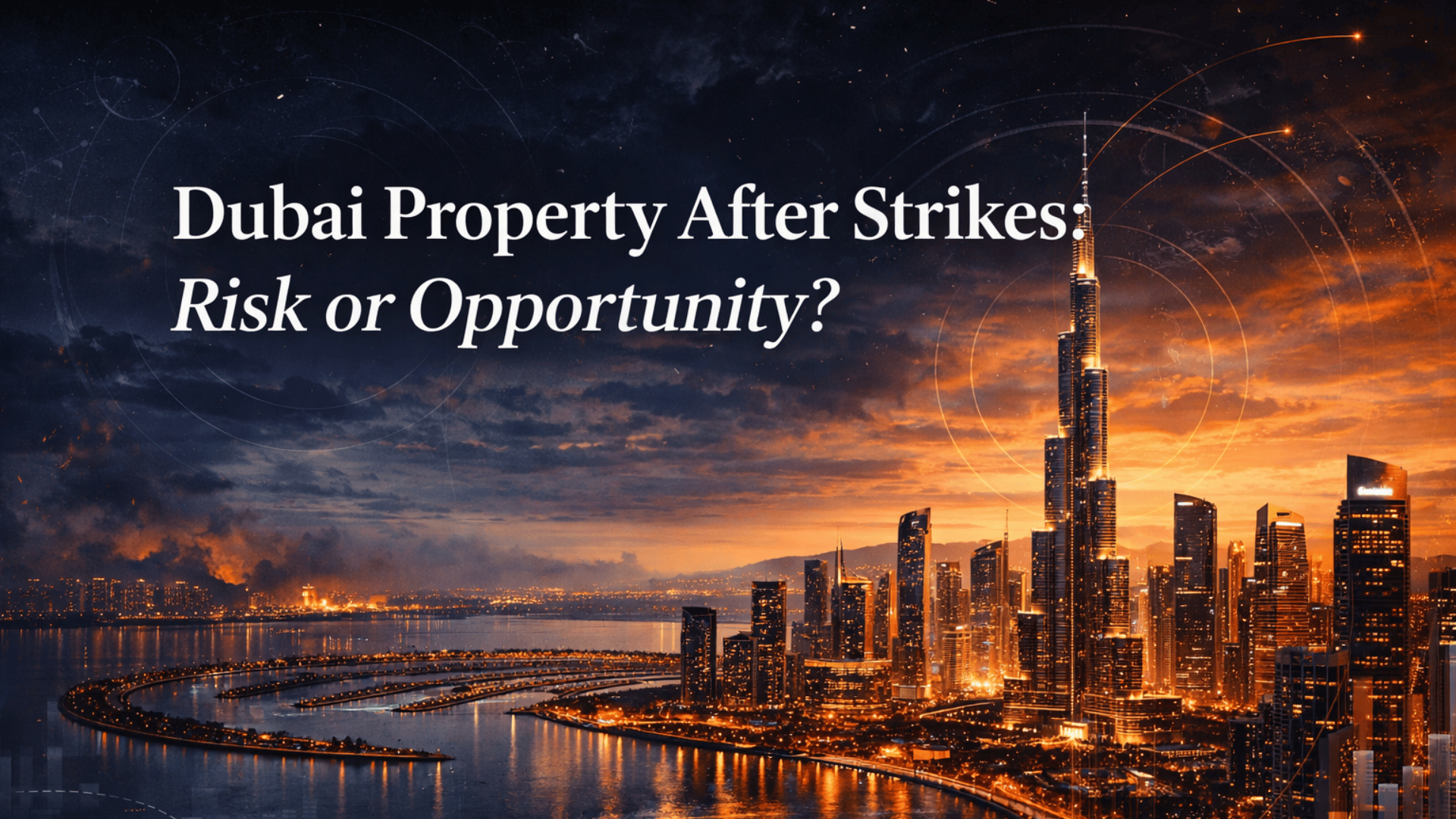
The recent missile and drone attacks linked to the Iran conflict have shaken headlines—and understandably, investor nerves. With airspace disruptions, emergency alerts, and visible geopolitical tension, many are asking: Is this a moment to panic, or a window of opportunity?
A closer look at the data and history suggests a more balanced—and even optimistic—answer.
1. The Immediate Reaction: Shock, Not Collapse
There’s no denying that the strikes created short-term disruption. Airspace closures, flight cancellations, and temporary panic affected business activity and investor sentiment.
In fact, Dubai—long seen as a safe haven—experienced a psychological shift as missile interceptions and alerts became public.
However, it’s important to separate emotional reaction from economic reality. Markets paused—but they did not collapse.
2. Dubai Real Estate Has Always Been Cyclical—and Resilient
Dubai’s property market is no stranger to shocks. From the 2008 financial crisis to COVID-19, the city has experienced sharp corrections—but also powerful recoveries.
History shows a clear pattern:
- Short-term uncertainty
- Temporary slowdown
- Strong rebound once confidence returns
Even now, analysts emphasize that while transaction volumes may slow, Dubai’s global appeal and investor base remain strong.
3. Strong Fundamentals Are Still Intact
Despite geopolitical noise, the core drivers of Dubai’s real estate market remain unchanged:
- Tax-free investment environment
- High rental yields
- Global investor demand
- Residency incentives like the Golden Visa
Dubai entered 2026 from a position of strength, with record demand and strong developer pipelines already in place.
This means the market is facing a temporary external shock—not an internal weakness.
4. Smart Money Sees Opportunity in Uncertainty
While some investors hesitate, experienced buyers understand a key principle:
uncertainty often creates the best entry points.
During such periods:
- Sellers become more flexible
- Negotiation power increases
- Premium properties may be available at better prices
This is why Dubai has always been known as a market for calculated risk-takers—those who act when others hesitate.
5. No Mass Exit—Only Strategic Pause
Despite dramatic headlines, there is no widespread evidence of investors abandoning Dubai. Instead, there is a temporary pause and reassessment.
Even during the strikes, most infrastructure damage was limited, with the majority of threats intercepted by advanced UAE defense systems.
This reinforces confidence in the UAE’s security preparedness and crisis management, which are critical factors for long-term investment decisions.
6. Long-Term Perspective Always Wins
Real estate is fundamentally a long-term asset class, not short-term speculation.
Geopolitical events may influence:
- Timing
- Sentiment
- Short-term pricing
But they rarely change the long-term trajectory of a city like Dubai, which is built on:
- Global connectivity
- Economic diversification
- Continuous infrastructure growth
In fact, analysts expect the market to stabilize and continue growing in the coming years as conditions normalize.
Conclusion: Panic Fades, Opportunity Remains
The missile strikes have undoubtedly created concern—but they have not changed the fundamentals of Dubai’s real estate market.
For short-term thinkers, this may feel like a moment of risk.
For long-term investors, it may be a moment of opportunity.
The key takeaway:
- Don’t panic
- Don’t rush
- Watch the market stabilize
- Act strategically
Dubai has never been a market for the overly cautious—it has always rewarded those who see beyond the noise and invest with conviction.